
A polished estimate can still leave important DeFi activity out of focus. For U.S. taxpayers, DeFi tax calculator limitations matter because filing status, deductions, credits, transaction details, and crypto holding periods can all affect how well an estimate reflects their tax position.
A calculator can provide an initial picture, but its result depends on the assumptions it uses and the information entered. This article explains how individual circumstances, inputs, holding periods, and decentralized exchange trades can shape a U.S. federal tax estimate, and when the calculation may need closer review.
You’ll learn why a token swap can have tax consequences, why a calculator may miss context behind DeFi activity, and which records help explain the transactions in an estimate. The goal is a clearer view of your U.S. tax position, not a number to accept at face value.
Key Takeaways
- Treat a calculator result as an estimate, then consider how filing status and personal tax details may change the picture.
- Review the tool’s assumptions and exclusions so you can spot activity or income it may not capture.
- Keep acquisition and transaction dates organized; holding periods can affect how crypto gains are assessed.
- Include decentralized exchange swaps in your transaction review, even when no cash was received.
- Use calculation tools to organize your records, and seek professional tax support when complex DeFi activity makes the result difficult to interpret.
Calculator estimates and individual circumstances
For U.S. taxpayers, an online estimate is a starting point, not a completed tax return. DeFi tax calculator limitations matter because filing status, deductions, credits, transaction details, and payment records can all affect the estimate and IRS reporting.
Tax-Year Coverage
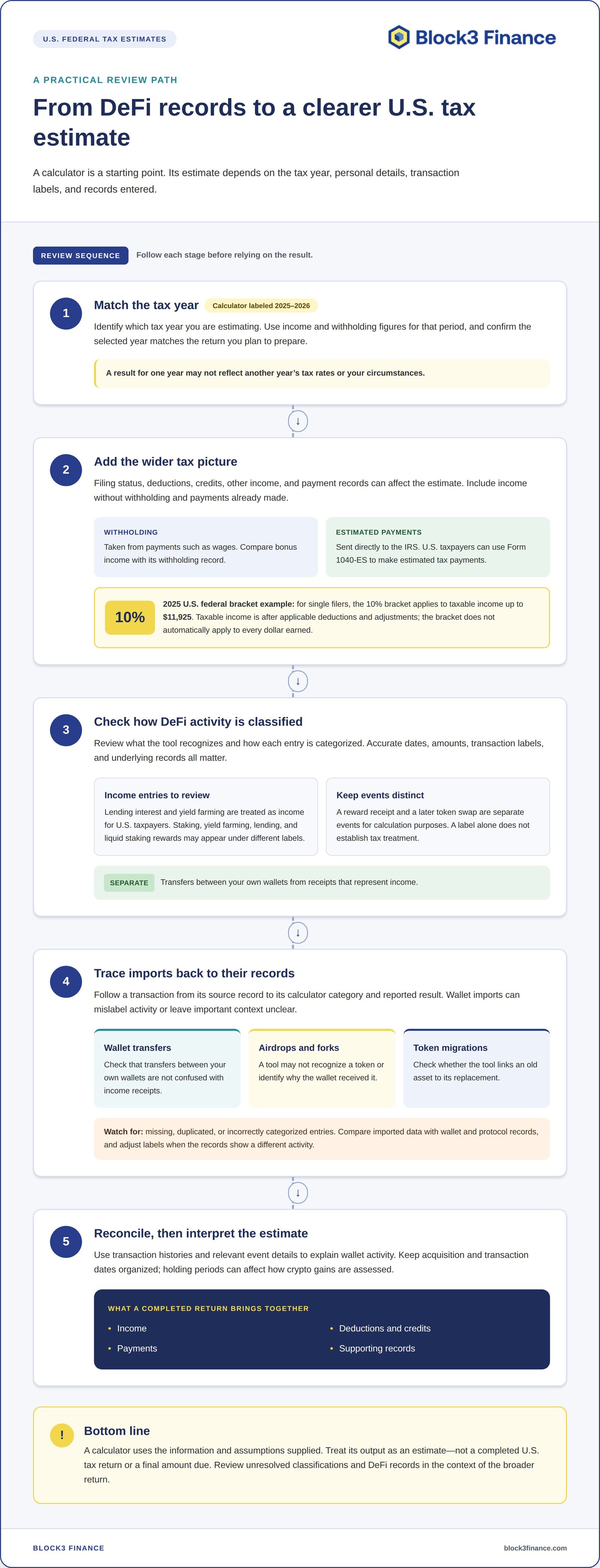
The income tax calculator is labeled for the 2025-2026 tax period. Identify which tax year you’re estimating before entering information, then use income and withholding figures for that period. A result for one year may not reflect another year’s tax rates or your circumstances. Confirm that the estimator’s selected year matches the return you plan to prepare.
Individual Circumstances and Reporting Risks
Filing status, deductions, credits, and other income affect a U.S. taxpayer’s liability. DeFi software may not capture every transaction detail or personal circumstance. If missing or misclassified information carries into an IRS return, reported income or tax may be inaccurate. The risk increases when wallet records don’t clearly explain a transaction.
For this estimate, taxable income means income remaining after applicable deductions and adjustments. For 2025, the U.S. federal 10% income tax bracket applies to single filers with taxable income up to $11,925, according to the Internal Revenue Service. That bracket applies to taxable income, not automatically to every dollar earned. Filing status and deductions help determine taxable income, while credits can affect the final liability.
Bonus withholding adds another variable. A calculator may estimate tax from the income entered, but the bonus withholding and its place in your full-year income also matter. If you enter bonus income without accounting for withholding, the estimated balance may differ from the eventual tax return. Compare the payment amount with its withholding record when reviewing the estimate.
Withholding and estimated payments also serve different roles. Withholding is taken from payments such as wages; estimated payments are sent directly to the IRS. U.S. taxpayers can use Form 1040-ES to make estimated tax payments. Include payments already made and income without withholding when interpreting an estimate, rather than treating its balance as a final amount due.
A calculator estimate is not a completed return. It uses the inputs and assumptions supplied, and its results may vary with individual circumstances or changes in tax laws or IRS regulations. A completed return brings together income, deductions, credits, payments, and supporting records. A U.S. tax filing and reporting review can help connect DeFi records with the broader return.
Tax software evaluates income alongside deductions and credits, and that combination frames an estimate more meaningfully than a single bracket or calculator output. U.S. federal tax brackets alone do not determine a taxpayer’s actual liability, since filing status, deductions, and credits can affect the amount owed. Treat the result as an estimate to review against your circumstances, not a final figure. A federal income tax calculator’s results may vary with individual circumstances and changes in tax laws or IRS regulations. Reassess the estimate if its assumptions or your circumstances change.
Calculator assumptions and exclusions
A U.S. tax calculator uses the information entered and its own assumptions to produce an estimate. The result depends on what the tool recognizes, how it classifies each entry, and which income or adjustments you provide. Those choices can affect the estimate before you use it to plan a payment or prepare reporting records.
Start by identifying the tool’s inputs. Does it distinguish ordinary income from asset sales? Can you edit a transaction’s category, acquisition date, or value? If a wallet import mislabels a token receipt, the calculator may carry that label into its totals. Trace a sample transaction from its source record to its category and reported result.
For U.S. taxpayers, lending interest from DeFi protocols and yield farming are treated as income for tax purposes. A calculator still needs accurate dates, amounts, and transaction labels to include these entries correctly. If a yield receipt is imported as a wallet transfer, the estimate may not reflect its income treatment. Both the classification and underlying record matter.
Staking, yield farming, lending, and liquid staking rewards may appear under different transaction labels in a calculator. A label alone doesn’t establish tax treatment, so review the activity, receipt, and transaction records behind it. A reward receipt and a later token swap, for example, are separate events for calculation purposes. Combining them can obscure what the software counted.
Airdrops, forks, and token migrations pose different data challenges. A tool may not recognize a new token, link an old asset to its replacement, or identify why a wallet received tokens. An entry could be missing, duplicated, or assigned to the wrong event. Keep the transaction history and relevant event details to explain the wallet record.
- Separate transfers between your own wallets from receipts that represent income.
- Adjust labels when a transaction record shows a different activity than the software assigned.
- Compare imported entries with wallet and protocol records before relying on the total.
Taxable income is the amount used to calculate income tax after applicable adjustments. A calculator can estimate it only from the information and assumptions it receives; its output is not a guarantee of the final reported amount. For a clearer view of how DeFi records fit into U.S. reporting, discuss a tax review when classifications remain unresolved.
A calculator estimates federal tax based on filing status and the applicable tax bracket or brackets. It uses expected gross income, less applicable deductions and adjustments, to estimate taxable income. The result is therefore sensitive to the income, deductions, adjustments, and filing status entered. Reviewing these inputs can clarify what the estimate represents, but it does not make the result a final tax determination.
U.S. taxpayers should consult current tax regulations because tax laws and brackets can change. A calculator’s assumptions may not reflect every applicable rule or a taxpayer’s full circumstances. Treat its output as a planning estimate, not a substitute for checking current requirements. Revisit the assumptions when reviewing the result, especially if income, deductions, adjustments, or filing status changes.
Capital gains and holding periods
For U.S. taxpayers, estimating a crypto gain or loss requires more than a sale price. A calculator must link each disposal to the asset’s cost basis, the recorded value associated with its acquisition, and its holding period. Missing acquisition records or mismatched wallet histories can affect the estimate.
In the United States, crypto held for over 12 months before a sale or trade may qualify for long-term capital gains tax rates, according to the Internal Revenue Service. The Internal Revenue Service gives a U.S. long-term capital gains tax rate range of 0% to 20% for crypto or DeFi tokens held for over 12 months. The Internal Revenue Service gives a U.S. short-term capital gains tax rate range of 10% to 37% for crypto or DeFi tokens.
Those ranges aren’t a single rate that applies to every taxpayer. The holding period helps determine which category may apply, while individual tax circumstances also affect the result. If a calculator starts the clock from an incorrect acquisition date, it may place a disposal in the wrong category. For example, importing a token into a new wallet shouldn’t count as a new purchase if it was an internal transfer.
How accurate are DeFi tax calculator cost-basis and capital-gains calculations? They’re only as reliable as the acquisition records, transaction links, and dates the software uses. If a protocol interaction obscures the original acquisition or a wallet import misses a transaction, the amounts may be incomplete or assigned to the wrong asset.
Review the transaction trail before relying on the totals. For each disposal, the calculation should link the token sold or traded to its acquisition record, relevant dates, and proceeds. Keep protocol receipts and wallet records together when an activity creates multiple entries. A calculator can show a clean summary even when its underlying records have gaps.
- Check acquisition dates: Confirm that the tool uses the original acquisition date for each asset.
- Trace asset movements: Separate transfers between your wallets from disposals to another party.
- Compare amounts: Match the calculator’s transaction entries against exchange and wallet histories.
Capital gains and losses from U.S. DeFi activity should be reported on Form 1040 and Form 8949 (Schedule D), according to the Internal Revenue Service. The records behind those forms matter: a missing disposal or duplicated entry can affect reported totals. Federal income tax is distinct from local tax considerations, so a federal estimate may not represent every tax amount relevant to a taxpayer.
Keep interest or rewards from a DeFi protocol distinct in the transaction record from a later sale or trade. Partners sharing accounts or wallets should preserve clear ownership and transaction details, so a disposal isn’t counted twice or omitted. For those navigating joint holdings and broader estate planning, Aiker Wills and Trusts provides professional guidance on structuring trusts and legal ownership documentation. A calculator’s result is most useful when its transaction history can be traced to the underlying records.
Crypto-to-crypto trades on decentralized exchanges
For U.S. taxpayers, a decentralized exchange can create taxable activity even when no cash changes hands. Accurate tracking starts with identifying each swap, token receipt, and liquidity-pool movement.
Crypto-to-Crypto Swap Treatment
In the United States, trading crypto for other crypto or fiat on a decentralized exchange is a taxable event subject to capital gains taxes. Swapping one token for another, for example, can require calculating a gain or loss on the token surrendered. The exchange’s transaction history should record the assets involved, timing, and values.
A calculator may receive only a transaction hash or a generic label such as “swap.” That label may not show which asset was disposed of, which was acquired, or whether the transaction involved several protocol steps. Review the underlying details, especially when one action routes through multiple pools or contracts. A single interface action can create records that require separate interpretation.
Liquidity-Pool Transaction Treatment
Liquidity-pool activity may involve depositing tokens, receiving a pool token, collecting rewards, and later withdrawing assets. Don’t collapse these movements into one unexplained transfer. Preserve each step and its wallet record so the calculation can distinguish contributed assets, tokens received, and later disposals.
How do U.S. tax rules treat DeFi swaps, staking rewards, and liquidity-pool transactions? Crypto swaps on decentralized exchanges are taxable events subject to capital gains taxes. Reward and pool entries need clear transaction records and appropriate classification. A calculator’s label alone doesn’t establish their treatment.
Use a structured review for each protocol interaction:
- Identify the action: Record whether the transaction was a swap, deposit, withdrawal, or reward receipt.
- Match the assets: Connect tokens leaving the wallet with tokens or pool receipts arriving.
- Preserve supporting records: Keep wallet histories and protocol details together for the relevant tax period.
Keeping these events separate helps reveal missing entries and prevents a reward receipt from being confused with a later token trade. It also clarifies which amounts relate to a disposal and which describe another protocol movement. Deductions and other personal details may affect a taxpayer’s overall federal tax situation, but they don’t replace transaction-level records.
A 37% rate appearing in a tax estimate doesn’t tell you how a particular swap was classified. The result depends on the transaction data and the taxpayer’s circumstances, not simply the highest displayed rate. When tracking leaves a pool movement or reward unresolved, discuss the transaction records with a tax professional before relying on the estimate.
DeFi tax calculation tools
Tax software can organize blockchain activity, but its results depend on which integrations it recognizes and how it classifies imported entries. DeFi tax calculator limitations become clearer when a wallet, protocol, or transaction type falls outside the tool’s supported coverage.
Protocol and Blockchain Support
There’s no universal list of supported DeFi protocols or blockchains. Each tool maintains its own integrations, which may change over time. Review the software’s coverage information for the networks and protocols you use, and note whether it imports activity directly or relies on transaction files you upload.
Support for a blockchain doesn’t necessarily mean every protocol interaction on it will import correctly. A tool may recognize a familiar swap but leave a less common contract interaction uncategorized. Review the transaction details and classification before treating imported activity as complete.
Pricing, Limits, and Wallet Support
Prices, transaction limits, and supported wallets vary by calculator and plan, so no single comparison applies across tools. Check plan terms against your wallet types, transaction volume, and networks. An address supported on one chain may not import activity from another.
Also consider whether the tool lets you export transaction-level records. Those details can help investigate an import gap or explain how the software calculated a reported total, rather than leaving you with only a summary figure.
Automatic tracking depends on whether the tool recognizes the wallet, network, and activity. It may import identifiable swaps, transfers, and reward events, but the labels still need review. Confirm that activity appears in the correct tax year and that the history has no obvious gaps or duplicates.
Liquidity Pools and LP Token Handling
Some calculators identify liquidity-pool deposits, withdrawals, and LP tokens, but the detail available depends on their protocol integrations. An LP token represents a position in a pool. Trace deposits and withdrawals to confirm the tool links the pool receipt to the relevant assets.
Impermanent loss describes a liquidity provider’s change in position relative to holding the deposited assets. A calculator’s display of that change doesn’t, by itself, determine its tax treatment. Keep pool records separate from swaps and reward receipts.
Bridges and wrapped tokens also require careful transaction matching. A bridge can create an outgoing record on one chain and an incoming record on another. Match the two sides so one transfer isn’t treated as separate, unrelated activity. Likewise, link wrapped tokens to the corresponding asset movements.
After importing wallet transactions, review uncategorized entries, missing transfers, duplicates, token labels, and dates against available records. Correct classification errors before relying on the estimate. A practical response to DeFi tax calculator limitations is to keep transaction-level records alongside the software summary, making corrections traceable.
Get help reviewing DeFi tax calculations when imports leave transactions unresolved.
Block3 Finance
Block3 Finance helps U.S. taxpayers turn fragmented DeFi activity into organized tax records and reporting. When calculator results leave gaps, wallet imports conflict, or transaction classifications remain unclear, its Crypto Tax Accountant support can help assess the records in context.
Tax Filing and Reporting connects reviewed transaction data with the tax return, while Audits and Compliance supports closer examination of reporting records. Monthly Accounting can help maintain clearer books as DeFi activity continues, rather than leaving reconciliation until filing time. The next step depends on whether you need to resolve historical transactions, prepare a return, or establish an ongoing recordkeeping process.
For support with your DeFi tax reporting, contact Block3 Finance.
Build a More Reliable Process for DeFi Taxes
Treat tax data as part of an ongoing financial process, not a year-end export. Clear records support better decisions as your U.S. DeFi activity changes, while a defined review process keeps estimates connected to the transactions behind them. This helps you move beyond the uncertainty of U.S. DeFi tax calculator limitations and build a U.S. reporting workflow you can maintain.
Block3 Finance can support U.S. DeFi tax reporting through Tax Filing and Reporting, Audits and Compliance, and Monthly Accounting. These services help connect transaction records with U.S. reporting and ongoing bookkeeping, giving U.S. individual taxpayers a structured path from analysis to action. The right support can help you make informed choices about what needs attention next without treating a calculator result as the final word.
Take the next step toward a clearer U.S. DeFi tax process: contact Block3 Finance about U.S. DeFi taxes. You can bring your records and questions into a focused conversation, then move forward with greater clarity and control.

Article by
Mahad Mohamed
Mahad Mohamed is an accountant and the CEO of Block3 Finance, with over 26+ years of Canadian and international tax and accounting experience. A crypto accounting specialist since the early days of Bitcoin, he has consulted for over 38 crypto companies and collaborated with legal professionals on regulatory matters. His expertise spans corporate reorganization, cross-border tax structuring (Canada & US), tax disputes, and CRA audits.
Previously, Mahad worked for the Canada Revenue Agency (CRA), Big4 accounting firms, and served as a Rulings Officer for the Federal Tax Authority of the UAE before acquiring Tax Partners in 2014.
Block3 Finance and Tax Partners has 44 full-time accountants and over 9,800+ clients.
Disclaimer
This article provides general information only and is current as of its publication date. It has not been updated and may be out of date. It does not constitute legal advice and should not be relied upon as such. Every tax situation is unique and may differ from the examples discussed in this article. If you have specific questions, you should seek the advice of our accountants for your unique circumstances.