
For U.S. taxpayers, DeFi capital gains tax generally depends on the difference between an asset’s adjusted tax basis, its cost for tax purposes after relevant adjustments, and the amount received when it’s disposed of. The holding period also matters. According to the Internal Revenue Service, a capital asset held for more than one year before disposal generally produces a long-term gain or loss; a profitable sale after less than one year is generally short-term and taxed as ordinary income. Long-term gains are commonly taxed at federal rates of 0%, 15%, or 20%, depending on taxable income.
DeFi activity can complicate a DeFi capital gains tax calculation when it involves token swaps, liquidity positions, or other on-chain movements. The key is to identify which transactions created a taxable gain or loss, calculate each result using the asset’s basis and disposal value, then account for holding periods and eligible losses. This guide explains the calculation, how U.S. federal short- and long-term rates differ, and how capital losses and carryovers are reported.
Key Takeaways
- A tax professional can organize DeFi disposals and related records so gains and losses are reported consistently, even when activity spans multiple transactions.
- According to the Internal Revenue Service, most sales and other capital transactions are generally reported on Form 8949 and summarized on Schedule D.
- The Internal Revenue Service allows eligible U.S. taxpayers to deduct up to $3,000 of net capital losses against income in a year, with remaining losses potentially carried forward.
- Before realizing a loss on a security, consider how buying the same or a substantially identical security within 30 days before or after the sale may invoke the U.S. wash-sale rule. This rule applies to securities and should not be assumed to apply to crypto investments generally.
- Professional review can help connect transaction records, loss carryovers, and tax reporting, while identifying where further tax planning may be relevant.
U.S. Federal capital gains tax rates
For U.S. federal tax purposes, the rate on a capital gain depends on the asset’s holding period and your taxable income. The Internal Revenue Service distinguishes short-term gains from long-term gains according to how long you held the asset.
DeFi transactions can trigger taxable events when they involve disposing of assets. A crypto-to-crypto swap may count as a taxable event; staking, lending, and liquidity-pool activity require transaction-by-transaction analysis to determine whether an asset was disposed of or received.
Wrapped tokens, bridges, and token migrations must be classified according to their actual mechanics, not just their labels. A professional considers whether a transaction transferred an asset, exchanged it for another, or otherwise changed ownership, as well as the transaction values and timing.
Federal and Long-Term Rate Categories
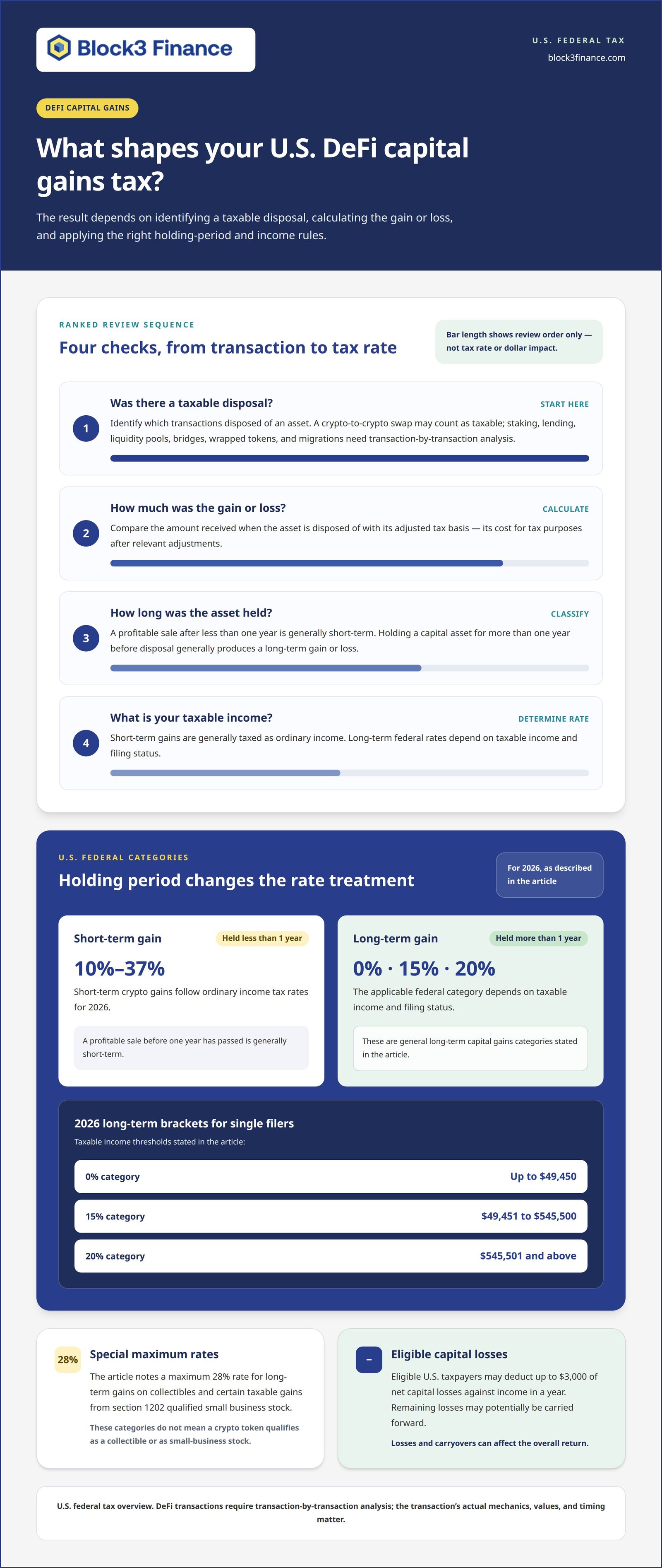
U.S. federal long-term capital gains generally fall into 0%, 15%, or 20% categories, while short-term gains are taxed at ordinary income rates. For 2026, single filers generally enter the 0% long-term band with taxable income up to $49,450; the 15% band runs from $49,451 to $545,500, and the 20% rate applies at $545,501 and above. These thresholds make taxable income central to the final rate.
Special gains can have different limits. U.S. long-term gains on collectibles have a maximum rate of 28%; certain taxable gains from section 1202 qualified small business stock also face a maximum federal rate of 28%. These categories don’t establish that a crypto token qualifies as a collectible or as small-business stock.
Holding Periods and Capital Gains Rates
A holding period is the time between acquiring an asset and disposing of it. According to the Internal Revenue Service, a capital asset held for more than one year before disposal generally produces a long-term gain or loss; a profitable sale after less than one year is generally short-term. The distinction matters because short-term gains are taxed as ordinary income, while long-term gains may qualify for different rates.
For crypto, U.S. short-term gains follow ordinary income tax rates, which range from 10% to 37% for 2026. Long-term rates range from 0% to 20% for 2026, depending on taxable income and filing status. A U.S. crypto tax analysis can distinguish these categories across transactions.
What are the differences between long-term and short-term capital gains under U.S. rules?
For U.S. taxpayers, the holding period determines whether a gain is short-term or long-term. This classification affects how the gain is taxed and how a professional organizes DeFi transactions for reporting.
Short-Term and Long-Term Holding Periods
A holding period is the time an asset is owned before it is disposed of. According to the Internal Revenue Service, a profitable sale after less than one year is generally short-term; holding a capital asset for more than one year before disposal generally produces a long-term gain or loss. The distinction matters because the two categories receive different federal tax treatment.
For example, if a U.S. taxpayer acquires a token and sells it before a year has passed, any profit is generally short-term. A sale after more than one year may qualify for long-term treatment. A tax professional reviews the acquisition and disposal dates for each asset instead of treating a wallet’s overall activity as one holding period.
Tax Treatment of Short-Term Gains
A short-term capital gain is profit from disposing of an asset held for less than one year. Under U.S. rules, it is taxed as ordinary income and included with income subject to the taxpayer’s ordinary federal income tax rates. Its impact depends on taxable income and filing circumstances.
According to the Internal Revenue Service, U.S. long-term capital gains are commonly taxed at rates of 0%, 15%, or 20%, depending on taxable income. This difference makes holding period a key part of a DeFi tax calculation, but it doesn’t determine the full tax result by itself. Taxable income and other transactions also affect the outcome.
DeFi rewards require separate classification. For U.S. reporting, a professional distinguishes staking rewards or yield-farming receipts from a later sale or swap of the tokens. The receipt may require income analysis, while a later disposal may create a separate capital gain or loss. The transaction details determine the treatment.
For individuals with frequent swaps, reward receipts, and liquidity-pool activity, recording separate dates and asset details helps distinguish short-term from long-term gains. A token received as a reward and later sold involves more than one event to assess. Keeping those events separate helps a tax professional determine how each should appear on the U.S. filing.
How can a tax professional report DeFi capital gains or losses for U.S. taxpayers?
For a U.S. return, a tax professional reconciles DeFi transactions, identifies taxable disposals, and separates realized results from unrealized changes. Useful records include wallet addresses, transaction histories, timestamps, token amounts, U.S. dollar values, protocol statements, and prior-year loss information. Incomplete records can obscure an asset’s basis and transaction dates.
Realized and Unrealized Gains and Losses
A realized gain or loss arises when an asset is disposed of; an unrealized change reflects a value increase or decrease in an asset still held. For U.S. tax reporting, this distinction keeps market movements separate from completed transactions. A token that rises in value but remains in a wallet has an unrealized change; a later sale or swap may realize a gain or loss.
A professional reviews transaction details to establish what happened, when it happened, and which asset was involved. Missing records from noncustodial wallets or DeFi protocols can make it harder to establish basis, timing, and proceeds, weakening the calculation behind a reported gain or loss.
Netting Gains Against Losses
Netting means applying eligible capital losses against capital gains to determine the net result for reporting. In the United States, losses and gains are first grouped by holding period. A professional then considers the remaining short-term and long-term totals together, rather than combining the separate categories at the outset.
The Internal Revenue Service says U.S. taxpayers may deduct up to $3,000 USD of net capital losses against income annually. Losses beyond the allowable deduction may be carried forward to future tax years. The resulting net gain or loss can affect the taxpayer’s income tax calculation, but the applicable tax rate still depends on the gain’s classification and the taxpayer’s circumstances.
Transaction Records for Tax Reporting
Transaction records are the evidence a professional uses to reconcile each disposal and calculate its reported result. U.S. taxpayers generally report most sales and other capital transactions on Form 8949 and summarize capital gains and deductible capital losses on Schedule D (Form 1040), according to the Internal Revenue Service.
For each DeFi transaction, records should show the date, asset, quantity, transaction type, and value in U.S. dollars. Wallet histories, exchange statements, protocol records, and documentation of transfers between wallets help distinguish a transfer from a disposal. A professional compares these records, investigates gaps, and uses supported figures in the U.S. filing.
U.S. capital loss deduction limits and carryovers
A capital loss occurs when an asset is disposed of for less than its tax basis, the amount used to measure a gain or loss. For U.S. taxpayers, a professional evaluates realized losses alongside gains, then determines which losses can reduce taxable income and which may be carried forward.
The Internal Revenue Service says U.S. taxpayers may deduct up to $3,000 USD of net capital losses against income annually. A net capital loss is the amount left when eligible capital losses exceed capital gains. If losses exceed the amount deductible against income, the unused balance may carry forward to future tax years and remain relevant to later returns.
Carryovers connect one tax year to the next. A professional reviews prior returns for available capital losses, confirms the carried amount is supported, and includes it in the current calculation. For example, an unused loss shown on a prior U.S. return may affect this year’s net result, rather than being treated as a new transaction.
Tax-loss harvesting means realizing an investment loss through a sale, then assessing how that loss interacts with gains and future plans. For DeFi activity, a professional reviews the transaction records, basis, and disposal value before including a loss in tax planning. The aim is accurate reporting, not selling an asset solely because its market value has fallen.
The U.S. wash sale rule can affect whether a loss on a security is currently recognized. According to the Internal Revenue Service, the rule generally applies when a security is sold at a loss and the taxpayer buys the same or a substantially identical security within 30 days before or after the sale. It does not automatically apply to DeFi or crypto assets generally. A tax professional considers relevant purchases when reviewing a proposed harvest.
Planning also means separating tax treatment from investment decisions. A capital loss may reduce taxable capital gains, while an allowed net loss deduction may affect other income. The outcome depends on the taxpayer’s complete transaction history, prior carryovers, and the character of each asset. Investment income alone does not show the full tax result.
For a U.S. filing, a professional reconciles sale records with wallet and protocol activity, checks loss calculations against prior-year figures, and includes eligible amounts in the return. This review helps avoid counting an unrealized decline as a realized capital loss or overlooking an earlier carryover when calculating the current year’s capital gains taxes.
How does a tax professional calculate U.S. DeFi capital gains?
A U.S. tax professional calculates each disposal by comparing its proceeds with the asset’s adjusted tax basis. Basis generally starts with the amount paid, subject to adjustments. The difference is a gain or loss. This transaction-level approach assigns a result to each movement instead of treating a wallet’s overall balance change as taxable profit.
For a DeFi capital gains tax calculation, a professional identifies the asset, acquisition date, amount received at disposal, and basis of the units disposed of. A token swap may involve disposing of one asset and acquiring another, so both sides need review. The result is then classified by holding period for U.S. tax reporting.
For a familiar comparison, an example in the tax facts shows stock bought for $50,000 and sold for $55,000, producing a $5,000 capital gain. DeFi assets use the same basic proceeds-minus-basis framework, but their transaction histories can involve multiple wallets and protocols. Stocks and tokens are different assets, so the example illustrates the arithmetic, not identical tax treatment.
Liquidity-pool deposits and withdrawals require analysis of the assets transferred, returned, or received, along with their transaction values and basis. A professional traces those movements to determine whether a disposal occurred and how to calculate any resulting gain or loss. The pool’s displayed balance alone does not establish the tax result.
Consider a token acquired in one transaction and later exchanged for another asset. A professional links the disposed token to its supported basis, records the value received, and calculates the difference. If the records do not establish which units were acquired or disposed of, the calculation may need closer reconciliation before reporting.
Timing also shapes the result. A professional matches acquisition and disposal dates to determine whether a gain or loss is short-term or long-term, then considers taxable income and filing status. For example, a married filer’s circumstances may affect the applicable federal rate. A DeFi capital gains tax calculation should therefore rely on transaction-level evidence, not an estimated portfolio profit.
A disciplined process makes the calculation traceable: identify each asset movement, support its basis and proceeds, classify the result, and reconcile it with the full transaction history. A transaction-level review can also distinguish transfers between a taxpayer’s wallets from exchanges that may create a taxable disposal.
Block3 Finance
Block3 Finance helps U.S. taxpayers bring structure to DeFi transaction records, gain calculations, and tax reporting. This support is useful when activity spans multiple wallets or protocols, or when swaps, liquidity pools, rewards, and token disposals make it difficult to trace each asset’s history.
A tax professional reviews transaction data to distinguish transfers from disposals, connect assets with their documented basis, and organize gains and losses for filing. The review can also account for holding periods and available loss carryovers, helping ensure reported figures reflect transaction records rather than a rough estimate of portfolio performance.
Through Tax Filing and Reporting, Block3 Finance supports the preparation and reporting side of the process. This can be relevant when U.S. DeFi activity needs to be reconciled with other capital transactions, or when records must be organized for the applicable tax forms. Clear reporting depends on a coherent account of what happened and when.
Monthly Accounting can help maintain ongoing visibility into digital-asset activity, rather than leaving a full year of transactions to reconstruct at filing time. Audits and Compliance can support a structured review of records and reporting. These services connect transaction-level accounting with broader compliance needs without treating every wallet movement as the same type of event.
A Crypto Tax Accountant can assess the tax treatment of DeFi activity, identify gaps that affect calculations, and help organize supporting information. This is especially relevant when a taxpayer has activity across noncustodial wallets, lending protocols, staking, or liquidity pools, where a complete transaction history is essential to the analysis.
For a productive review, a professional needs available wallet and exchange histories, protocol records, acquisition and disposal details, and prior-year tax information relevant to losses carried forward. The work focuses on reconciling these sources and explaining how transaction classifications affect the U.S. return. The result is a clearer basis for filing and compliance decisions, not investment or trading advice.
If you’re ready to discuss your DeFi tax reporting needs, contact Block3 Finance.
Frequently Asked Questions
Is Capital Income Tax-Advantaged?
Not always. U.S. tax treatment depends on the type of income and the taxpayer’s circumstances. For example, the Internal Revenue Service says the net investment income tax can add 3.8% on investment income, including capital gains, when modified adjusted gross income exceeds applicable thresholds. So a favorable capital gains rate doesn’t necessarily settle the full federal tax impact. Investment income may also interact with other parts of a taxpayer’s return.
What Are Capital Gain Taxes?
Capital gains taxes may apply to profit from disposing of an investment asset. They do not apply to every increase in an account’s displayed value. For U.S. taxpayers, state treatment can differ from federal treatment, and many states tax capital gains and ordinary income at the same rates. A taxpayer’s overall result can therefore reflect both federal and state rules.
Do capital gains affect the tax bracket?
A gain can affect the tax calculation, but it does not automatically mean all of a taxpayer’s income is taxed at a higher rate. U.S. federal tax brackets apply progressively, so different portions of a return may be taxed at different rates. A professional considers taxable income and filing status together, then assesses whether investment income affects other federal tax calculations.
Is crypto taxed as capital gains?
Crypto can be subject to capital gains treatment in the United States when a transaction disposes of an asset. Reporting remains relevant even if a taxpayer doesn’t receive Form 1099. For example, a person who exchanges tokens through a wallet should retain transaction records rather than relying only on tax forms received from platforms. The transaction details help establish what must be reported.
What assets are typically subject to capital gains tax?
U.S. capital gains may apply when investments such as stocks, digital assets, and real estate are disposed of. The category matters because some assets have specific rules: for instance, gains on certain depreciated real estate can involve separate rate treatment. An asset’s use, history, and tax classification help determine which rules apply, not its market value alone.
How are DeFi transactions taxed as capital gains in the United States?
U.S. taxpayers report crypto activity as part of their federal individual return, not on a separate crypto return, according to Block3 Finance’s tax guidance. DeFi transactions must be classified according to what occurred, such as a disposal, reward, or other receipt. Keeping protocol and wallet records together helps a tax professional connect on-chain activity with the appropriate reporting treatment.
How does a tax professional calculate crypto capital gains using cost basis and fair market value?
A tax professional uses cost basis and fair market value to determine the reported result for a disposal. The review may involve matching exchange confirmations with wallet activity and identifying records for the same transaction. This reconciliation matters when a taxpayer uses multiple platforms, because duplicated or disconnected records can distort the transaction history used for tax reporting.
Can DeFi capital losses offset other crypto gains or ordinary income in the United States?
Yes. For U.S. taxpayers, eligible realized losses from DeFi assets can be considered alongside gains from other crypto transactions, rather than being limited to the protocol where they arose. A net capital loss may also reduce other income within the applicable deduction limit, with unused amounts potentially carried forward. The taxpayer’s complete return and prior loss history affect the final treatment.

Article by
Mahad Mohamed
Mahad Mohamed is an accountant and the CEO of Block3 Finance, with over 26+ years of Canadian and international tax and accounting experience. A crypto accounting specialist since the early days of Bitcoin, he has consulted for over 38 crypto companies and collaborated with legal professionals on regulatory matters. His expertise spans corporate reorganization, cross-border tax structuring (Canada & US), tax disputes, and CRA audits.
Previously, Mahad worked for the Canada Revenue Agency (CRA), Big4 accounting firms, and served as a Rulings Officer for the Federal Tax Authority of the UAE before acquiring Tax Partners in 2014.
Block3 Finance and Tax Partners has 44 full-time accountants and over 9,800+ clients.
Disclaimer
This article provides general information only and is current as of its publication date. It has not been updated and may be out of date. It does not constitute legal advice and should not be relied upon as such. Every tax situation is unique and may differ from the examples discussed in this article. If you have specific questions, you should seek the advice of our accountants for your unique circumstances.
Frequently Asked Questions
Is Capital Income Tax-Advantaged?
Not always. U.S. tax treatment depends on the type of income and the taxpayer’s circumstances. For example, the Internal Revenue Service says the net investment income tax can add 3.8% on investment income, including capital gains, when modified adjusted gross income exceeds applicable thresholds. So a favorable capital gains rate doesn’t necessarily settle the full federal tax impact. Investment income may also interact with other parts of a taxpayer’s return.
What Are Capital Gain Taxes?
Capital gains taxes may apply to profit from disposing of an investment asset. They do not apply to every increase in an account’s displayed value. For U.S. taxpayers, state treatment can differ from federal treatment, and many states tax capital gains and ordinary income at the same rates. A taxpayer’s overall result can therefore reflect both federal and state rules.
Do capital gains affect the tax bracket?
A gain can affect the tax calculation, but it does not automatically mean all of a taxpayer’s income is taxed at a higher rate. U.S. federal tax brackets apply progressively, so different portions of a return may be taxed at different rates. A professional considers taxable income and filing status together, then assesses whether investment income affects other federal tax calculations.
Is crypto taxed as capital gains?
Crypto can be subject to capital gains treatment in the United States when a transaction disposes of an asset. Reporting remains relevant even if a taxpayer doesn’t receive Form 1099. For example, a person who exchanges tokens through a wallet should retain transaction records rather than relying only on tax forms received from platforms. The transaction details help establish what must be reported.
What assets are typically subject to capital gains tax?
U.S. capital gains may apply when investments such as stocks, digital assets, and real estate are disposed of. The category matters because some assets have specific rules: for instance, gains on certain depreciated real estate can involve separate rate treatment. An asset’s use, history, and tax classification help determine which rules apply, not its market value alone.
How are DeFi transactions taxed as capital gains in the United States?
U.S. taxpayers report crypto activity as part of their federal individual return, not on a separate crypto return, according to Block3 Finance’s tax guidance. DeFi transactions must be classified according to what occurred, such as a disposal, reward, or other receipt. Keeping protocol and wallet records together helps a tax professional connect on-chain activity with the appropriate reporting treatment.
How does a tax professional calculate crypto capital gains using cost basis and fair market value?
A tax professional uses cost basis and fair market value to determine the reported result for a disposal. The review may involve matching exchange confirmations with wallet activity and identifying records for the same transaction. This reconciliation matters when a taxpayer uses multiple platforms, because duplicated or disconnected records can distort the transaction history used for tax reporting.
Can DeFi capital losses offset other crypto gains or ordinary income in the United States?
Yes. For U.S. taxpayers, eligible realized losses from DeFi assets can be considered alongside gains from other crypto transactions, rather than being limited to the protocol where they arose. A net capital loss may also reduce other income within the applicable deduction limit, with unused amounts potentially carried forward. The taxpayer’s complete return and prior loss history affect the final treatment.