
What if the greatest risk to your runway isn't market volatility, but the invisible friction of a disorganized ledger? For US founders, the era of innovation has collided with the rigorous reporting requirements of the 2026 tax year.
You likely understand that maintaining a digital asset reserve is essential for scaling, yet the complexity of reconciling thousands of on-chain transactions for IRS compliance can feel overwhelming. Effective crypto treasury management for startups is no longer just a defensive necessity. It's a strategic advantage that converts raw liquidity into a defensible engine for growth.
This guide will empower you to master the nuances of Form 1099-DA reporting and US GAAP standards to ensure your startup remains audit-ready. We'll detail how to navigate the current federal licensing regimes and establish a sophisticated financial governance policy that secures investor confidence.
Key Takeaways
- Stabilize your operational runway by leveraging stablecoins as a strategic bridge and implementing diversification to mitigate asset-specific volatility.
- Navigate the complexities of ASU 2023-08 to ensure your fair value measurements and on-chain transaction mappings satisfy rigorous IRS reporting standards.
- Build a secure governance framework for crypto treasury management for startups by combining MPC wallet technology with clearly defined signing authority protocols.
- Leverage fractional CFO expertise and corporate structuring to transform your treasury from a compliance burden into a scalable, audit-ready financial engine.
What is Crypto Treasury Management for US Startups?
Effective crypto treasury management for startups is the disciplined oversight of a firm's digital holdings to optimize liquidity while maintaining rigorous security protocols. It represents a shift from passive asset holding to an active, offensive strategy designed to fuel growth. For venture-backed entities in the US, this function is no longer optional; it's a fiduciary necessity that ensures the company remains solvent regardless of market conditions.
Startups face a different set of challenges than established enterprises. Your operational runway is often tied to volatile assets, meaning that a sudden market drawdown can slash your burn capacity overnight. Managing these assets requires a deep understanding of the core principles of treasury management while adapting to the unique velocity and transparency of blockchain technology. You must move beyond the "HODL" mentality to embrace professional operations that satisfy both the IRS and your lead investors.
Partnering with a specialized financial navigator allows founders to offload the complexity of on-chain reconciliation. By integrating professional CFO services, you gain the technical rigor needed to transform a volatile balance sheet into a stable foundation for scaling. This proactive approach resolves the friction between cutting-edge innovation and legacy financial expectations.
The Core Objectives of a Startup Treasury
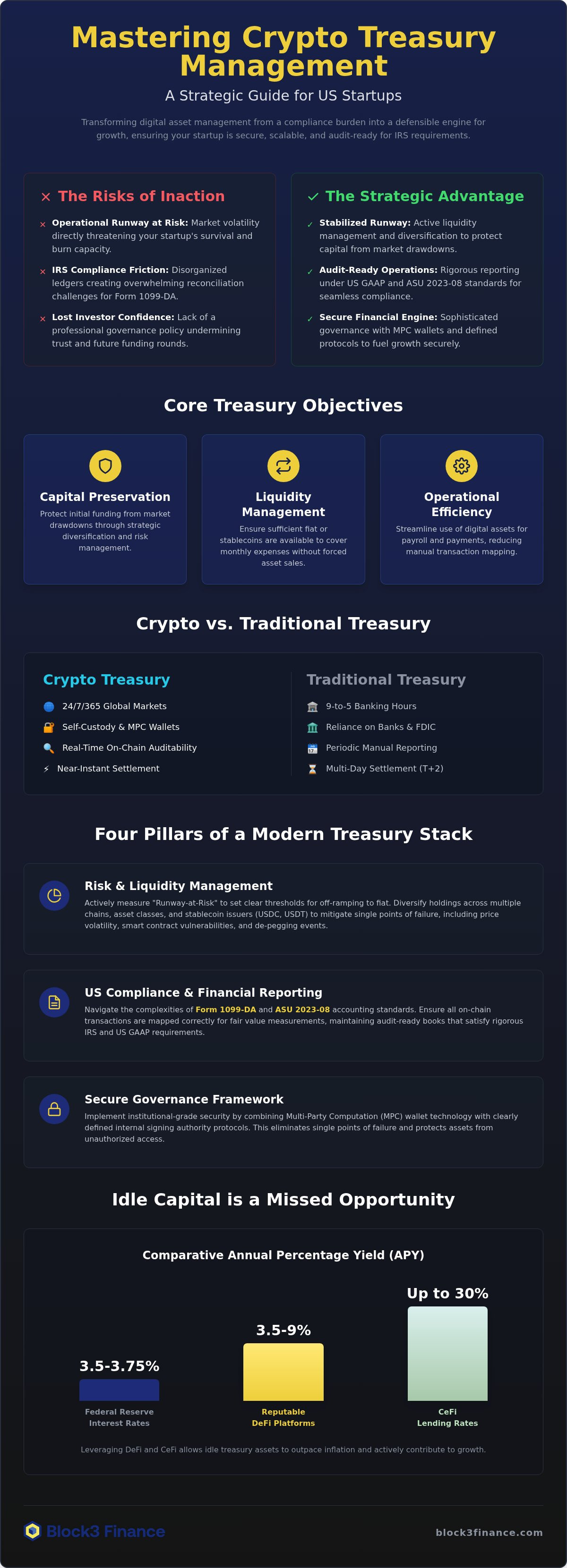
Capital preservation remains your primary directive. You must protect your initial seed or Series A funding from significant market drawdowns through strategic diversification. Liquidity management ensures that you always have enough fiat or stablecoins to cover monthly expenses without being forced to sell assets at a loss. Finally, operational efficiency streamlines the way you use digital assets for payroll and vendor payments, reducing the time spent on manual transaction mapping.
Crypto vs. Traditional Treasury Management
Traditional banking operates on a 9-to-5 schedule; crypto markets never sleep. This 24/7 environment requires automated monitoring and a different approach to risk. While traditional firms rely on FDIC insurance, crypto startups must master self-custody or utilize institutional-grade multi-party computation (MPC) wallets. The burden of security sits squarely on the firm. However, the blockchain offers unparalleled transparency. You can verify your assets on-chain in real-time, providing a level of trust and auditability that traditional financial institutions can't match. This real-time verification is essential for maintaining "audit-ready" books under US GAAP standards.
Managing Digital Asset Liquidity and Risk
Mastering crypto treasury management for startups requires more than just securing private keys. It demands a rigorous approach to liquidity that ensures your venture remains operational through every market cycle. You must move beyond simple accumulation to a strategy that prioritizes the preservation of your runway.
A primary tool in this effort is the calculation of "Runway-at-Risk." This metric determines how much of your operational capital is exposed to asset-specific volatility and sets clear thresholds for when you must off-ramp to fiat. By establishing these boundaries, you protect your ability to meet payroll even if the broader market faces a significant drawdown.
Risk assessment must be comprehensive. You are not only managing price fluctuations but also smart contract vulnerabilities, protocol failures, and counterparty risks. Diversifying your holdings across multiple chains and asset classes reduces the impact of a single point of failure within your financial ecosystem.
Stablecoin Strategies for US Entities
US startups often treat stablecoins like USDC or USDT as a vital bridge for operational expenses within their crypto treasury management for startups strategy. For 2026 tax reporting, it's essential to follow current IRS guidance on digital assets to ensure every stablecoin conversion is documented correctly. Prioritizing regulated, US-dollar-pegged assets is the standard for firms that want to maintain audit-ready books.
Managing de-pegging risk is a critical component of your policy. Rather than relying on a single issuer, a diversified basket of stablecoins provides a safety net against unforeseen regulatory or liquidity shocks. This approach ensures your payroll remains seamless and your vendor relationships stay secure.
Hedging and Yield Generation
Idle capital represents a missed opportunity for growth. As of July 2026, reputable DeFi platforms offer yields between 3.5% and 9% APY, while CeFi lending rates can reach as high as 30%. These options allow you to outpace inflation even as the Federal Reserve holds key interest rates between 3.5% and 3.75%. This strategy converts idle assets into a productive force for your business.
Every yield-bearing strategy involves a trade-off between returns and security. You must evaluate the underlying code and governance of any protocol before committing startup funds. Participation in DAO voting can also be a strategic move to protect your interests in the protocols where your capital resides.
Developing these sophisticated frameworks often requires an outside perspective to ensure no blind spots remain in your financial architecture. If you're ready to build a more resilient treasury, you can speak with our strategic advisors to align your holdings with your long-term roadmap.
Navigating IRS Compliance and Financial Reporting
Compliance has become the primary hurdle for scaling ventures. While early-stage firms often focus on security, the survival of a venture-backed startup now depends on maintaining defensible financial records. Every on-chain movement must be mapped to a specific business event to ensure your books remain audit-ready for both the IRS and future investors.
The complexity of crypto treasury management for startups increases exponentially as you scale. Without a rigorous framework for data reconciliation, year-end reporting becomes a chaotic and expensive liability. Implementing consistent monthly bookkeeping allows you to identify discrepancies in real-time rather than scrambling during tax season.
A robust audit trail is your best defense against regulatory scrutiny. You must document the "why" behind every transaction, whether it's a vendor payment, a liquidity provision, or an internal transfer. This level of transparency transforms your treasury from a black box into a clear, professional financial engine.
US GAAP and Fair Value Accounting
The financial landscape for digital assets changed significantly with the implementation of ASU 2023-08. This standard shifted the treatment of crypto from "intangible assets" to fair value reporting. This means your balance sheet now reflects the real-time market value of your holdings, providing a more accurate picture of your startup's financial health.
These real-time valuation changes impact your income statement directly. You must use consistent, high-fidelity pricing sources to ensure your reporting remains reliable. This proactive approach to accounting demonstrates to stakeholders that you have total command over your volatile balance sheet.
IRS Reporting Requirements for Treasuries
The 2026 tax year introduces mandatory cost basis reporting for brokers, making it easier for the IRS to track your digital activity. You are responsible for tracking the cost basis and capital gains across every wallet in your ecosystem. Following official IRS guidance on digital assets is essential for staying compliant with these evolving rules.
Income from staking, airdrops, and DeFi yield must be recorded at its fair market value at the time of receipt. Additionally, you must remain aware of disclosure requirements like Form 8300 for large transactions. Failing to report these activities accurately can lead to severe penalties and trigger intrusive audits that disrupt your focus on growth.
Managing these requirements requires a blend of technical blockchain knowledge and traditional tax expertise. By centralizing your data and automating the reconciliation process, you can navigate these high-stakes requirements with confidence and precision.
Building a Treasury Stack: Policy and Governance
Governance is the bedrock of institutional credibility. For a venture-backed firm, the ability to move company funds should never rest with a single individual. Establishing a robust policy ensures that your financial operations remain transparent, secure, and resilient against internal and external threats.
A formal Treasury Policy Statement (TPS) serves as your operational constitution. It defines the limits of your risk appetite and the specific protocols for asset movement. Without this document, your crypto treasury management for startups remains a reactive exercise rather than a disciplined strategy. You must institutionalize trust through technical controls and clear administrative hierarchies.
Internal controls are essential to prevent unauthorized transfers or internal fraud. Regular reporting to your board of directors should occur on a monthly cadence, providing a clear snapshot of treasury health and runway status. This consistent communication builds the long-term confidence required to scale in a volatile environment.
The Written Treasury Policy
Your policy must set maximum exposure limits for specific tokens and DeFi protocols to prevent over-concentration. It should clearly define "Authorized Signers" and mandate multi-signature approval for any transaction exceeding a specific dollar threshold. Additionally, you need clear guidelines for when to utilize on-ramp solutions to convert crypto to fiat based on your current burn rate. This prevents emotional decision-making during market swings and keeps your operational capital stable.
Security Infrastructure for Startups
Choosing the right technical stack is a balance between security and velocity. Multi-Party Computation (MPC) wallets offer a sophisticated alternative to traditional multi-sig setups, allowing your team to distribute private key shards and eliminate single points of failure. This technology is particularly effective for growing teams that require flexible permissioning without sacrificing the integrity of their reserves.
You must maintain a strict separation between "Cold Storage" for long-term reserves and "Hot Wallets" for daily operations. Cold storage keeps the bulk of your capital offline, protecting it from digital exploits. For your active operational wallets, whitelisting the addresses of your payroll providers and frequent vendors is a mandatory defense against phishing and address-replacement attacks. This layered defense ensures that your assets remain under your total command.
If you need assistance drafting a custom governance framework or selecting the right security stack, contact our strategic advisors to secure your startup's financial future.
Strategic Oversight: The Role of Fractional CFO Services
Software alone cannot provide the strategic foresight required to navigate a volatile digital economy. While security platforms offer the tools for execution, a Fractional CFO provides the intellectual leadership needed to align your holdings with your venture's long-term objectives. They act as your visionary navigator, ensuring that your crypto treasury management for startups strategy remains resilient through shifting regulatory tides and market cycles.
Strategic tax planning is a critical component of this oversight. By utilizing sophisticated corporate structuring, you can optimize your treasury's efficiency and minimize unnecessary tax exposure under current IRS rules. This proactive approach ensures that your startup isn't just surviving. You're actively cultivating a defensible financial position that appeals to sophisticated investors.
Preparing for your next fundraising round requires more than just a pitch deck. Clean, institutional-grade treasury records significantly accelerate the due diligence process for Series A and B rounds. When you demonstrate total command over your on-chain data, you signal to venture capital firms that your startup is a disciplined, low-risk investment. This transparency is the key to unlocking higher valuations and more favorable terms.
Tokenomics and Financial Modeling
Your CFO must analyze the specific impact of token vesting schedules on your company's liquidity. Large unlocks can create sudden shifts in your balance sheet that require pre-emptive planning to maintain operational stability. Modeling "Black Swan" events allows you to stress-test your runway, ensuring your startup remains solvent even during severe bear markets. This high-level modeling also informs the timing of liquidations to minimize the tax impact while maintaining a healthy cash reserve.
Audit Readiness and Investor Relations
Professional audit preparation is the most effective way to build trust with institutional stakeholders. Traditional VCs often struggle to interpret raw blockchain data; your financial partner acts as a translator, converting complex on-chain activity into the standardized financial reports they expect. This clarity reduces friction during investor updates and positions your firm as an industry leader.
Managing a treasury is an ongoing journey that evolves with your company's growth. It requires constant vigilance and a commitment to best practices. To secure your startup's financial future and master these complexities, reach out to Block3 Finance to begin building your professional roadmap today.
Master Your Financial Evolution
The evolution of finance requires a new set of rules and the technical rigor to execute them. By mastering crypto treasury management for startups, you move beyond simple survival and begin to leverage your digital assets as a sophisticated engine for growth. You now possess the framework to transform volatile on-chain data into defensible, audit-ready records that satisfy both the IRS and your most demanding investors.
Success in the 2026 landscape depends on your ability to bridge the gap between cutting-edge blockchain technology and legacy corporate finance. As a provider ranked #1 by Bitcoin.com with over 13 years of specialized experience, we've helped more than 980 global clients gain total command over their financial destiny. You don't have to navigate these high-stakes complexities alone.
Secure your startup's runway with expert Crypto CFO and Accounting services. Our team is ready to help you build a resilient, forward-looking treasury policy that protects your capital and empowers your vision. Let's build the future of your firm together.
Frequently Asked Questions
What is the difference between a crypto treasury and a crypto wallet?
A crypto wallet is a technical tool used for the storage and transfer of digital assets. In contrast, crypto treasury management for startups is a comprehensive financial function that encompasses policy, risk oversight, and strategic liquidity planning. While a wallet holds the keys, the treasury department determines how those assets are deployed to secure the company's operational runway.
Does the IRS require startups to report every crypto transaction?
Yes, the IRS requires US startups to report every transaction that constitutes a taxable event, including exchanges, payments, and the receipt of income. For the 2026 tax year, you must also account for mandatory cost basis reporting on Form 1099-DA. Maintaining precise records for every on-chain movement is the only way to ensure your books remain defensible during an audit.
How do I pay US employees in crypto while staying tax compliant?
To pay US employees in digital assets, you must treat the transfer as wages subject to federal income tax withholding and FICA taxes based on the asset's fair market value at the time of payment. You're required to report these earnings in USD on the employee's Form W-2. It's essential to calculate the exact value at the moment of transfer to avoid withholding errors that could trigger IRS penalties.
What is ASU 2023-08 and does it apply to my startup?
ASU 2023-08 is a financial accounting standard that requires US entities to measure certain crypto assets at fair value each reporting period. It applies to most startups holding digital assets on their balance sheet, replacing the old model that treated crypto as an intangible asset. This shift ensures your financial statements reflect the real-time market value of your holdings, which is a requirement for most venture capital due diligence.
Should my startup hold Bitcoin on its balance sheet?
Holding Bitcoin is a strategic choice that depends on your firm's risk tolerance and long-term capital preservation goals. While it offers potential for appreciation, the volatility can significantly impact your reported earnings under fair value accounting rules. You must establish clear exposure limits within your treasury policy to ensure market swings don't compromise your ability to fund operations.
How do I off-ramp crypto to pay for traditional business expenses?
You can off-ramp assets by utilizing regulated crypto-to-fiat payment solutions that convert digital holdings into USD for transfer to your corporate bank account. Every conversion is a taxable event under IRS rules, so you must document the cost basis and the fair market value at the time of the trade. This ensures your ledger remains balanced and your tax liabilities are accurately calculated.
Can a DAO be considered a startup for treasury management purposes?
A Decentralized Autonomous Organization (DAO) is often treated as a startup for crypto treasury management for startups if it operates through a legal wrapper with US tax obligations. These entities face unique hurdles in mapping decentralized on-chain activity to a centralized tax-paying entity. Professional oversight is required to ensure that governance-driven movements of capital don't result in unforeseen tax liabilities for the organization.
What are the biggest risks of managing a crypto treasury in-house?
The primary risks include catastrophic security exploits due to poor private key management and significant compliance failures from inaccurate transaction mapping. In-house teams often lack the specialized tools required to reconcile thousands of DeFi transactions into audit-ready financial statements. These errors can lead to intrusive IRS audits and can even jeopardize your standing with investors during future fundraising rounds.

Article by
Mahad Mohamed
Mahad Mohamed is an accountant and the CEO of Block3 Finance, with over 26+ years of Canadian and international tax and accounting experience. A crypto accounting specialist since the early days of Bitcoin, he has consulted for over 38 crypto companies and collaborated with legal professionals on regulatory matters. His expertise spans corporate reorganization, cross-border tax structuring (Canada & US), tax disputes, and CRA audits.
Previously, Mahad worked for the Canada Revenue Agency (CRA), Big4 accounting firms, and served as a Rulings Officer for the Federal Tax Authority of the UAE before acquiring Tax Partners in 2014.
Block3 Finance and Tax Partners has 44 full-time accountants and over 9,800+ clients.
Disclaimer
This article provides general information only and is current as of its publication date. It has not been updated and may be out of date. It does not constitute legal advice and should not be relied upon as such. Every tax situation is unique and may differ from the examples discussed in this article. If you have specific questions, you should seek the advice of our accountants for your unique circumstances.
Frequently Asked Questions
What is the difference between a crypto treasury and a crypto wallet?
A crypto wallet is a technical tool used for the storage and transfer of digital assets. In contrast, crypto treasury management for startups is a comprehensive financial function that encompasses policy, risk oversight, and strategic liquidity planning. While a wallet holds the keys, the treasury department determines how those assets are deployed to secure the company's operational runway.
Does the IRS require startups to report every crypto transaction?
Yes, the IRS requires US startups to report every transaction that constitutes a taxable event, including exchanges, payments, and the receipt of income. For the 2026 tax year, you must also account for mandatory cost basis reporting on Form 1099-DA. Maintaining precise records for every on-chain movement is the only way to ensure your books remain defensible during an audit.
How do I pay US employees in crypto while staying tax compliant?
To pay US employees in digital assets, you must treat the transfer as wages subject to federal income tax withholding and FICA taxes based on the asset's fair market value at the time of payment. You're required to report these earnings in USD on the employee's Form W-2. It's essential to calculate the exact value at the moment of transfer to avoid withholding errors that could trigger IRS penalties.
What is ASU 2023-08 and does it apply to my startup?
ASU 2023-08 is a financial accounting standard that requires US entities to measure certain crypto assets at fair value each reporting period. It applies to most startups holding digital assets on their balance sheet, replacing the old model that treated crypto as an intangible asset. This shift ensures your financial statements reflect the real-time market value of your holdings, which is a requirement for most venture capital due diligence.
Should my startup hold Bitcoin on its balance sheet?
Holding Bitcoin is a strategic choice that depends on your firm's risk tolerance and long-term capital preservation goals. While it offers potential for appreciation, the volatility can significantly impact your reported earnings under fair value accounting rules. You must establish clear exposure limits within your treasury policy to ensure market swings don't compromise your ability to fund operations.
How do I off-ramp crypto to pay for traditional business expenses?
You can off-ramp assets by utilizing regulated crypto-to-fiat payment solutions that convert digital holdings into USD for transfer to your corporate bank account. Every conversion is a taxable event under IRS rules, so you must document the cost basis and the fair market value at the time of the trade. This ensures your ledger remains balanced and your tax liabilities are accurately calculated.
Can a DAO be considered a startup for treasury management purposes?
A Decentralized Autonomous Organization (DAO) is often treated as a startup for crypto treasury management for startups if it operates through a legal wrapper with US tax obligations. These entities face unique hurdles in mapping decentralized on-chain activity to a centralized tax-paying entity. Professional oversight is required to ensure that governance-driven movements of capital don't result in unforeseen tax liabilities for the organization.
What are the biggest risks of managing a crypto treasury in-house?
The primary risks include catastrophic security exploits due to poor private key management and significant compliance failures from inaccurate transaction mapping. In-house teams often lack the specialized tools required to reconcile thousands of DeFi transactions into audit-ready financial statements. These errors can lead to intrusive IRS audits and can even jeopardize your standing with investors during future fundraising rounds.