
With 25% of Canadian adults now holding digital assets, the era of casual reporting has ended as the CRA implements mandatory reporting for crypto service providers in 2026. You've likely felt the friction of managing crypto tax loss harvesting across hundreds of DeFi transactions, fearing that a single misstep could trigger the superficial loss rule. This regulation denies a tax claim if you or an affiliated person buys the same asset within 30 days before or after the sale.
This guide provides a masterclass in navigating these complexities, showing you how to legally reduce your 2026 tax bill by offsetting gains with strategic losses. We'll move beyond defensive accounting to help you gain total command over your portfolio's impact on your bottom line. You'll learn the precise 31 day discipline required to stay compliant with the Income Tax Act while ensuring your Adjusted Cost Base (ACB), the average cost of your holdings, remains audit-ready.
We'll examine the specific thresholds for 2026 federal tax brackets and how to navigate the 50% capital gains inclusion rate. By the end of this strategy guide, you'll have a roadmap for turning market volatility into a calculated financial advantage.
Key Takeaways
- Master the precision of crypto tax loss harvesting to surgically reduce your 2026 taxable capital gains under current CRA regulations.
- Navigate the complexities of the superficial loss rule by strictly observing the 61-day window to ensure your claims remain defensible.
- Learn how the "Identical Properties" rule affects your weighted average Adjusted Cost Base across diverse wallets and DeFi protocols.
- Identify underwater positions with significant unrealized losses to execute a year-end strategy that maximizes your financial agency.
- Transition from reactive filing to a proactive, audit-ready posture by transforming complex on-chain data into compliant financial records.
What is Crypto Tax Loss Harvesting for Canadian Investors?
In the eyes of the Canada Revenue Agency (CRA), cryptocurrency is a commodity rather than a legal tender. This classification creates a powerful opportunity for crypto tax loss harvesting, which is the deliberate disposal of assets at a loss to neutralize realized capital gains. By selling "underwater" positions before the December 31 deadline, you effectively lower the "taxable capital gain" reported on your T1 Income Tax and Benefit Return.
The 2026 tax year represents a significant shift in transparency. With Crypto Asset Service Providers (CASPs) now required to report both crypto-to-fiat and crypto-to-crypto trades directly to the CRA, your on-chain activity is more visible than ever. Proactive rebalancing isn't just about saving money. It's about maintaining a clean, defensible financial record in a high-scrutiny environment where the CRA's ability to track digital assets has reached a new level of sophistication.
Capital Gains vs. Business Income in Canada
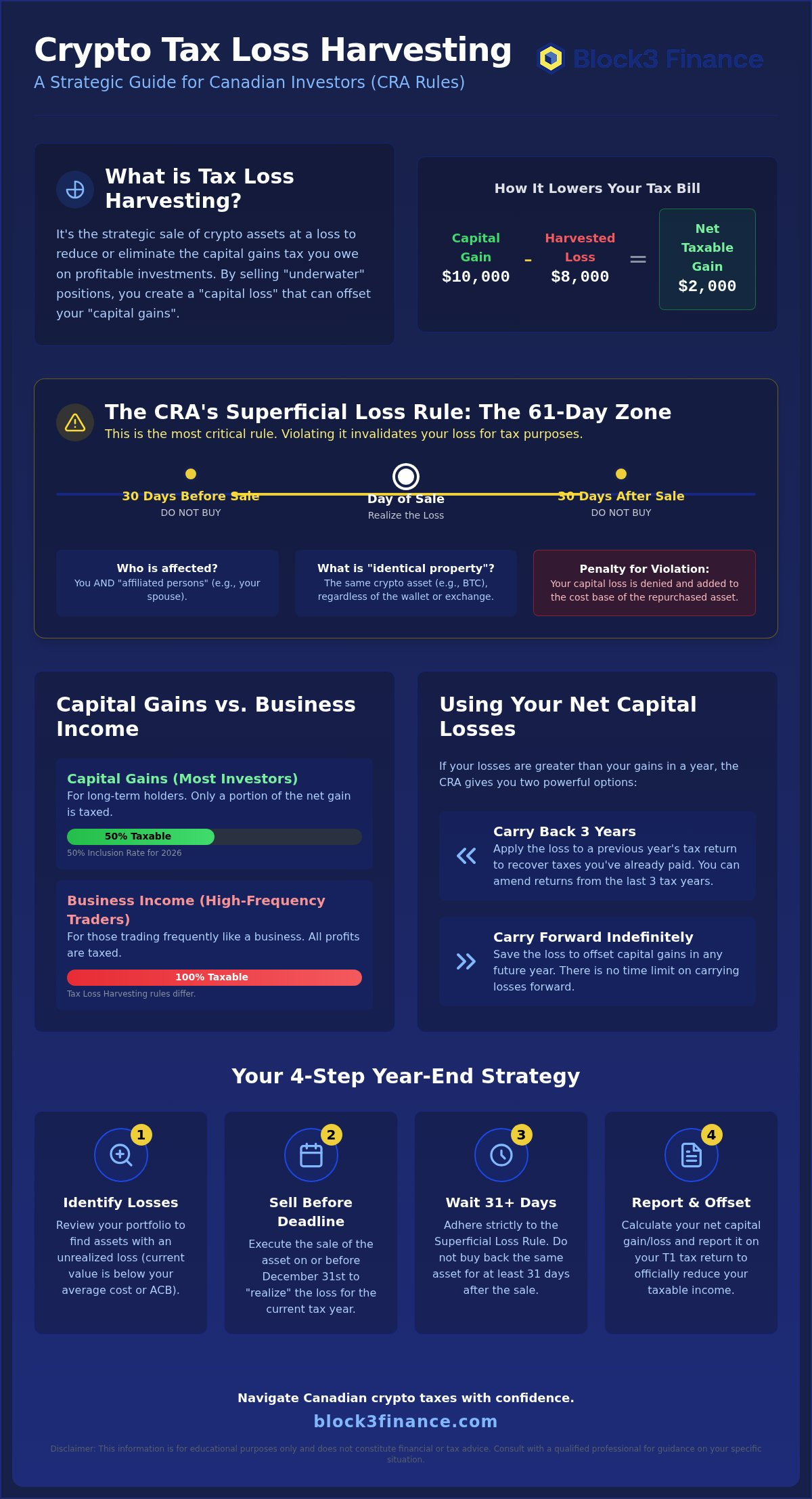
The CRA distinguishes between casual investors and those "carrying on a business." If you trade with high frequency or use specialized software to scalp profits, the CRA might classify your gains as business income, which is 100% taxable. Most long-term holders fall under capital gains, where only 50% of the gain is included in your taxable income for 2026. This distinction is vital because crypto tax loss harvesting primarily serves those filing as capital property holders. Those deemed to be running a business must treat losses as business losses, which follow different deduction rules under the Income Tax Act.
The "Netting" Process: Offsetting Gains with Losses
Canadian tax law follows a specific sequence for applying your losses. First, you must apply your current year capital losses against your current year capital gains to arrive at a net figure. If your losses exceed your gains, you cannot use the excess to offset other income like your employment salary. Instead, you have two powerful options to exercise your financial agency:
- Carry the loss back to any of the three previous tax years to recover taxes already paid.
- Carry the loss forward indefinitely to offset future Canadian capital gains.
This flexibility allows you to cultivate a long-term strategy that evolves with the market's volatility. Our crypto tax accountants specialize in navigating these specific CRA rules to ensure your filings are both optimized and compliant. We turn raw on-chain data into a roadmap for growth, ensuring you never pay more than the law requires.
Navigating the CRA Superficial Loss Rule
The 61-day danger zone is the primary obstacle for anyone executing crypto tax loss harvesting in Canada. Under the Canadian Income Tax Act, a capital loss is deemed "superficial" if you or an affiliated person reacquires the same asset within 30 days before or after the settlement date. This rule prevents taxpayers from creating artificial losses solely for tax purposes while maintaining their market position.
If you trigger this rule, the CRA denies the loss claim immediately. Instead of offsetting your realized gains, the denied amount is added to the Adjusted Cost Base (ACB) of the newly acquired property. This mechanism defers the tax benefit until you eventually sell the new asset, providing no immediate relief for your 2026 tax obligations.
Mastering the nuances of Navigating the CRA Superficial Loss Rule is essential for maintaining a defensible financial record. Many investors mistakenly apply US-based "wash sale" advice, which leads to rejected claims during a CRA audit. We help you navigate these high-stakes environments by enforcing the strict discipline required to keep your losses valid.
The 30-Day Window: A Practical Example
If you sell 1.0 BTC at a loss on December 15, 2026, you must not reacquire any BTC until after January 15, 2027. This 61-day period encompasses the 30 days preceding the trade and the 30 days following it. You cannot bypass this by selling on one exchange and immediately buying back on another protocol or wallet. The CRA considers the asset "identical property" regardless of the platform used for the transaction.
Affiliated Persons and Corporate Entities
The superficial loss rule extends beyond your personal accounts to include "affiliated persons" such as a spouse, common-law partner, or a corporation you control. If you sell ETH at a loss while your spouse buys the same amount of ETH in their account within the window, your loss is denied. This restriction also applies to repurchases made within registered accounts like an RRSP or TFSA, which can permanently trap the loss without a tax benefit.
Managing these triggers requires precise oversight, especially when your strategy involves corporate structuring for digital asset holdings. Complexity increases when multiple entities interact with the same asset classes across different jurisdictions. If you are managing a high-volume portfolio across multiple entities, speaking with our team can ensure your harvesting strategy remains fully compliant with the Income Tax Act.
Calculating Adjusted Cost Base (ACB) for Strategic Harvesting
Precision is the precursor to agency. Calculating your Adjusted Cost Base (ACB) is not a mere clerical task but a critical component of strategic financial navigation. The CRA requires Canadian taxpayers to use the "Identical Properties" rule, which mandates a weighted average calculation for all units of a specific digital asset, regardless of where they are held.
This requirement creates significant friction for investors moving assets across multiple wallets, centralized exchanges (CEXs), and DeFi protocols. Unlike other jurisdictions that may allow for Specific Identification (Spec ID) or First-In, First-Out (FIFO) methods, the CRA remains steadfast in its application of the weighted average cost basis. Successfully executing crypto tax loss harvesting depends entirely on the accuracy of this single figure, as it determines the exact magnitude of your realized loss.
Your cost basis isn't just the sticker price of the asset. In Canada, you must integrate all associated transaction costs, such as gas fees and exchange commissions, directly into your ACB. These costs increase your total investment and, consequently, can enlarge the potential loss available for harvesting when market prices decline.
The Weighted Average Method
To calculate your weighted average ACB, you must track every acquisition of an identical asset. You add the total cost of all purchases, including fees, and divide that sum by the total number of units held. This process must be updated with every new acquisition to ensure your records remain current and defensible.
Complex on-chain events like hard forks or airdrops require specialized handling. The CRA typically views these as having a cost basis of zero at the time of receipt, which can significantly dilute your weighted average if not tracked with precision. Our team provides comprehensive Crypto Accounting services to manage these calculations, ensuring your portfolio remains optimized for future tax events.
Tracking Tools vs. Professional Reconciliation
While automated tracking tools offer a starting point, they often struggle with complex DeFi liquidations or multi-step smart contract interactions. These "black box" software reports frequently lack the transparency required by the CRA, which may reject filings that do not provide clear source data for every transaction. The CRA requires a clear trail from the original fiat on-ramp to the final disposal.
Relying solely on automation without human oversight is a defensive posture that leaves you vulnerable to audits. A crypto tax specialist provides the methodical reconciliation necessary to turn raw data into a clean, audit-ready record. We resolve the friction of cross-chain data, providing you with the intellectual leadership needed to thrive in a complex regulatory landscape.
Step-by-Step: Executing Your 2026 Year-End Strategy
Execution is where strategy meets reality. Begin by auditing all realized gains from January through November 2026. This allows you to quantify your current tax liability before the year-end window closes, giving you the agency to offset those gains with precision.
Identify your "underwater" positions. These are digital assets where the current fair market value has dipped below your calculated Adjusted Cost Base (ACB). Selling these positions triggers the capital loss needed for effective crypto tax loss harvesting, directly reducing your 2026 taxable income.
Timing is essential. Don't wait until December 31 to execute your trades. Exchange settlement times and potential network congestion can delay the finalization of a transaction, which might push the loss into the 2027 tax year. Maintain an audit trail for every transaction, documenting the intent and keeping records of the order execution to ensure your filings remain defensible.
Handling Illiquid or Worthless Tokens
Investors often hold "dust" or tokens from failed projects that no longer have liquidity on centralized or decentralized exchanges. You cannot realize a loss if you cannot sell the asset. In these specific cases, you may need to utilize a "Deed of Abandonment" or send the tokens to a verified burn address to formally dispose of the property.
The CRA requires clear evidence that an asset is truly worthless before accepting such a claim. This documentation should include proof of platform insolvency, permanent delisting from major exchanges, or a sustained zero-bid environment. Without this rigorous proof, the CRA may deny the loss claim during a future audit, leaving you with an unexpected tax liability.
Post-Sale Discipline: The 31-Day Rule
Strategic discipline doesn't end with the click of a "sell" button. Set calendar alerts for 31 days after each harvest to prevent accidental repurchases that would trigger the superficial loss rule. This monitoring must extend to affiliated accounts, including those held by a spouse or a corporation you control, to ensure no wash-trading occurs across your entire financial ecosystem.
Finally, organize your data for the 2026 filing season. Personal filers in Canada must report these transactions on T1 Schedule 3, while corporate entities utilize T2 Schedule 6. If you require professional oversight to reconcile complex DeFi transactions before the deadline, contact our specialized team to ensure your year-end strategy is executed with total precision.
Professional Crypto Tax Compliance with Block3 Finance
Mastery over a volatile landscape requires more than just automated tracking; it demands a sophisticated partner who can translate complex on-chain activity into a position of strength. Block3 Finance transforms raw, fragmented data from hundreds of protocols into clean, CRA-compliant reports. We move beyond the limitations of generic accounting by adopting an offensive posture that focuses on total financial command and long-term growth.
Our firm brings 13 years of specialized blockchain expertise to every engagement, a depth of experience that generalist accountants cannot match. We've supported 980+ global clients in maintaining defensible financial records that withstand the highest levels of scrutiny. By integrating crypto tax loss harvesting into a broader, year-round strategy, we help you resolve the friction between innovation and regulation.
We serve as a "Visionary Navigator" for high-growth Web3 firms and high-net-worth individuals who require elite strategic oversight. Our methodology ensures that your tax filings aren't just a reactive summary of the past, but a roadmap for thriving in an increasingly transparent environment. This proactive stance turns compliance into a competitive advantage.
Audit-Ready Books and CFO Oversight
Maintaining audit-ready books is a non-negotiable requirement for serious participants in the digital asset space. Our CFO Services provide the high-level financial planning necessary to scale your operations while optimizing your corporate structure for tax efficiency. We ensure that every transaction, from simple trades to complex liquidations, is documented with the precision required for a formal CRA audit.
This level of oversight is essential for those managing multi-entity structures across different jurisdictions. We eliminate the "black box" uncertainty of software-only reports by providing human-verified reconciliation. This disciplined approach guarantees that your financial history is transparent, accurate, and fully compliant with the Income Tax Act.
Get Started Before the Deadline
The window for effective year-end planning is narrow, and the 2026 filing season will be the most transparent in Canadian history. Starting the reconciliation process early allows our team to identify opportunities for crypto tax loss harvesting that might be missed in the December rush. Early action provides the time needed to resolve complex data discrepancies before they become liabilities.
Don't leave your financial security to chance or unverified software. We invite you to contact our Ontario-based team to discuss your specific portfolio needs. Secure your 2026 tax strategy today and gain the agency to navigate the future of finance with confidence.
Master Your 2026 Tax Strategy
Precision in Adjusted Cost Base (ACB) tracking and strict adherence to the 61-day superficial loss window are the foundations of a resilient strategy. By identifying underwater positions before the year-end deadline, you transform market volatility into a calculated tax advantage. This proactive approach ensures you maintain total command over your financial landscape while staying aligned with the Income Tax Act.
Successfully executing crypto tax loss harvesting requires more than just selling assets; it demands a rigorous audit trail and specialized oversight. Our team ensures your records are clean and defensible under the latest CRA reporting requirements. We resolve the friction of complex on-chain data, providing the intellectual leadership needed to thrive in a high-stakes regulatory environment.
As Ontario-based CRA compliance specialists ranked #1 by Bitcoin.com, we provide the audit-defensible record keeping necessary to protect your wealth. We help you move beyond reactive filing to ensure your portfolio is optimized for long-term growth and mastery. Our 13 years of blockchain expertise serves as your roadmap for navigating the future of finance.
Book a consultation with our Canadian crypto tax experts to secure your financial future today. Take command of your digital asset landscape and enter the new tax year with total confidence.
Frequently Asked Questions
Can I sell my crypto for a loss and buy it back immediately in Canada?
No, you can't buy it back immediately without losing your tax deduction. The CRA superficial loss rule requires you to wait more than 30 days before and after the settlement date to ensure the loss remains valid for your 2026 filing.
How long can I carry forward crypto tax losses under CRA rules?
You can carry forward capital losses indefinitely to offset future gains in any tax year. The CRA also allows you to carry back these losses to any of the three previous tax years to recover taxes you've already paid on past capital gains.
Does the superficial loss rule apply if I buy back a different cryptocurrency?
The rule only applies to "identical property" as defined by the Income Tax Act. Selling Bitcoin at a loss and immediately purchasing Ethereum is generally permitted, but buying a highly similar asset like Wrapped Bitcoin (WBTC) could trigger CRA scrutiny during an audit.
Can I use crypto capital losses to offset my regular employment income?
No, you can't apply capital losses against your employment salary or interest income. These losses are strictly limited to offsetting capital gains, which ensures that crypto tax loss harvesting remains a specialized strategy for portfolio rebalancing rather than general income reduction.
What forms do I need to file for crypto tax loss harvesting in Canada?
Individual taxpayers must report their capital gains and losses on T1 Schedule 3. If you're managing digital assets through a company, you'll need to use T2 Schedule 6 to document these transactions for the 2026 tax year.
Does the CRA track decentralized exchange (DEX) transactions for losses?
Yes, the CRA uses advanced on-chain forensic tools to monitor decentralized activity. With new 2026 reporting requirements for service providers, the agency has increased its ability to link wallet addresses to Canadian taxpayers, making accurate record-keeping essential for all DEX trades.
What happens if I accidentally trigger a superficial loss?
Your current year loss claim will be denied by the CRA. The denied amount isn't lost forever; it's added to the Adjusted Cost Base of your new purchase, which reduces your future taxable gain when you eventually sell that specific asset.
Can my spouse buy the same crypto I sold at a loss?
No, your spouse is considered an affiliated person under Canadian law. If they purchase the identical asset within the 61-day window, your crypto tax loss harvesting claim will be denied, even if the trade happened in a completely separate account.

Article by
Mahad Mohamed
Mahad Mohamed is an accountant and the CEO of Block3 Finance, with over 26+ years of Canadian and international tax and accounting experience. A crypto accounting specialist since the early days of Bitcoin, he has consulted for over 38 crypto companies and collaborated with legal professionals on regulatory matters. His expertise spans corporate reorganization, cross-border tax structuring (Canada & US), tax disputes, and CRA audits.
Previously, Mahad worked for the Canada Revenue Agency (CRA), Big4 accounting firms, and served as a Rulings Officer for the Federal Tax Authority of the UAE before acquiring Tax Partners in 2014.
Block3 Finance and Tax Partners has 44 full-time accountants and over 9,800+ clients.
Disclaimer
This article provides general information only and is current as of its publication date. It has not been updated and may be out of date. It does not constitute legal advice and should not be relied upon as such. Every tax situation is unique and may differ from the examples discussed in this article. If you have specific questions, you should seek the advice of our accountants for your unique circumstances.
Frequently Asked Questions
Can I sell my crypto for a loss and buy it back immediately in Canada?
No, you can't buy it back immediately without losing your tax deduction. The CRA superficial loss rule requires you to wait more than 30 days before and after the settlement date to ensure the loss remains valid for your 2026 filing.
How long can I carry forward crypto tax losses under CRA rules?
You can carry forward capital losses indefinitely to offset future gains in any tax year. The CRA also allows you to carry back these losses to any of the three previous tax years to recover taxes you've already paid on past capital gains.
Does the superficial loss rule apply if I buy back a different cryptocurrency?
The rule only applies to "identical property" as defined by the Income Tax Act. Selling Bitcoin at a loss and immediately purchasing Ethereum is generally permitted, but buying a highly similar asset like Wrapped Bitcoin (WBTC) could trigger CRA scrutiny during an audit.
Can I use crypto capital losses to offset my regular employment income?
No, you can't apply capital losses against your employment salary or interest income. These losses are strictly limited to offsetting capital gains, which ensures that crypto tax loss harvesting remains a specialized strategy for portfolio rebalancing rather than general income reduction.
What forms do I need to file for crypto tax loss harvesting in Canada?
Individual taxpayers must report their capital gains and losses on T1 Schedule 3. If you're managing digital assets through a company, you'll need to use T2 Schedule 6 to document these transactions for the 2026 tax year.
Does the CRA track decentralized exchange (DEX) transactions for losses?
Yes, the CRA uses advanced on-chain forensic tools to monitor decentralized activity. With new 2026 reporting requirements for service providers, the agency has increased its ability to link wallet addresses to Canadian taxpayers, making accurate record-keeping essential for all DEX trades.
What happens if I accidentally trigger a superficial loss?
Your current year loss claim will be denied by the CRA. The denied amount isn't lost forever; it's added to the Adjusted Cost Base of your new purchase, which reduces your future taxable gain when you eventually sell that specific asset.
Can my spouse buy the same crypto I sold at a loss?
No, your spouse is considered an affiliated person under Canadian law. If they purchase the identical asset within the 61-day window, your crypto tax loss harvesting claim will be denied, even if the trade happened in a completely separate account.