
The same crypto sale can produce a gain or a loss depending on which purchase lot supplies its cost basis. For U.S. taxpayers, cost basis generally starts with an asset’s value when acquired and includes relevant acquisition costs; cost basis tracking for crypto connects that amount to the units later sold. Starting January 1, 2025, per-wallet tracking is the only acceptable cost-basis tracking method for U.S. taxpayers.
It’s easy to think the sale price alone determines the tax result, but the purchase history matters just as much. This article explains what cost basis means, how it affects capital gains and losses, how common tracking methods differ, and how crypto sales are reported for U.S. tax purposes. You’ll also learn why complete records of purchases, sales, fees, and wallet transfers help preserve each asset’s tax history.
Key Takeaways
- Learn how purchase value and relevant acquisition costs establish a crypto asset’s basis, then shape the gain or loss when it’s sold.
- Compare common lot-selection methods and understand why the records supporting your chosen method matter.
- See how U.S. broker reporting and your own tax forms fit together, and why exchange information may not tell the whole story.
- Understand why documenting transfers between your own wallets helps preserve each asset’s purchase history and avoid misleading gain calculations.
- Find out when Block3 Finance’s tax filing, reporting, and compliance support can help bring complex crypto records into a clearer tax picture.
What is cost basis?
For U.S. tax purposes, cost basis is the amount assigned to crypto units when acquired, including relevant acquisition costs. It helps determine the gain or loss when those specific units are later sold. Since January 1, 2025, U.S. taxpayers use per-wallet cost basis tracking, so the wallet or exchange account matters.
Tracking Basis by Wallet
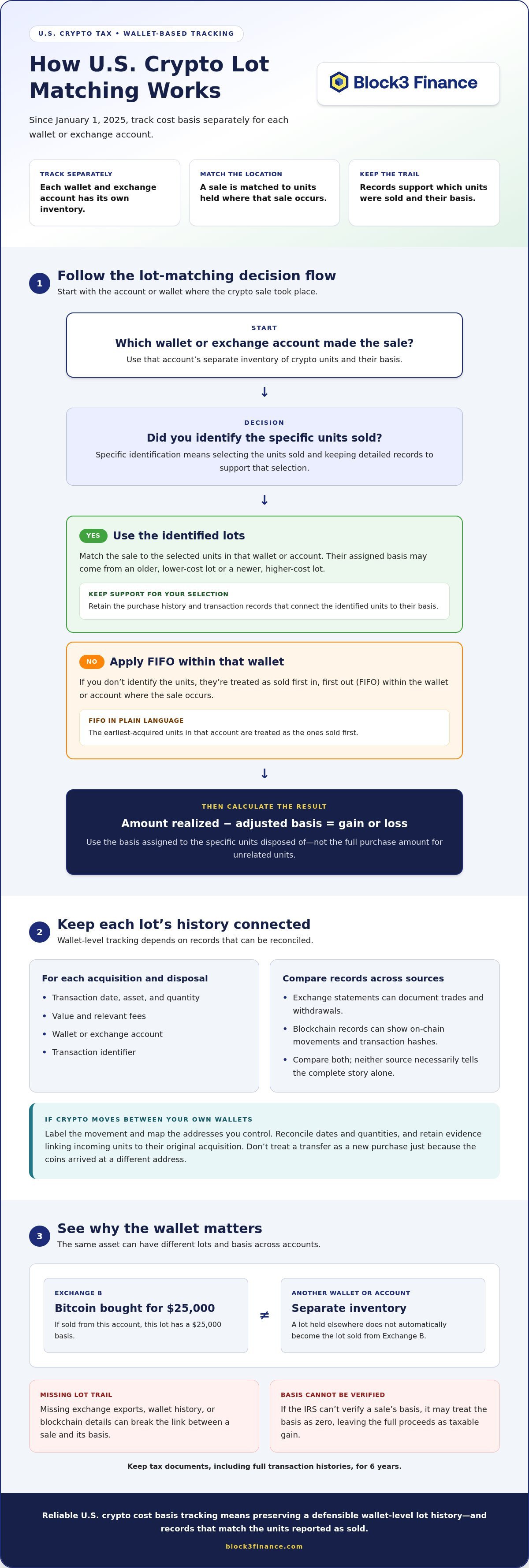
Per-wallet tracking keeps a separate inventory of crypto units and their basis for each wallet or exchange account. That distinction matters when you hold the same asset in multiple places: a purchase lot in one account doesn’t automatically become the lot sold from another. For example, bitcoin bought for $25,000 on Exchange B has a $25,000 basis when sold from that account. Keep exchange accounts and self-hosted wallets distinct, and reconcile transfers between them.
Wallet-Based Tracking and Specific Identification
Under U.S. wallet-based tracking, a sale is matched to units held in the wallet or account where the sale occurs. Specific identification means selecting the units sold and keeping detailed records to support that selection. This may mean using an older, lower-cost lot or a newer, higher-cost lot. If you don’t identify the units, they’re treated as sold first in, first out within each wallet or account.
Before January 1, 2025, the IRS allowed universal tracking, which could combine holdings across wallets and accounts. The change makes separate inventories central to U.S. accounting. An exchange account, a self-hosted wallet, and addresses generated by an HD wallet can all appear in transaction records. Record which addresses you control and map movements between them, so an internal transfer doesn’t look like a sale or create a second purchase lot.
For each acquisition and disposal, keep the transaction date, asset, quantity, value, fees, wallet or account, and transaction identifier. Exchange statements can document trades and withdrawals; blockchain records can show on-chain movements and transaction hashes. Neither source necessarily tells the complete story on its own. Compare them, label transfers between your own wallets, and retain evidence linking each incoming unit to its original acquisition.
Missing exchange exports, wallet history, or blockchain details can break the lot trail. Start with available exchange statements, wallet backups, transaction hashes, and address histories, then reconcile dates and quantities across sources. Don’t treat a transfer as a new purchase merely because coins arrived at a different address. If the IRS can’t verify a sale’s basis, it may treat the basis as zero, leaving the full proceeds as taxable gain. Keep tax documents, including full transaction histories, for 6 years.
Reliable cost basis tracking for crypto means preserving a defensible lot history, not just recording your portfolio’s current value. A complete wallet-level inventory shows which units left an account, how their basis was assigned, and whether the supporting records match the reported transaction.
Cost basis definition and capital gains calculation
For U.S. federal income tax, a digital asset’s gain or loss is the amount realized minus its adjusted basis. Basis generally starts with the fair market value when the asset is acquired, plus relevant acquisition costs.
Staking and mining rewards generally receive a basis equal to their fair market value when received. Airdrops generally use their fair market value at receipt. If they have no market value then, the value when a market becomes available can be used.
Including Purchase and Sale Fees
Fees tied to acquiring an asset can increase its basis, while selling costs affect the amount realized. Record each fee with its transaction to calculate the gain or loss from the actual disposal, rather than relying on headline prices.
For example, buying ten coins for $5 each and paying $1 in transaction fees gives a total basis of $51, or $5.10 per coin. If one coin is later sold, use that unit’s basis and account for applicable selling costs when determining proceeds. Keep exchange receipts or transaction records that connect each fee to its purchase or sale.
Digital-Asset Disposal Calculations
For U.S. reporting, subtract the adjusted basis of the disposed units from the amount realized. The result determines whether the transaction produces a capital gain or loss and ties the calculation to the specific units sold.
For instance, a purchase of ten AAVE tokens for $500 gives each token a $50 basis before relevant adjustments. If an investor disposes of some tokens, the calculation uses the basis assigned to those units, not the full $500 purchase amount. Preserve the quantity and acquisition details so the calculation reflects the actual disposal.
A crypto cost basis calculator can organize acquisition dates, quantities, fair market values, purchase fees, sale proceeds, and disposal costs. Useful software also keeps each lot distinct, records the method used to match disposed units, and flags missing prices or inconsistent transaction data. Review the underlying transactions before relying on its output: a polished summary can’t correct inaccurate imports or an incorrect lot match.
Brooke buys bitcoin for $1,200 and later sells it for $1,800. If the original purchase cost is known and no adjustments apply, the capital gain is $600. This straightforward example shows why the original acquisition record matters: the sale proceeds alone don’t reveal the taxable gain. For complex transaction histories, a crypto tax accounting discussion can help clarify how records and calculations fit together.
Cost basis reporting on Form 1099-DA and Form 8949
For U.S. taxpayers, Form 1099-DA provides broker-reported digital-asset transaction information, while Form 8949 supports reporting sales with their documented basis. Reconcile those forms with your own transaction records before filing.
For the 2025 tax year, Form 1099-DA reporting covers proceeds, and cost basis reporting isn’t required. Centralized exchanges aren’t required to track and report basis to the IRS for that tax year. Beginning January 1, 2025, U.S. crypto exchanges must track transactions and report information on Form 1099-DA. For digital-asset transactions from 2026 onward, brokers must report gross proceeds and adjusted basis for covered assets acquired and held within the same broker account, according to the Internal Revenue Service.
The broker’s figures are not always the complete tax record. A 1099-DA may not reflect a purchase made on another exchange, a transfer to a self-hosted wallet, or a sale from a different account. Compare each reported disposal with your own lot records. If the broker’s statement and your documented transaction history differ, preserve the underlying records supporting the accurate amount.
Taxpayers may report the correct cryptocurrency basis on Form 8949 when they have purchase documentation. For each sale, connect the reported proceeds to the units disposed of, their acquisition records, and relevant adjustments. A purchase confirmation, exchange statement, wallet transaction, and blockchain record can each support a part of that history. Keep the lot-level detail, not just a portfolio-wide total.
Use a reconciliation process that makes differences visible:
- Match each Form 1099-DA transaction to the corresponding sale or disposal in your ledger.
- Compare the asset, quantity, date, proceeds, and account against exchange and wallet records.
- Identify transfers between your own wallets separately from sales to another party.
- Document any corrected basis on Form 8949 with the purchase evidence behind it.
Tax software can organize transactions, but its output depends on the imported records and inventory structure. Without a carryforward inventory file, a tool may not show an auditable lot history across tax periods. Check whether it preserves each acquisition lot, matches disposals to those lots, and carries remaining units into the next tax year. A summary gain total alone doesn’t explain which units were sold.
Cross-border activity means reconciling additional records, not applying another country’s rules to this U.S. discussion. If you use a foreign exchange or hold assets across platforms, keep its statements alongside your U.S. wallet and broker records. Store transaction dates, asset quantities, proceeds, and purchase details together, including the currency shown on source statements. This helps distinguish platform reporting from your complete tax history.
Finally, retain the transaction-level files used to prepare Form 8949 and compare them with each broker statement. That record trail helps explain the actual basis used when selling, especially when a digital asset moved between accounts before disposal.
FIFO, LIFO, HIFO, ACB, Spec ID, and other methods
Lot-selection methods determine which acquired units are matched to a crypto sale, changing the calculated gain or loss. For U.S. taxpayers, FIFO and specific identification are supported methods. Keep records showing how each disposal was matched.
Comparing FIFO, LIFO, HIFO, ACB, LCFO, and LGUT
FIFO matches a sale to the earliest-acquired units; LIFO matches the most recently acquired, while HIFO selects the highest-cost units first. ACB uses an average cost basis, which the IRS doesn’t allow for cryptocurrency. LCFO and LGUT are labels, not substitutes for a documented, identifiable lot-selection method for U.S. reporting.
The numerical effect can be substantial. If one bitcoin sells for $120,000, matching a $70,000 purchase under FIFO produces a $50,000 gain. Matching a $100,000 purchase under LIFO produces a $20,000 gain. These examples show how lot selection changes the reported result, not the amount received from the sale.
Specific Identification of Crypto Lots
Specific identification means selecting the particular units sold and keeping detailed records that link them to their acquisition history. This matters because a sale can be matched to a higher- or lower-basis lot, affecting the reported gain or loss.
For example, if a taxpayer bought bitcoin in separate transactions, the records should identify the selected purchase lot, its quantity, acquisition date, and basis. Exchange or wallet records can support that link. Without adequate documentation, the selected lot may not be substantiated. Under U.S. rules, units sold without identification are treated as sold first in, first out within each wallet or account.
Selecting Lots with HIFO
HIFO, or highest in, first out, matches a disposal to the available units with the highest basis. It may reduce a gain when the selected lot has a higher basis, but records must identify and substantiate those specific units.
Consider a sale for $45,000. A $40,000 HIFO basis produces a $5,000 gain, while a $30,000 FIFO basis produces a $15,000 gain. HIFO isn’t a shortcut around documentation: using it without proper records may result in additional tax. Compare the acquisition lots available in the relevant account and preserve evidence for the one selected.
For U.S. crypto reporting, method labels alone don’t establish which units were sold. Keep a consistent lot history linking each disposal to the units acquired, and use supported methods with records that substantiate the reported basis. This makes it easier to explain why a sale produced its reported gain or loss.
Crypto cost basis and capital gains or losses
For U.S. taxpayers, basis links each crypto acquisition to a later sale, trade, or payment. The difference between adjusted basis and the amount realized determines the capital gain or loss.
Capital Gains and Losses
A capital gain occurs when proceeds exceed the adjusted basis of the units disposed of; a capital loss occurs when proceeds are lower. For example, buying 1 ETH for $2,000 and later selling it for $3,500 produces a $1,500 gain before applicable adjustments.
The original acquisition history matters even when the asset changes wallets or platforms. Taxpayers need to connect the disposed units to their purchase lots and retain evidence for the basis method used. The Internal Revenue Service may charge a 20% accuracy-related penalty when cost basis isn’t adequately supported.
Crypto Trades and Spending
For U.S. tax purposes, a crypto-to-crypto trade is treated as a sale of the first token and a purchase of the second, or two transactions. Spending crypto on goods or services also disposes of the asset, so compare its value at disposal with its adjusted basis.
For example, exchanging one token for another can create a gain or loss on the first token’s disposal. The received token starts a new acquisition record, generally using its fair market value at receipt plus relevant fees. Record both sides of the trade rather than treating it as a simple currency conversion.
The shift from universal tracking to per-wallet records changed how taxpayers organized existing holdings. The IRS issued Revenue Procedure 2024-28 to guide that transition and provide a one-time safe harbor for reallocating unused basis across wallets as of January 1, 2025. The IRS states taxpayers had to complete this basis reallocation by the earlier of their first disposal after January 1, 2025, or the due date of their 2025 tax return.
The inventory carried into each wallet matters. A lot’s original basis must stay connected to its remaining units, including after transfers. If you dispose of units from an account with incomplete history, the calculation may not match your actual acquisition records. Keep a lot-level schedule of purchases, disposals, transfers, and remaining units across tax periods.
For each taxable event, preserve the date, units disposed of, proceeds or value received, and assigned basis. Separate sale proceeds from the value of a newly acquired token, then document fees and any basis adjustments. This record trail helps explain the reported gain or loss and support the taxpayer’s treatment if the transaction history is reviewed.
If you need help organizing crypto disposals and basis records for U.S. reporting, discuss your crypto tax records.
Block3 Finance: Tax Filing and Reporting
Block3 Finance helps U.S. crypto taxpayers turn transaction histories and lot records into tax filing and reporting. When exchange statements, wallet activity, and Form 8949 calculations need reconciliation, its Crypto Tax Accountant support can help organize the reporting picture. Audits and Compliance can also help address documentation and recordkeeping needs, while Monthly Accounting supports ongoing transaction tracking.
This documentation is especially useful when you have activity across multiple exchanges or wallets, missing transaction details, or basis records to carry forward between tax periods. Clear accounting links acquisitions, transfers, and disposals so reported gains and losses reflect documented lots.
Contact Block3 Finance to discuss your crypto tax filing and reporting needs.
Make Your Crypto Records Work for You
Strong cost basis tracking for crypto isn’t just a tax-season task. Make it part of your ongoing financial process, recording each new transaction with the context needed for future reporting. This helps maintain continuity as your activity, accounts, or business needs change.
Block3 Finance supports this work through Tax Filing and Reporting, Audits and Compliance, and Monthly Accounting. If you want help turning crypto transaction records into a more structured reporting process, contact Block3 Finance to discuss your needs.
Clear records help you make informed decisions with confidence.
Frequently Asked Questions
What happens when you transfer between your own wallets?
A transfer between wallets you own generally isn’t taxable in the United States, but document it as an internal movement. Keep the sending and receiving addresses, transaction hash, date, asset, and quantity together. For example, a transfer from your exchange account to your self-hosted wallet shouldn’t appear as a sale and a separate purchase. Without evidence linking both accounts to you, the IRS may treat the movement as a sale.
How does cost basis work for cryptocurrency taxes in the US?
For U.S. federal income tax, cost basis helps determine the gain or loss when you dispose of cryptocurrency. Compare the amount realized from the disposal with the adjusted basis of the units involved. If you sell only part of a holding, for example, calculate using the basis assigned to those units, not the entire balance. Your acquisition history and documented lot selection support the amount reported for that transaction.
How do you calculate crypto cost basis, including fees?
Start with the asset’s fair market value when acquired, then include relevant acquisition costs. For a disposal, use the basis of the units sold and account for relevant selling costs when determining proceeds. Keep purchase confirmations and fee entries linked to the matching transaction instead of combining unrelated fees into one total. For a crypto-to-crypto trade, record the outgoing asset’s disposal and the incoming asset’s acquisition separately.
Which crypto cost-basis accounting methods are allowed by the IRS?
The IRS supports first in, first out (FIFO) and specific identification for cryptocurrency basis. Average cost basis isn’t allowed for cryptocurrency. Specific identification requires detailed records linking selected units to their acquisition lots. Keep the method and supporting records consistent with the account where the units were held and disposed of. A method’s label alone doesn’t show which purchase lot supplied the basis for a reported sale.
Can US taxpayers use FIFO, specific identification, or HIFO for crypto?
U.S. taxpayers can use FIFO or specific identification, with records supporting the units sold. HIFO selects the units with the highest basis first, but using it without proper documentation may result in additional tax. Keep records showing the selected acquisition lot, quantity, and transaction history. Don’t assume a tax-software setting alone establishes that a HIFO selection has the documentation needed to support the reported basis.
How do you track crypto cost basis across multiple exchanges and wallets?
Maintain a separate transaction history for each exchange account and wallet, then reconcile movements between them. A working ledger can record the asset, quantity, acquisition date, value, fees, transaction hash, and account for every activity. Mark transfers between your own accounts so they don’t appear as separate sales or purchases. Compare exchange exports with blockchain activity, and investigate unmatched deposits or withdrawals before calculating gains for a tax return.
What happens to crypto cost basis when transferring coins between wallets?
The original acquisition basis generally follows the transferred units rather than resetting to their value when they arrive. Preserve the lot history when moving coins, including the quantity transferred and its source wallet. If a transfer includes only part of a lot, record how much moved and how much remains. This links a later sale to the original purchase, even if the coins have passed through several wallets.
What records and tax forms are needed to report crypto cost basis in the US?
Keep exchange statements, purchase and sale confirmations, wallet histories, transaction hashes, fee records, and documents showing transfers between your own accounts. U.S. taxpayers generally report crypto activity with their federal return, using Form 8949 to report sales and exchanges where applicable; crypto activity is reported on Form 1040, with no separate crypto return required. Reconcile broker statements with your own lot records, since they may not show activity across every account.

Article by
Mahad Mohamed
Mahad Mohamed is an accountant and the CEO of Block3 Finance, with over 26+ years of Canadian and international tax and accounting experience. A crypto accounting specialist since the early days of Bitcoin, he has consulted for over 38 crypto companies and collaborated with legal professionals on regulatory matters. His expertise spans corporate reorganization, cross-border tax structuring (Canada & US), tax disputes, and CRA audits.
Previously, Mahad worked for the Canada Revenue Agency (CRA), Big4 accounting firms, and served as a Rulings Officer for the Federal Tax Authority of the UAE before acquiring Tax Partners in 2014.
Block3 Finance and Tax Partners has 44 full-time accountants and over 9,800+ clients.
Disclaimer
This article provides general information only and is current as of its publication date. It has not been updated and may be out of date. It does not constitute legal advice and should not be relied upon as such. Every tax situation is unique and may differ from the examples discussed in this article. If you have specific questions, you should seek the advice of our accountants for your unique circumstances.
Frequently Asked Questions
What happens when you transfer between your own wallets?
A transfer between wallets you own generally isn’t taxable in the United States, but document it as an internal movement. Keep the sending and receiving addresses, transaction hash, date, asset, and quantity together. For example, a transfer from your exchange account to your self-hosted wallet shouldn’t appear as a sale and a separate purchase. Without evidence linking both accounts to you, the IRS may treat the movement as a sale.
How does cost basis work for cryptocurrency taxes in the US?
For U.S. federal income tax, cost basis helps determine the gain or loss when you dispose of cryptocurrency. Compare the amount realized from the disposal with the adjusted basis of the units involved. If you sell only part of a holding, for example, calculate using the basis assigned to those units, not the entire balance. Your acquisition history and documented lot selection support the amount reported for that transaction.
How do you calculate crypto cost basis, including fees?
Start with the asset’s fair market value when acquired, then include relevant acquisition costs. For a disposal, use the basis of the units sold and account for relevant selling costs when determining proceeds. Keep purchase confirmations and fee entries linked to the matching transaction instead of combining unrelated fees into one total. For a crypto-to-crypto trade, record the outgoing asset’s disposal and the incoming asset’s acquisition separately.
Which crypto cost-basis accounting methods are allowed by the IRS?
The IRS supports first in, first out (FIFO) and specific identification for cryptocurrency basis. Average cost basis isn’t allowed for cryptocurrency. Specific identification requires detailed records linking selected units to their acquisition lots. Keep the method and supporting records consistent with the account where the units were held and disposed of. A method’s label alone doesn’t show which purchase lot supplied the basis for a reported sale.
Can US taxpayers use FIFO, specific identification, or HIFO for crypto?
U.S. taxpayers can use FIFO or specific identification, with records supporting the units sold. HIFO selects the units with the highest basis first, but using it without proper documentation may result in additional tax. Keep records showing the selected acquisition lot, quantity, and transaction history. Don’t assume a tax-software setting alone establishes that a HIFO selection has the documentation needed to support the reported basis.
How do you track crypto cost basis across multiple exchanges and wallets?
Maintain a separate transaction history for each exchange account and wallet, then reconcile movements between them. A working ledger can record the asset, quantity, acquisition date, value, fees, transaction hash, and account for every activity. Mark transfers between your own accounts so they don’t appear as separate sales or purchases. Compare exchange exports with blockchain activity, and investigate unmatched deposits or withdrawals before calculating gains for a tax return.
What happens to crypto cost basis when transferring coins between wallets?
The original acquisition basis generally follows the transferred units rather than resetting to their value when they arrive. Preserve the lot history when moving coins, including the quantity transferred and its source wallet. If a transfer includes only part of a lot, record how much moved and how much remains. This links a later sale to the original purchase, even if the coins have passed through several wallets.
What records and tax forms are needed to report crypto cost basis in the US?
Keep exchange statements, purchase and sale confirmations, wallet histories, transaction hashes, fee records, and documents showing transfers between your own accounts. U.S. taxpayers generally report crypto activity with their federal return, using Form 8949 to report sales and exchanges where applicable; crypto activity is reported on Form 1040, with no separate crypto return required. Reconcile broker statements with your own lot records, since they may not show activity across every account.