
Your NFT wallet is no longer a private ledger. It's now a transparent data stream feeding directly into the IRS's automated systems, making precise NFT tax reporting a critical requirement for every serious investor. You've likely felt the growing weight of compliance as the February 16, 2027, deadline for receiving Form 1099-DA approaches.
It's exhausting to track every mint and swap across multiple wallets while worrying if a specific asset triggers the 28% collectible tax rate. We understand that managing digital assets requires more than just defensive record-keeping. It demands a proactive strategy for growth and protection in a volatile regulatory environment.
This guide empowers you to master the complexities of IRS digital asset rules to secure full compliance and optimize your liability through strategic loss harvesting. We'll analyze how the IRS applies "look-through analysis" to your portfolio, the nuances of new reporting forms, and how to maintain the defensible financial records necessary to navigate the 2026 tax year with total confidence.
Key Takeaways
- Classify NFTs as property under IRS rules to identify every taxable event, which is any transaction that creates a tax liability.
- Determine if your assets are subject to the 28% maximum collectible tax rate by applying a "look-through analysis," which evaluates the tax status of the underlying asset.
- Master NFT tax reporting for 2026 by reconciling your personal wallet records against the automated data found on new 1099-DA forms.
- Track your cost basis, or the original purchase price of your assets, to accurately calculate gains and optimize your tax position through loss harvesting.
- Build a set of defensible financial records that turn complex blockchain history into a clear roadmap for IRS compliance and audit protection.
IRS Classification: Defining NFTs as Digital Assets for US Taxpayers
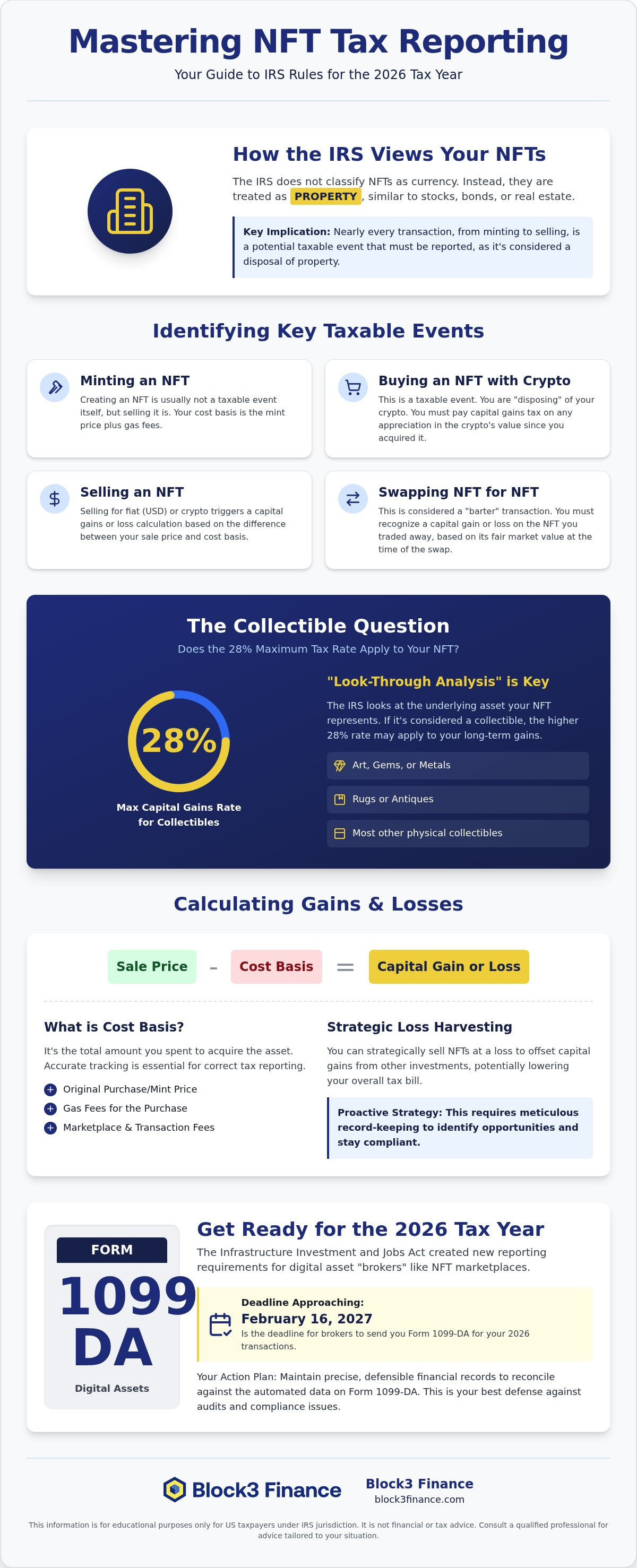
The Internal Revenue Service (IRS) maintains a firm stance on the nature of non-fungible tokens. For US taxpayers, these assets aren't considered legal tender or currency but are instead classified as property. This distinction is fundamental to NFT tax reporting because it subjects every transaction to the same general tax principles that govern real estate or stock sales.
The IRS defines a digital asset as any unique digital representation of value that is recorded on a cryptographically secured distributed ledger. To better understand the technical origins, you can explore what are NFTs and how they function as distinct entries on a blockchain. Because they are unique, the IRS views each transfer as a disposal of property that can trigger immediate tax liabilities.
Under current federal law, every NFT transaction is a potential taxable event. Whether you're minting, swapping, or selling, you're interacting with a regulatory framework that demands precise documentation. The "look-through" rule dictates that the tax treatment of an NFT depends entirely on whether the underlying asset it represents is classified as a collectible under existing tax law.
The Legal Framework for Digital Property
The Infrastructure Investment and Jobs Act of 2021 laid the groundwork for the 2026 reporting standards we see today. This legislation expanded the definition of "brokers" to include entities that facilitate digital asset transfers, which now include various NFT marketplaces. This expansion ensures that the IRS receives more automated data than ever before.
The IRS distinguishes between convertible virtual currency and non-fungible tokens based on their interchangeability. While Bitcoin is fungible, the unique nature of an NFT means its utility dictates its tax treatment. If an NFT provides access to a service or represents a piece of digital art, the IRS evaluates the specific rights granted to the owner when determining the cost basis and gain.
IRS Notice 2023-27 and the Future of NFT Law
IRS Notice 2023-27 signaled a significant shift in how the agency views these assets by introducing the possibility of "collectible" status under Section 1(h)(4). This means that if your NFT represents a work of art, a rug, or a gem, it may be subject to a maximum 28% capital gains rate. This is significantly higher than the standard long-term rates for other digital assets.
The underlying asset determines the tax bracket for the token, which directly impacts your long-term investment strategy for 2026. You must adopt an offensive posture in your financial planning to account for these higher rates. Utilizing professional tax reporting services ensures that your records are defensible and that you aren't caught off guard by these specialized classifications.
Taxable Events: Identifying NFT Income and Capital Gains
Mastery over NFT tax reporting begins with recognizing every interaction as a potential fiscal trigger. The IRS views these assets as property, a stance rooted in foundational guidance like IRS Notice 2014-21. This classification means your digital collectibles are subject to the same rigorous scrutiny as stocks or real estate.
Buying an NFT with cryptocurrency is not a tax-neutral event. You're essentially disposing of your crypto to acquire the token. If your ETH or SOL has increased in value since you originally purchased it, you owe capital gains tax on that appreciation the moment you hit the "buy" button. This creates a "double tax" risk where you may owe money to the IRS even if you haven't converted your gains back into cash.
Selling an NFT for fiat or another digital asset creates a secondary taxable event. Your gain or loss is calculated by subtracting your cost basis from the final sale price. Cost basis is the original purchase price of an asset, including any transaction fees, used to determine your taxable profit. Gas fees, which are the costs paid to network validators to process transactions on the blockchain, are generally added to this basis to help lower your total taxable gain.
Tax Implications for NFT Investors
Calculating your cost basis depends on how you acquired the asset. When you mint an NFT, your basis includes the mint price plus the gas fees paid for the successful transaction. If you buy on a secondary marketplace, your basis is the fair market value of the cryptocurrency used at the time of the trade.
NFT-to-NFT trades are treated as barter transactions. You must determine the fair market value, or the current dollar value of the asset, at the exact time of the swap to report the gain or loss on the asset you traded away. Airdrops, which are tokens or NFTs sent to your wallet for free, are generally taxed as ordinary income based on their value the day they appear in your wallet.
Tax Obligations for Professional NFT Creators
Professional creators face distinct challenges under IRS rules. Initial sales of your work are reported as ordinary income, usually on Schedule C, which is the form used to report business profits. Secondary market royalties, or creator fees, are also treated as ordinary income rather than capital gains.
Distinguishing between a hobbyist and a professional Web3 business is vital for claiming business deductions. You can learn more about our accounting services for creators to ensure your business remains compliant. If your portfolio involves high-volume trades or complex royalties, reach out to an expert strategist to build a defensible record of your activity.
The Collectible Question: Navigating the 28% Tax Rate
Standard capital assets held for more than a year typically benefit from preferential long-term rates between 0% and 20%. The IRS applies a different standard to assets it deems "collectibles," which are subject to a maximum federal tax rate of 28%. This distinction is a critical component of NFT tax reporting for investors seeking to protect their post-tax returns.
The IRS employs a "look-through" analysis to define these assets. If the underlying property the NFT represents is a collectible, the token itself is treated as one for tax purposes. This means the tax treatment is not determined by the token's technical structure but by the nature of the digital or physical asset it signifies.
Strategic holding periods are essential for mitigating high-tax exposure. You must move away from a reactive stance and adopt a philosophy of total command over your acquisition data. By identifying which assets trigger this higher rate early in the year, you can better plan your disposals to optimize your overall tax liability.
When Does an NFT Become a Collectible?
Under IRS criteria, collectibles include items such as art, rugs, antiques, precious metals, gems, and specific stamps or coins. Many profile picture (PFP) projects are categorized as art because their value is derived from their visual and aesthetic qualities. When these tokens are sold, they trigger the 28% rate rather than the lower standard capital gains rates.
Gaming NFTs and utility tokens often occupy a gray area in the tax code. If a token's value is tied strictly to its function within a virtual economy rather than its aesthetic appeal, it might escape the collectible classification. You can find more detailed definitions on the IRS Digital Assets page to help determine where your portfolio stands under current federal law.
Strategies for Long-Term Capital Gains
Holding your assets for at least 366 days is the baseline for qualifying for long-term treatment. Selling before this milestone results in short-term gains, which are taxed as ordinary income at rates that can reach 37%. For high-income earners in 2026, the 28% collectible cap can actually offer a slight reprieve compared to ordinary income brackets, though it remains more expensive than standard capital gains.
Mitigating this high-tax exposure requires a proactive approach to portfolio management. We recommend reviewing your acquisition dates and the specific utility of each asset to build a defensible tax position. You can explore our Definitive Guide to Cryptocurrency Tax Filing to learn how these rates interact with your broader digital asset strategy.
Record Keeping and 2026 Reporting: Form 1099-DA and Beyond
The year 2026 represents a major shift in how the IRS monitors digital asset activity in the United States. For the first time, brokers and marketplaces are required to provide automated data streams directly to the government. This makes precise NFT tax reporting an active requirement rather than a passive suggestion.
Form 1099-DA is the new standard for broker reporting of digital asset sales. Marketplaces such as OpenSea or Blur must now issue these forms to U.S. taxpayers. For the 2026 tax year, the deadline for you to receive your copy of Form 1099-DA is February 16, 2027.
You must reconcile your private on-chain records against these automated IRS filings. Discrepancies between your self-reported data and the broker's 1099-DA can trigger automated flags. While the broker reports the gross proceeds, you remain responsible for calculating and proving your cost basis to ensure you aren't overpaying on your capital gains.
Form 8949 remains the primary vehicle for detailing individual NFT sales and their associated basis. Every unique token disposal must be listed here to provide a clear audit trail. Schedule D then summarizes these detailed entries to calculate your total capital gains or losses for the federal tax year.
The 2026 Reporting Workflow
Establishing a disciplined workflow is the only way to maintain command over a high-volume portfolio. We recommend a four-step process to ensure your records are defensible. This methodical approach eliminates the friction of last-minute filing and reduces the risk of IRS inquiries.
- Step 1: Aggregate data from all Ethereum, Solana, and Layer 2 (L2) wallets into a single source of truth.
- Step 2: Reconcile 1099-DA forms from marketplaces against your internal transaction logs.
- Step 3: Calculate gains using either Specific Identification or the First-In, First-Out (FIFO) method to optimize your tax liability.
- Step 4: File Form 8949 to disclose your cost basis and gross proceeds for every taxable event.
Managing Lost, Stolen, or Worthless NFTs
Claiming a deduction for a "worthless" NFT is notoriously difficult under current IRS rules. The government typically requires a specific, identifiable event that proves the asset has zero value and no prospect of recovery. Simply having a "floor price" of zero on a marketplace is often insufficient proof for a total loss deduction.
Rug pulls and fraudulent projects present a similar challenge on your U.S. tax return. You must maintain rigorous documentation, including etherscan records and project communications, to prove the loss of value. Without this evidence, the IRS may disallow the loss, leaving you with a higher tax bill than necessary.
Turning chaotic on-chain history into clean, defensible financial records requires specialized expertise. You can contact our tax specialists for audit-ready records to protect your wealth. If you need a professional to navigate these new 2026 requirements, reach out to a crypto tax accountant today.
Navigating High-Stakes NFT Portfolios with Block3 Finance
Block3 Finance transforms the friction of volatile on-chain data into the absolute clarity of defensible financial records. We recognize that NFT tax reporting for 2026 requires more than a simple calculation of gains and losses. It demands an offensive strategy built on thirteen years of deep immersion in the blockchain ecosystem.
Our team specializes in the high-stakes environment of high-net-worth portfolios and complex DeFi interactions. We don't just manage your regulations; we empower you to gain total command over your digital wealth. By utilizing proactive tax planning, we help you mitigate the impact of the 28% collectible tax rate and optimize your long-term liability.
Maintaining a grounded and disciplined approach is essential when the IRS increases its automated surveillance. We provide the elite strategizing necessary to resolve the friction between legacy finance and the digital future. Our commitment to best practices ensures that your 2026 filings are both accurate and strategically optimized.
Why Specialized Crypto Accounting Matters
Generic tax software often fails when faced with the nuances of NFT metadata or the complexities of multi-stage minting processes. These tools provide a defensive posture that leaves you vulnerable to IRS scrutiny. Our "Visionary Navigator" approach provides the technical rigor of traditional auditing while maintaining the mindset of a bold innovator.
We build a comprehensive roadmap for thriving in a digital economy that is constantly shifting. This ensures that your records are not just compliant but are strategically organized to support future growth. Our goal is to serve as a calm force in a chaotic industry, providing the intellectual leadership you need to navigate high-stakes environments.
Strategic CFO Services for Web3 Enterprises
Web3 enterprises require a level of financial oversight that goes beyond basic bookkeeping. We provide sophisticated corporate entity structuring for NFT studios and investment funds to ensure maximum tax efficiency. This proactive alignment of your business operations protects your assets and keeps you audit-ready throughout the fiscal year.
Strategic financial leadership is the foundation of any successful digital asset venture. Explore our Fractional CFO Services to learn how we can resolve the friction in your corporate structure. We help you transition from merely observing industry evolution to becoming an active participant in its future.
Total command over your financial landscape is within reach. If you're ready to secure your 2026 compliance with a partner who understands the high-stakes nature of digital assets, reach out to our elite strategy team today. We turn the complexity of the blockchain into a clear path for mastery and growth.
Mastering Your Digital Asset Compliance for 2026 and Beyond
The 2026 tax year demands a transition from reactive record-keeping to a proactive strategy of total command. You've seen how the IRS uses "look-through" analysis to apply the 28% collectible rate and how the new Form 1099-DA creates a transparent data stream for regulators. Success in this high-stakes environment requires more than just meeting deadlines; it requires turning chaotic on-chain history into a strategic advantage.
Effective NFT tax reporting is the foundation of a resilient digital portfolio. By reconciling your private wallet data against broker filings and optimizing your cost basis, you protect your wealth from unnecessary scrutiny. We've helped over 980 global clients navigate these complexities with a "Visionary Navigator" mindset that prioritizes growth and stability.
As a top-ranked provider by Bitcoin.com with over 13 years of blockchain financial expertise, our elite strategists are ready to help you thrive in this evolving landscape. Secure your digital legacy with Block3 Finance's tax specialists to ensure your records are audit-ready and your liability is optimized. You have the power to turn regulatory friction into financial agency.
Frequently Asked Questions
Do I have to pay tax if I just trade one NFT for another?
Yes, the IRS treats an NFT-to-NFT swap as a taxable barter transaction. You're effectively selling one piece of property to acquire another, which requires you to report a capital gain or loss based on the fair market value of the assets at the time of the trade. Failing to account for these swaps is a common pitfall in NFT tax reporting that can lead to unexpected liabilities.
How does the IRS know about my NFT trades if I use a private wallet?
The blockchain is a transparent, public ledger that the IRS monitors using sophisticated data analytics and specialized software. Additionally, for the 2026 tax year, marketplaces are required to issue Form 1099-DA for digital asset sales. This provides the IRS with an automated data stream that links your on-chain activity directly to your tax identity.
Are NFT gas fees tax-deductible for investors?
Investors cannot deduct gas fees as a direct expense, but they can add these costs to the asset's cost basis. By including the gas paid for minting or purchasing in your basis, you reduce the total taxable gain when you eventually sell the token. This strategy is essential for optimizing your tax position and ensuring your records remain defensible.
What is the tax rate for NFTs held longer than one year?
The rate depends on whether the IRS classifies the NFT as a collectible. Standard digital assets held longer than a year qualify for long-term capital gains rates of 0%, 15%, or 20%. However, if an NFT represents a collectible like art or a gem, it's subject to a higher maximum tax rate of 28% under Section 1(h)(4) of the tax code.
Can I use tax-loss harvesting with NFTs that have lost all their value?
You can use tax-loss harvesting, but you must realize the loss through a verifiable transaction. The IRS rarely allows "worthless" deductions for assets still sitting in your wallet. You typically need to sell the NFT, even for a nominal amount, to close the position and use the resulting capital loss to offset other gains in your portfolio.
How do I report NFT royalties as a creator?
Creators report secondary market royalties as ordinary income, typically on Schedule C for professional Web3 businesses. These payments aren't considered capital gains because they're derived from your ongoing work and intellectual property. Accurate NFT tax reporting for creators requires distinguishing these recurring payments from the initial sale of the asset.
What should I do if I didn't receive a Form 1099-DA from my marketplace?
You must report all taxable events regardless of whether you receive a 1099-DA. If a marketplace or broker fails to provide the form by the February 16, 2027, deadline, you are responsible for using your own on-chain records to complete Form 8949. Relying on the absence of a form is not a valid defense during an IRS audit.
Is minting an NFT a taxable event for the creator?
Minting an NFT is generally not a taxable event for the creator. The act of creating a digital asset on the blockchain doesn't trigger a tax liability until you sell or exchange the token. Once the first sale occurs, the proceeds are taxed as ordinary income based on the fair market value of the currency you receive in exchange.

Article by
Mahad Mohamed
Mahad Mohamed is an accountant and the CEO of Block3 Finance, with over 26+ years of Canadian and international tax and accounting experience. A crypto accounting specialist since the early days of Bitcoin, he has consulted for over 38 crypto companies and collaborated with legal professionals on regulatory matters. His expertise spans corporate reorganization, cross-border tax structuring (Canada & US), tax disputes, and CRA audits.
Previously, Mahad worked for the Canada Revenue Agency (CRA), Big4 accounting firms, and served as a Rulings Officer for the Federal Tax Authority of the UAE before acquiring Tax Partners in 2014.
Block3 Finance and Tax Partners has 44 full-time accountants and over 9,800+ clients.
Disclaimer
This article provides general information only and is current as of its publication date. It has not been updated and may be out of date. It does not constitute legal advice and should not be relied upon as such. Every tax situation is unique and may differ from the examples discussed in this article. If you have specific questions, you should seek the advice of our accountants for your unique circumstances.
Frequently Asked Questions
When Does an NFT Become a Collectible?
Under IRS criteria, collectibles include items such as art, rugs, antiques, precious metals, gems, and specific stamps or coins. Many profile picture (PFP) projects are categorized as art because their value is derived from their visual and aesthetic qualities. When these tokens are sold, they trigger the 28% rate rather than the lower standard capital gains rates. Gaming NFTs and utility tokens often occupy a gray area in the tax code. If a token's value is tied strictly to its function within a virtual economy rather than its aesthetic appeal, it might escape the collectible classification. You can find more detailed definitions on the IRS Digital Assets page to help determine where your portfolio stands under current federal law.
Do I have to pay tax if I just trade one NFT for another?
Yes, the IRS treats an NFT-to-NFT swap as a taxable barter transaction. You're effectively selling one piece of property to acquire another, which requires you to report a capital gain or loss based on the fair market value of the assets at the time of the trade. Failing to account for these swaps is a common pitfall in NFT tax reporting that can lead to unexpected liabilities.
How does the IRS know about my NFT trades if I use a private wallet?
The blockchain is a transparent, public ledger that the IRS monitors using sophisticated data analytics and specialized software. Additionally, for the 2026 tax year, marketplaces are required to issue Form 1099-DA for digital asset sales. This provides the IRS with an automated data stream that links your on-chain activity directly to your tax identity.
Are NFT gas fees tax-deductible for investors?
Investors cannot deduct gas fees as a direct expense, but they can add these costs to the asset's cost basis. By including the gas paid for minting or purchasing in your basis, you reduce the total taxable gain when you eventually sell the token. This strategy is essential for optimizing your tax position and ensuring your records remain defensible.
What is the tax rate for NFTs held longer than one year?
The rate depends on whether the IRS classifies the NFT as a collectible. Standard digital assets held longer than a year qualify for long-term capital gains rates of 0%, 15%, or 20%. However, if an NFT represents a collectible like art or a gem, it's subject to a higher maximum tax rate of 28% under Section 1(h)(4) of the tax code.
Can I use tax-loss harvesting with NFTs that have lost all their value?
You can use tax-loss harvesting, but you must realize the loss through a verifiable transaction. The IRS rarely allows "worthless" deductions for assets still sitting in your wallet. You typically need to sell the NFT, even for a nominal amount, to close the position and use the resulting capital loss to offset other gains in your portfolio.
How do I report NFT royalties as a creator?
Creators report secondary market royalties as ordinary income, typically on Schedule C for professional Web3 businesses. These payments aren't considered capital gains because they're derived from your ongoing work and intellectual property. Accurate NFT tax reporting for creators requires distinguishing these recurring payments from the initial sale of the asset.
What should I do if I didn't receive a Form 1099-DA from my marketplace?
You must report all taxable events regardless of whether you receive a 1099-DA. If a marketplace or broker fails to provide the form by the February 16, 2027, deadline, you are responsible for using your own on-chain records to complete Form 8949. Relying on the absence of a form is not a valid defense during an IRS audit.
Is minting an NFT a taxable event for the creator?
Minting an NFT is generally not a taxable event for the creator. The act of creating a digital asset on the blockchain doesn't trigger a tax liability until you sell or exchange the token. Once the first sale occurs, the proceeds are taxed as ordinary income based on the fair market value of the currency you receive in exchange.