
What if the CRA already knows about your undisclosed digital assets through AI-driven blockchain analytics before you even open your tax software? Many Canadian investors wonder what happens if i dont file crypto, often assuming the decentralized nature of the blockchain provides a permanent shield against federal oversight. It's common to feel a sense of anxiety as the April 30, 2026, deadline approaches; the fear of a sudden audit or the confusion between capital gains and business income can be paralyzing for even the most seasoned traders.
We're here to help you move from a defensive posture to one of total command over your financial landscape. You'll understand the specific financial penalties, audit risks, and legal consequences of failing to report cryptocurrency to the CRA, and learn how to rectify past omissions. This guide explores how the CRA currently flags transactions over $10,000 and the impact of the new global information sharing frameworks. We'll also detail the Voluntary Disclosures Program, a vital mechanism that offers a strategic second chance to correct your records and mitigate interest charges before the CRA's dedicated crypto audit teams intervene.
Key Takeaways
- Clarify the CRA's classification of cryptocurrency as a commodity and how the 2026 'Digital Asset' definitions impact your specific filing obligations under the Income Tax Act.
- Identify the immediate financial consequences and understand exactly what happens if i dont file crypto, including the 5% late-filing penalty and compounding monthly interest.
- Discover the mechanisms the CRA uses to track digital assets, including their power to compel KYC data from Canadian exchanges and third-party service providers.
- Learn how to utilize the Voluntary Disclosures Program (VDP) as a proactive "second chance" to correct past reporting errors and mitigate the risk of criminal prosecution.
- Recognize why professional crypto accounting is essential for navigating the complexities of DeFi and NFT transactions while maintaining audit-ready financial records.
Does the CRA Require You to Report Cryptocurrency?
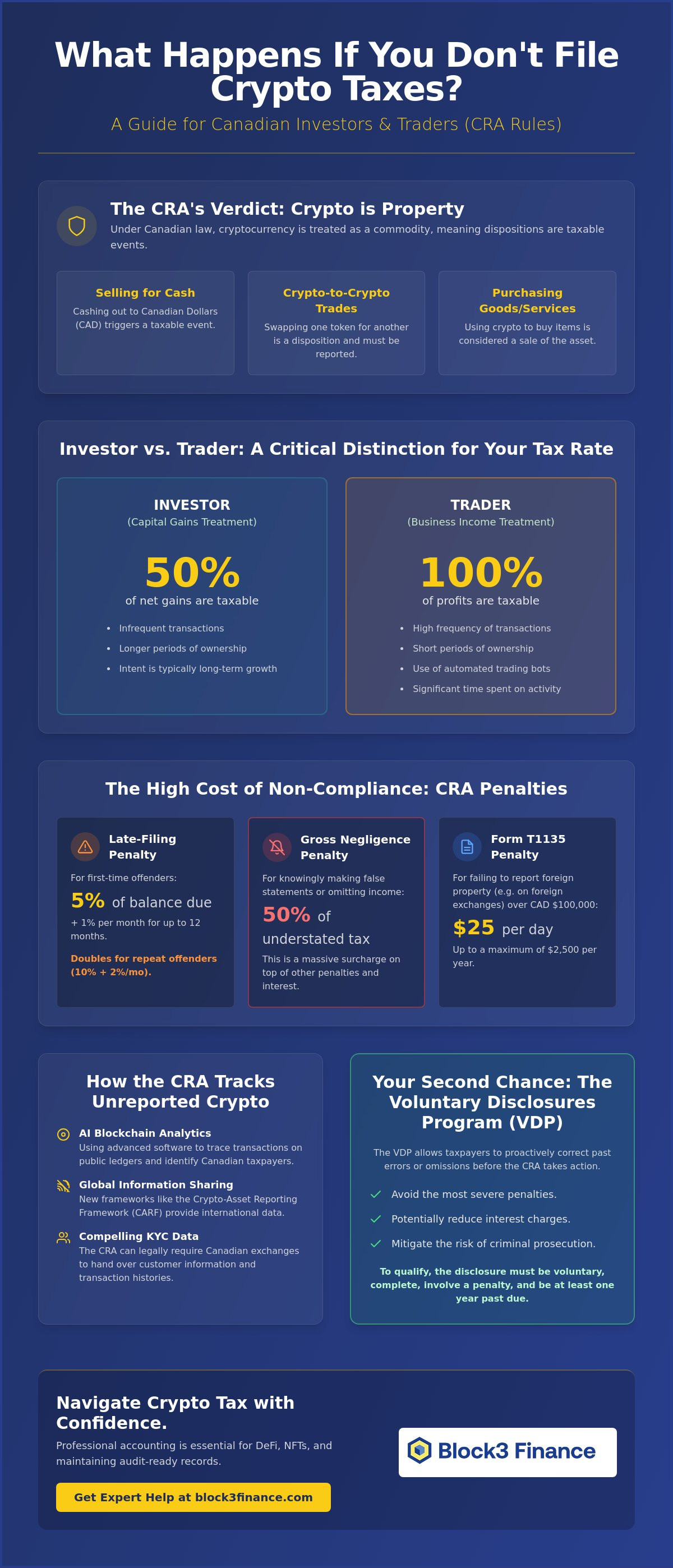
The Canada Revenue Agency (CRA) maintains a definitive stance: cryptocurrency is a commodity, not legal tender. This classification dictates that any transaction involving digital assets follows the rules of barter transactions. For the 2026 tax year, the definition of a "Digital Asset" under the Income Tax Act has been refined to encompass a broad range of cryptographic tokens, including stablecoins, governance tokens, and wrapped assets. This update ensures that the tax base remains comprehensive as the ecosystem evolves. Every time you dispose of these assets, whether by selling for CAD, purchasing goods, or swapping one token for another, you trigger a taxable event. Many Canadians mistakenly believe that staying within the crypto ecosystem avoids taxation; however, crypto-to-crypto trades are considered a disposition at fair market value.
Determining Your Tax Status: Investor vs. Trader
The distinction between capital gains and business income is the most critical factor in your total tax liability. For most individuals, 50% of net capital gains are included in taxable income. If your activities are classified as "carrying on a business," 100% of the profits become taxable. The CRA evaluates several criteria to make this determination, including the frequency of your transactions, the period of ownership, your level of specialized knowledge, and the clear intent to profit. For instance, if you use sophisticated trading bots or spend several hours daily managing positions, the agency is more likely to view your activity as a business. This classification drastically changes your tax liability, potentially doubling the amount of tax you owe compared to capital gains treatment. Professional Tax Filing and Reporting is essential for ensuring your activity is categorized correctly before an auditor intervenes.
The 'Question' on Your T1 Return
Transparency is no longer optional. When completing your T1 return, you must report capital gains or losses on Schedule 3. A significant risk involves the T1135 form, also known as the Foreign Income Verification Statement. If the total cost of your specified foreign property, which includes crypto held on foreign exchanges or in certain foreign wallets, exceeds CAD $100,000 at any point during the year, you must file this form. Failing to do so can result in a penalty of $25 per day, up to a maximum of $2,500 per year. When taxpayers ask what happens if i dont file crypto, they often overlook these specific administrative traps. Checking "No" to the foreign asset question when you hold significant balances abroad is a dangerous move that signals intentional non-compliance to the authorities, often triggering a deeper investigation into your entire financial history.
The Financial Penalties for Failing to File Crypto Taxes
The CRA doesn't just ask for compliance; it enforces it through a rigid structure of financial deterrents. If you miss the April 30 deadline, the late-filing penalty starts at 5% of your balance owing. This isn't a one-time fee. For every full month your return remains outstanding, the agency adds another 1% for up to 12 months. Repeated failures trigger escalating consequences. If the CRA has already applied a late-filing penalty in any of the three previous tax years, the base penalty jumps from 5% to 10%. Additionally, the monthly accrual increases from 1% to 2% for up to 20 months. This aggressive scaling is designed to penalize habitual non-compliance and ensure that the cost of ignoring the law far outweighs the perceived benefit of tax secrecy.
When taxpayers ask what happens if i dont file crypto, they often underestimate the severity of gross negligence penalties. If the CRA determines you knowingly made a false statement or omitted income, they can apply a penalty equal to 50% of the understated tax or $100, whichever is greater. This is a massive surcharge that quickly erases any gains made from trading. Investors are increasingly being Targeted with Audits specifically to identify these discrepancies. These audits often look back several years, meaning a single mistake can have a long-lasting financial impact.
Compound Interest: The Hidden Cost of Waiting
Arrears interest, which is the interest charged on outstanding tax balances, is the silent killer of crypto portfolios. The CRA charges a prescribed interest rate on all balances owing, which compounds daily from the original due date. This interest applies even if you didn't know you owed taxes. By 2026, multi-year omissions could see a principal tax bill grow significantly. A debt that seemed manageable five years ago can easily double when interest and late fees are layered on top. This interest is not tax-deductible, making it a pure loss for the taxpayer.
Civil vs. Criminal Penalties
It's vital to distinguish between tax avoidance and tax evasion. Tax avoidance involves using legal means to minimize liability, while tax evasion is the deliberate misrepresentation of facts. Under the Income Tax Act, evasion is a criminal offense. If convicted, you could face fines up to 200% of the taxes evaded and potential prison sentences. The CRA often looks for 'willful blindness,' where an investor intentionally ignores their reporting requirements to avoid knowing the truth. Understanding what happens if i dont file crypto is the first step in avoiding the transition from a civil dispute to a criminal investigation. If you're concerned about your historical filings, speaking with a crypto tax specialist can help you identify a path toward compliance.
How the CRA Tracks Unreported Crypto Activity
The assumption that the blockchain serves as an impenetrable veil of anonymity is a dangerous fallacy in the current regulatory environment. The CRA utilizes Section 231.2 of the Income Tax Act to compel data from third parties, including major Canadian exchanges such as Coinsquare and Bitbuy. Through "Unnamed Persons" requirements, the agency obtains comprehensive lists of high-volume traders, effectively deanonymizing thousands of accounts in a single legal action. If you are wondering what happens if i dont file crypto, remember that these legal requirements have already been successfully used to harvest data on thousands of Canadian users, linking their off-chain identities to their on-chain movements.
Beyond exchange data, the agency employs sophisticated blockchain forensics software to trace movements across decentralized protocols. These tools analyze public ledger data to link "private" wallets to known identities by identifying patterns in on-chain behavior. The integration of artificial intelligence into these audit processes allows the CRA to flag discrepancies between reported income and actual digital asset activity with surgical precision. This proactive stance shifts the burden of proof onto the taxpayer. When individuals ask what happens if i dont file crypto, they often fail to realize that the CRA likely already possesses their transaction history before the tax season even begins.
Bank Account Monitoring and Anti-Money Laundering (AML)
Financial institutions act as the first line of observation for the federal government. FINTRAC (Financial Transactions and Reports Analysis Centre of Canada) requires banks and money services businesses to report any transaction exceeding $10,000. These reports create a permanent trail of fiat on-ramps and off-ramps that the CRA cross-references during "lifestyle audits." If your visible wealth or bank deposits don't align with your reported annual income, the agency will investigate the source of those funds. They look for the friction between your reported lifestyle and your actual liquidity.
International Information Sharing
The reach of the CRA extends far beyond Canadian borders through the expansion of the Common Reporting Standard (CRS) and the implementation of the Crypto-Asset Reporting Framework (CARF). Starting with the 2026 tax year, this international agreement facilitates the automatic exchange of information between global tax authorities. This means that assets held on foreign exchanges are no longer hidden from domestic oversight. The resolution of these data gaps makes global compliance inevitable. If you are concerned about potential discrepancies in your history, it's vital to get your books audit-ready with our specialized services before the CRA initiates contact.
The Voluntary Disclosures Program (VDP): Your Second Chance
If the CRA's advanced tracking capabilities have left you anxious about what happens if i dont file crypto, the Voluntary Disclosures Program (VDP) offers a formal, strategic pathway to resolution. This program isn't a simple amendment to a previous return; it is a specialized application that allows taxpayers to come forward and correct historical omissions before the agency initiates an audit or enforcement action. By successfully navigating the VDP, you can secure a waiver of criminal prosecution and potentially receive relief from gross negligence penalties and a portion of the arrears interest. It transforms a potentially ruinous liability into a structured compliance exercise, giving you total command over your financial standing once again.
For those hesitant to reveal their identity immediately, the "No-Name" disclosure process provides a layer of preliminary protection. This allows you to seek advice on how the program might apply to your specific digital asset activity without disclosing your name or social insurance number. This is a critical tactical advantage for investors with complex DeFi or NFT histories who need to understand their exposure before committing to a full disclosure. It allows for a measured, intellectual approach to compliance in a volatile regulatory landscape.
The Four Pillars of a Valid Disclosure
The CRA does not grant relief to every applicant. To qualify for the VDP, your disclosure must meet four strict criteria. First, it must be voluntary; if the CRA has already contacted you regarding your crypto activity or started a "lifestyle audit," your window of opportunity has closed. Second, it must be complete. You cannot cherry-pick specific profitable years or report only certain tokens while omitting others. Third, the omission must involve a potential penalty. Finally, the information must be past due, which generally means the return or information must be at least one year late. Failing to meet even one of these pillars results in a rejected application, leaving you exposed to the full weight of the financial penalties described in previous sections.
The Application Process for Crypto Filers
Precision is the primary requirement for a successful VDP submission. The process begins with a comprehensive reconstruction of all on-chain activity across every wallet, protocol, and exchange used during the non-compliant years. This involves calculating the adjusted cost base for every trade and identifying every taxable disposition at fair market value. Once this data is meticulously verified, you must submit Form RC199, the Voluntary Disclosures Program Application, to the CRA. A critical move to demonstrate good faith is paying the estimated tax owing immediately upon submission. This proactive payment signals to the agency that you're committed to rectifying your status and resolving the friction in your tax history. If you're ready to secure your financial future and resolve historical omissions, reach out to our specialized crypto tax team today.
Mastering Compliance with Professional Crypto Accounting
Traditional accounting methods often crumble under the weight of modern blockchain activity. Relying on manual spreadsheets for high-volume DeFi protocols or NFT mints is a recipe for systemic failure. These manual processes are prone to human error and lack the technical rigor required to survive a federal investigation. When investors ask what happens if i dont file crypto, they must also consider the risks of filing incorrectly due to fragmented data. Block3 Finance specializes in resolving this friction by transforming chaotic on-chain data into tax-ready books that meet the highest standards of the Crypto Tax Accountant profession. We ensure every transaction is captured, classified, and compliant with current CRA frameworks.
The decentralized landscape moves faster than traditional reporting cycles. We act as a bridge between your digital activity and the requirements of the Canadian tax system, providing clarity where there is typically confusion. By implementing professional-grade software and specialized methodologies, we eliminate the guesswork that leads to audit triggers. Our goal is to move you from a defensive posture to one of total command, where your records are as sophisticated as the assets you hold.
Audit-Proofing Your Digital Portfolio
A defensible financial record is your strongest shield against CRA scrutiny. We establish a permanent audit trail for every transaction, ensuring that every movement of capital is accounted for with precision. This level of detail is vital when handling complex scenarios like lost private keys, protocol hacks, or bridge transactions between disparate chains. Without a clear narrative supported by data, the CRA may categorize these events as taxable dispositions rather than losses, leading to an inflated tax bill. To maintain total command over your records, learn about our Monthly Accounting and Bookkeeping services. We don't just record data; we cultivate an environment of transparency that protects your wealth from aggressive enforcement actions.
Strategic Tax Leadership for Web3
The evolution from an individual trader to a sophisticated corporate entity requires more than just basic filing. Our Fractional CFO Services provide the strategic oversight necessary to navigate corporate structuring and long-term financial planning. As your portfolio grows, the complexity of your obligations under the Income Tax Act increases proportionally. We help you transition into a corporate structure that optimizes your tax position while maintaining rigorous compliance. This proactive methodology shifts the narrative from managing regulations to mastering growth. If you're struggling with historical omissions, contact Block3 Finance today to resolve your crypto tax backlog and secure your standing in the digital economy.
Take Command of Your Digital Tax Strategy
The landscape of Canadian digital asset taxation has shifted from a period of relative obscurity to one of absolute transparency. Understanding what happens if i dont file crypto is no longer a theoretical exercise; it's a necessary step in protecting your portfolio from escalating 2026 penalties and daily compounding interest. The CRA now possesses the analytical tools to deanonymize the blockchain, yet they also offer a structured path toward resolution through the Voluntary Disclosures Program. Inaction only compounds the risks, while proactive reporting secures your standing in the digital economy.
As a top-ranked crypto tax firm by Bitcoin.com with over 13 years of specialized blockchain financial expertise, Block3 Finance has helped 980+ clients globally navigate these high-stakes environments. We provide the technical rigor required to transform fragmented transaction histories into defensible records, ensuring you maintain total agency over your wealth. Secure your financial future with expert CRA crypto tax filing. You don't have to navigate this volatile landscape alone; the right partnership turns complex compliance into a foundation for your future growth.
Frequently Asked Questions
Is crypto tax-free in Canada if I don't cash out to a bank?
No, cryptocurrency is not tax-free simply because it remains within a digital wallet. The CRA views any exchange of a digital asset as a taxable disposition at its fair market value in Canadian dollars. This includes swapping one token for another or using crypto to purchase goods. Staying on-chain doesn't defer your liability; every trade requires precise reporting to avoid the compounding interest that occurs when you don't file crypto.
Can the CRA see my trades on decentralized exchanges like Uniswap?
Yes, the CRA can effectively track decentralized activity through advanced blockchain analytics and forensics. While DEXs like Uniswap don't collect KYC data, the agency traces the flow of funds from centralized on-ramps to your private wallets. By deanonymizing the ledger, they link your identity to your on-chain behavior. Relying on the perceived anonymity of DeFi is a high-risk strategy that often leads to targeted audits.
What if I lost money on crypto? Do I still have to file?
Filing is mandatory even if you've experienced a net loss. Reporting these losses on your T1 return allows you to establish a capital loss balance, which can be used to offset future capital gains. Without a formal filing, you lose the ability to carry these losses forward or back three years. Maintaining a clean record of losses is a strategic move that protects your future liquidity and ensures long-term compliance.
How many years back can the CRA audit my cryptocurrency transactions?
The CRA typically audits within a three-year window from the date of your initial assessment. However, this limitation disappears if the agency suspects fraud or gross negligence. In cases of misrepresentation, they can look back indefinitely to reconstruct your financial history. Given the permanence of the blockchain, your 2026 transactions remain visible and auditable for a decade or more, making historical accuracy a non-negotiable requirement.
Does Coinbase or Binance report my information to the CRA?
Major exchanges operating in Canada are legally required to comply with CRA data requests. Under Section 231.2 of the Income Tax Act, the agency has already compelled platforms to hand over detailed user records. With the implementation of the Crypto-Asset Reporting Framework in 2026, international exchanges will also begin sharing data automatically with the CRA, ensuring that foreign holdings are no longer invisible to domestic authorities.
What should I do if I received a 'matching' letter from the CRA?
You must treat a matching letter as a formal warning that the CRA has identified a discrepancy in your reporting. This usually occurs when the income you reported doesn't match the data they received from exchanges or financial institutions. You should immediately reconstruct your transaction history to identify the error. Responding with a professional, data-backed explanation is the only way to resolve the friction before it escalates into a full-scale audit.
Can I go to jail for not reporting crypto in Canada?
Criminal prosecution and potential jail time are real consequences for tax evasion in Canada. While simple errors usually result in financial penalties, the deliberate concealment of assets or falsification of records is a criminal offense. Convictions can lead to prison sentences and fines reaching 200% of the taxes evaded. Moving from a defensive posture to total transparency is the only way to eliminate the risk of criminal liability.
Is there a minimum amount of crypto profit that is tax-exempt?
There is no minimum threshold or tax-exempt amount for cryptocurrency profits in Canada. Every cent of gain realized from a disposition is subject to taxation under CRA rules. Unlike some foreign jurisdictions that offer small exemptions for personal use, the Canadian framework requires you to report all activity regardless of the dollar amount. Even small trades contribute to your total tax liability and must be included in your annual filing.

Article by
Mahad Mohamed
Mahad Mohamed is an accountant and the CEO of Block3 Finance, with over 26+ years of Canadian and international tax and accounting experience. A crypto accounting specialist since the early days of Bitcoin, he has consulted for over 38 crypto companies and collaborated with legal professionals on regulatory matters. His expertise spans corporate reorganization, cross-border tax structuring (Canada & US), tax disputes, and CRA audits.
Previously, Mahad worked for the Canada Revenue Agency (CRA), Big4 accounting firms, and served as a Rulings Officer for the Federal Tax Authority of the UAE before acquiring Tax Partners in 2014.
Block3 Finance and Tax Partners has 44 full-time accountants and over 9,800+ clients.
Disclaimer
This article provides general information only and is current as of its publication date. It has not been updated and may be out of date. It does not constitute legal advice and should not be relied upon as such. Every tax situation is unique and may differ from the examples discussed in this article. If you have specific questions, you should seek the advice of our accountants for your unique circumstances.
Frequently Asked Questions
Determining Your Tax Status: Investor vs. Trader
The distinction between capital gains and business income is the most critical factor in your total tax liability. For most individuals, 50% of net capital gains are included in taxable income. If your activities are classified as "carrying on a business," 100% of the profits become taxable. The CRA evaluates several criteria to make this determination, including the frequency of your transactions, the period of ownership, your level of specialized knowledge, and the clear intent to profit. For instance, if you use sophisticated trading bots or spend several hours daily managing positions, the agency is more likely to view your activity as a business. This classification drastically changes your tax liability, potentially doubling the amount of tax you owe compared to capital gains treatment. Professional Tax Filing and Reporting is essential for ensuring your activity is categorized correctly before an auditor intervenes.
The 'Question' on Your T1 Return
Transparency is no longer optional. When completing your T1 return, you must report capital gains or losses on Schedule 3. A significant risk involves the T1135 form, also known as the Foreign Income Verification Statement. If the total cost of your specified foreign property, which includes crypto held on foreign exchanges or in certain foreign wallets, exceeds CAD $100,000 at any point during the year, you must file this form. Failing to do so can result in a penalty of $25 per day, up to a maximum of $2,500 per year. When taxpayers ask what happens if i dont file crypto, they often overlook these specific administrative traps. Checking "No" to the foreign asset question when you hold significant balances abroad is a dangerous move that signals intentional non-compliance to the authorities, often triggering a deeper investigation into your entire financial history. The CRA doesn't just ask for compliance; it enforces it through a rigid structure of financial deterrents. If you miss the April 30 deadline, the late-filing penalty starts at 5% of your balance owing. This isn't a one-time fee. For every full month your return remains outstanding, the agency adds another 1% for up to 12 months. Repeated failures trigger escalating consequences. If the CRA has already applied a late-filing penalty in any of the three previous tax years, the base penalty jumps from 5% to 10%. Additionally, the monthly accrual increases from 1% to 2% for up to 20 months. This aggressive scaling is designed to penalize habitual non-compliance and ensure that the cost of ignoring the law far outweighs the perceived benefit of tax secrecy. When taxpayers ask what happens if i dont file crypto, they often underestimate the severity of gross negligence penalties. If the CRA determines you knowingly made a false statement or omitted income, they can apply a penalty equal to 50% of the understated tax or $100, whichever is greater. This is a massive surcharge that quickly erases any gains made from trading. Investors are increasingly being Targeted with Audits specifically to identify these discrepancies. These audits often look back several years, meaning a single mistake can have a long-lasting financial impact.
Compound Interest: The Hidden Cost of Waiting
Arrears interest, which is the interest charged on outstanding tax balances, is the silent killer of crypto portfolios. The CRA charges a prescribed interest rate on all balances owing, which compounds daily from the original due date. This interest applies even if you didn't know you owed taxes. By 2026, multi-year omissions could see a principal tax bill grow significantly. A debt that seemed manageable five years ago can easily double when interest and late fees are layered on top. This interest is not tax-deductible, making it a pure loss for the taxpayer.
Civil vs. Criminal Penalties
It's vital to distinguish between tax avoidance and tax evasion. Tax avoidance involves using legal means to minimize liability, while tax evasion is the deliberate misrepresentation of facts. Under the Income Tax Act, evasion is a criminal offense. If convicted, you could face fines up to 200% of the taxes evaded and potential prison sentences. The CRA often looks for 'willful blindness,' where an investor intentionally ignores their reporting requirements to avoid knowing the truth. Understanding what happens if i dont file crypto is the first step in avoiding the transition from a civil dispute to a criminal investigation. If you're concerned about your historical filings, speaking with a crypto tax specialist can help you identify a path toward compliance. The assumption that the blockchain serves as an impenetrable veil of anonymity is a dangerous fallacy in the current regulatory environment. The CRA utilizes Section 231.2 of the Income Tax Act to compel data from third parties, including major Canadian exchanges such as Coinsquare and Bitbuy. Through "Unnamed Persons" requirements, the agency obtains comprehensive lists of high-volume traders, effectively deanonymizing thousands of accounts in a single legal action. If you are wondering what happens if i dont file crypto, remember that these legal requirements have already been successfully used to harvest data on thousands of Canadian users, linking their off-chain identities to their on-chain movements. Beyond exchange data, the agency employs sophisticated blockchain forensics software to trace movements across decentralized protocols. These tools analyze public ledger data to link "private" wallets to known identities by identifying patterns in on-chain behavior. The integration of artificial intelligence into these audit processes allows the CRA to flag discrepancies between reported income and actual digital asset activity with surgical precision. This proactive stance shifts the burden of proof onto the taxpayer. When individuals ask what happens if i dont file crypto, they often fail to realize that the CRA likely already possesses their transaction history before the tax season even begins.
Bank Account Monitoring and Anti-Money Laundering (AML)
Financial institutions act as the first line of observation for the federal government. FINTRAC (Financial Transactions and Reports Analysis Centre of Canada) requires banks and money services businesses to report any transaction exceeding $10,000. These reports create a permanent trail of fiat on-ramps and off-ramps that the CRA cross-references during "lifestyle audits." If your visible wealth or bank deposits don't align with your reported annual income, the agency will investigate the source of those funds. They look for the friction between your reported lifestyle and your actual liquidity.
International Information Sharing
The reach of the CRA extends far beyond Canadian borders through the expansion of the Common Reporting Standard (CRS) and the implementation of the Crypto-Asset Reporting Framework (CARF). Starting with the 2026 tax year, this international agreement facilitates the automatic exchange of information between global tax authorities. This means that assets held on foreign exchanges are no longer hidden from domestic oversight. The resolution of these data gaps makes global compliance inevitable. If you are concerned about potential discrepancies in your history, it's vital to get your books audit-ready with our specialized services before the CRA initiates contact. If the CRA's advanced tracking capabilities have left you anxious about what happens if i dont file crypto, the Voluntary Disclosures Program (VDP) offers a formal, strategic pathway to resolution. This program isn't a simple amendment to a previous return; it is a specialized application that allows taxpayers to come forward and correct historical omissions before the agency initiates an audit or enforcement action. By successfully navigating the VDP, you can secure a waiver of criminal prosecution and potentially receive relief from gross negligence penalties and a portion of the arrears interest. It transforms a potentially ruinous liability into a structured compliance exercise, giving you total command over your financial standing once again. For those hesitant to reveal their identity immediately, the "No-Name" disclosure process provides a layer of preliminary protection. This allows you to seek advice on how the program might apply to your specific digital asset activity without disclosing your name or social insurance number. This is a critical tactical advantage for investors with complex DeFi or NFT histories who need to understand their exposure before committing to a full disclosure. It allows for a measured, intellectual approach to compliance in a volatile regulatory landscape.
The Four Pillars of a Valid Disclosure
The CRA does not grant relief to every applicant. To qualify for the VDP, your disclosure must meet four strict criteria. First, it must be voluntary; if the CRA has already contacted you regarding your crypto activity or started a "lifestyle audit," your window of opportunity has closed. Second, it must be complete. You cannot cherry-pick specific profitable years or report only certain tokens while omitting others. Third, the omission must involve a potential penalty. Finally, the information must be past due, which generally means the return or information must be at least one year late. Failing to meet even one of these pillars results in a rejected application, leaving you exposed to the full weight of the financial penalties described in previous sections.
The Application Process for Crypto Filers
Precision is the primary requirement for a successful VDP submission. The process begins with a comprehensive reconstruction of all on-chain activity across every wallet, protocol, and exchange used during the non-compliant years. This involves calculating the adjusted cost base for every trade and identifying every taxable disposition at fair market value. Once this data is meticulously verified, you must submit Form RC199, the Voluntary Disclosures Program Application, to the CRA. A critical move to demonstrate good faith is paying the estimated tax owing immediately upon submission. This proactive payment signals to the agency that you're committed to rectifying your status and resolving the friction in your tax history. If you're ready to secure your financial future and resolve historical omissions, reach out to our specialized crypto tax team today. Traditional accounting methods often crumble under the weight of modern blockchain activity. Relying on manual spreadsheets for high-volume DeFi protocols or NFT mints is a recipe for systemic failure. These manual processes are prone to human error and lack the technical rigor required to survive a federal investigation. When investors ask what happens if i dont file crypto, they must also consider the risks of filing incorrectly due to fragmented data. Block3 Finance specializes in resolving this friction by transforming chaotic on-chain data into tax-ready books that meet the highest standards of the Crypto Tax Accountant profession. We ensure every transaction is captured, classified, and compliant with current CRA frameworks. The decentralized landscape moves faster than traditional reporting cycles. We act as a bridge between your digital activity and the requirements of the Canadian tax system, providing clarity where there is typically confusion. By implementing professional-grade software and specialized methodologies, we eliminate the guesswork that leads to audit triggers. Our goal is to move you from a defensive posture to one of total command, where your records are as sophisticated as the assets you hold.
Audit-Proofing Your Digital Portfolio
A defensible financial record is your strongest shield against CRA scrutiny. We establish a permanent audit trail for every transaction, ensuring that every movement of capital is accounted for with precision. This level of detail is vital when handling complex scenarios like lost private keys, protocol hacks, or bridge transactions between disparate chains. Without a clear narrative supported by data, the CRA may categorize these events as taxable dispositions rather than losses, leading to an inflated tax bill. To maintain total command over your records, learn about our Monthly Accounting and Bookkeeping services. We don't just record data; we cultivate an environment of transparency that protects your wealth from aggressive enforcement actions.
Strategic Tax Leadership for Web3
The evolution from an individual trader to a sophisticated corporate entity requires more than just basic filing. Our Fractional CFO Services provide the strategic oversight necessary to navigate corporate structuring and long-term financial planning. As your portfolio grows, the complexity of your obligations under the Income Tax Act increases proportionally. We help you transition into a corporate structure that optimizes your tax position while maintaining rigorous compliance. This proactive methodology shifts the narrative from managing regulations to mastering growth. If you're struggling with historical omissions, contact Block3 Finance today to resolve your crypto tax backlog and secure your standing in the digital economy. The landscape of Canadian digital asset taxation has shifted from a period of relative obscurity to one of absolute transparency. Understanding what happens if i dont file crypto is no longer a theoretical exercise; it's a necessary step in protecting your portfolio from escalating 2026 penalties and daily compounding interest. The CRA now possesses the analytical tools to deanonymize the blockchain, yet they also offer a structured path toward resolution through the Voluntary Disclosures Program. Inaction only compounds the risks, while proactive reporting secures your standing in the digital economy. As a top-ranked crypto tax firm by Bitcoin.com with over 13 years of specialized blockchain financial expertise, Block3 Finance has helped 980+ clients globally navigate these high-stakes environments. We provide the technical rigor required to transform fragmented transaction histories into defensible records, ensuring you maintain total agency over your wealth. Secure your financial future with expert CRA crypto tax filing. You don't have to navigate this volatile landscape alone; the right partnership turns complex compliance into a foundation for your future growth.
Is crypto tax-free in Canada if I don't cash out to a bank?
No, cryptocurrency is not tax-free simply because it remains within a digital wallet. The CRA views any exchange of a digital asset as a taxable disposition at its fair market value in Canadian dollars. This includes swapping one token for another or using crypto to purchase goods. Staying on-chain doesn't defer your liability; every trade requires precise reporting to avoid the compounding interest that occurs when you don't file crypto.
Can the CRA see my trades on decentralized exchanges like Uniswap?
Yes, the CRA can effectively track decentralized activity through advanced blockchain analytics and forensics. While DEXs like Uniswap don't collect KYC data, the agency traces the flow of funds from centralized on-ramps to your private wallets. By deanonymizing the ledger, they link your identity to your on-chain behavior. Relying on the perceived anonymity of DeFi is a high-risk strategy that often leads to targeted audits.
What if I lost money on crypto? Do I still have to file?
Filing is mandatory even if you've experienced a net loss. Reporting these losses on your T1 return allows you to establish a capital loss balance, which can be used to offset future capital gains. Without a formal filing, you lose the ability to carry these losses forward or back three years. Maintaining a clean record of losses is a strategic move that protects your future liquidity and ensures long-term compliance.
How many years back can the CRA audit my cryptocurrency transactions?
The CRA typically audits within a three-year window from the date of your initial assessment. However, this limitation disappears if the agency suspects fraud or gross negligence. In cases of misrepresentation, they can look back indefinitely to reconstruct your financial history. Given the permanence of the blockchain, your 2026 transactions remain visible and auditable for a decade or more, making historical accuracy a non-negotiable requirement.
Does Coinbase or Binance report my information to the CRA?
Major exchanges operating in Canada are legally required to comply with CRA data requests. Under Section 231.2 of the Income Tax Act, the agency has already compelled platforms to hand over detailed user records. With the implementation of the Crypto-Asset Reporting Framework in 2026, international exchanges will also begin sharing data automatically with the CRA, ensuring that foreign holdings are no longer invisible to domestic authorities.
What should I do if I received a 'matching' letter from the CRA?
You must treat a matching letter as a formal warning that the CRA has identified a discrepancy in your reporting. This usually occurs when the income you reported doesn't match the data they received from exchanges or financial institutions. You should immediately reconstruct your transaction history to identify the error. Responding with a professional, data-backed explanation is the only way to resolve the friction before it escalates into a full-scale audit.
Can I go to jail for not reporting crypto in Canada?
Criminal prosecution and potential jail time are real consequences for tax evasion in Canada. While simple errors usually result in financial penalties, the deliberate concealment of assets or falsification of records is a criminal offense. Convictions can lead to prison sentences and fines reaching 200% of the taxes evaded. Moving from a defensive posture to total transparency is the only way to eliminate the risk of criminal liability.
Is there a minimum amount of crypto profit that is tax-exempt?
There is no minimum threshold or tax-exempt amount for cryptocurrency profits in Canada. Every cent of gain realized from a disposition is subject to taxation under CRA rules. Unlike some foreign jurisdictions that offer small exemptions for personal use, the Canadian framework requires you to report all activity regardless of the dollar amount. Even small trades contribute to your total tax liability and must be included in your annual filing.