
The era of treating digital assets as a tax-free frontier ended the moment the IRS deployed AI-powered tools to scan the blockchain for underreported income. You likely feel the friction of fragmented data across multiple chains and the persistent uncertainty regarding the 28% collectibles tax rate. It's a volatile landscape where a single complex minting event can create a reporting liability if your cost basis isn't perfectly documented. We recognize that managing a high-volume portfolio often feels like a defensive struggle against shifting regulations. This guide transforms that burden into a position of strategic mastery. You'll learn to navigate the complexities of NFT tax reporting and build a defensible, audit-ready financial record that stands up to the most rigorous scrutiny. We're moving beyond simple data entry to explore on-chain financial forensics, the specifics of the new Form 1099-DA requirements, and the precise application of 2026 capital gains brackets to your digital portfolio.
Key Takeaways
- Understand the critical shift toward "collectibles" classification and how it impacts your long-term capital gains obligations under the 28% maximum tax rate.
- Differentiate between the ordinary income tax burdens of NFT creators and the capital gains triggers faced by active investors to avoid costly overpayment.
- Navigate the "Airdrop Dilemma" and the tax friction of cross-chain bridging with precise NFT tax reporting methodologies that satisfy 2026 reporting standards.
- Build a defensible, audit-ready financial record by transforming fragmented on-chain data into a clear, fiat-denominated narrative of your digital asset history.
- Gain total command over your portfolio by leveraging specialized tax filing and compliance frameworks designed for high-stakes blockchain environments.
The Evolution of NFT Tax Reporting and the 'Collectibles' Debate
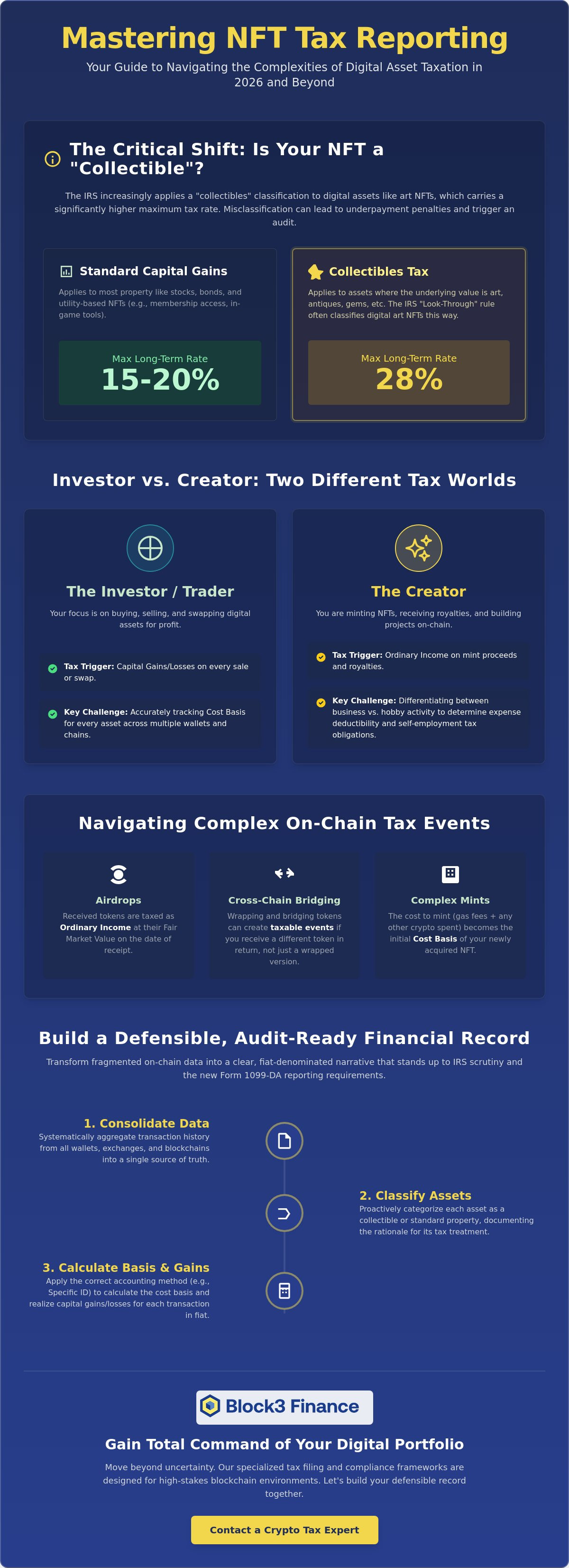
Mastery of your digital portfolio requires more than just tracking price action. It demands a rigorous approach to NFT tax reporting, which we define as the systematic reconciliation of on-chain events into precise, fiat-denominated tax liabilities. In 2026, the regulatory environment has moved past the era of ambiguity. The IRS no longer treats every digital asset as generic property; instead, it increasingly applies a specialized "collectibles" classification that carries a 28% maximum tax rate. This shift creates a high-stakes threshold for high-volume investors. If you fail to classify your assets proactively before your year-end filing, you risk significant overpayment or, worse, an intensive audit of your entire history.
Why the IRS Views Your JPG as Property (and Sometimes Art)
The tax identity of a digital asset depends entirely on its function and the nature of the underlying asset. While most traders understand what an NFT is in a technical sense, the IRS applies a "Look-Through" rule to determine its tax character. This means the agency examines whether the token represents a piece of digital art, a gaming utility, or a right to a physical object. The Look-Through rule dictates that an NFT is taxed as a collectible if the underlying asset it represents falls under the statutory definition of a collectible. Utility-based NFTs, such as those used for membership access or in-game tools, typically retain standard property status. Digital art, however, often triggers the 28% rate, making precise categorization essential for your financial health.
The Consequences of Misclassification in 2026
The financial impact of misclassification is rarely neutral. Applying standard capital gains rates of 15% or 20% to an asset the IRS deems a collectible creates a tax underpayment that accumulates interest and penalties. Beyond the immediate cost, the IRS now uses AI-powered tools to identify "red flags" in digital asset filings. Reporting significant NFT losses against other income without a defensible classification can trigger an inquiry into your entire portfolio. We advocate for a filing strategy built on intellectual depth. This involves documenting the specific rationale for every asset's tax treatment, ensuring your record isn't just a list of trades but a comprehensive, defensible narrative. Proactive classification resolves the friction between high-growth strategies and the reality of 2026 compliance.
Distinguishing Tax Obligations for NFT Investors vs. Creators
Determining your specific tax liability starts with identifying your functional role within the blockchain ecosystem. The IRS treats NFTs as digital assets, but it applies vastly different frameworks depending on whether you're building the underlying project or simply speculating on the floor price. For investors, every sale, asset-to-asset swap, or purchase made with an NFT triggers a capital gains event. Creators, however, face a more complex mandate where initial mint proceeds and secondary royalties are categorized as ordinary income. This distinction is paramount as we enter 2026, especially with the introduction of Form 1099-DA, which requires marketplaces to report gross proceeds for high-volume traders directly to the agency.
Professional status under Section 162 versus hobbyist classification under Section 183 changes the entire financial equation for those minting assets. If the IRS deems your activity a business, you gain the ability to deduct necessary expenses, though you're also subject to self-employment taxes. Hobbyists, conversely, must report all income without the benefit of deducting related costs. Engaging a crypto tax accountant ensures these distinctions are managed with precision, preventing the misclassification of income that often leads to overpayment.
The Investor's Path: Capital Gains and Cost Basis Mastery
Effective NFT tax reporting for investors requires a granular focus on cost basis. When you purchase an NFT using ETH or SOL, you're essentially performing two transactions: selling the cryptocurrency and buying the digital asset. You must calculate the fair market value of the crypto at the moment of the swap to establish your basis. We recommend utilizing Specific Identification over the standard FIFO (First-In, First-Out) method when possible. This allows you to select high-basis assets for sale, effectively reducing your taxable gains. You should also rigorously track gas fees, as these costs are added to your basis or subtracted from your proceeds, directly lowering your total liability.
The Creator's Mandate: Royalties and Self-Employment Considerations
Creators must view their smart contract royalties as recurring ordinary income rather than capital growth. These automated payments are taxed at your marginal income tax rate the moment they hit your wallet. For professional creators, this necessitates a disciplined approach to quarterly estimated tax payments to avoid underpayment penalties. To maintain a defensible position, you must document all business-related deductions, including:
- Artist and developer contract fees
- Marketing and community management expenses
- Software subscriptions and hardware used for asset generation
- Marketplace listing and minting fees
By treating your NFT project as a corporate entity, you shift from a defensive posture to one of strategic growth, ensuring your NFT tax reporting reflects the professional depth of your operation.
Navigating Complex On-Chain Events: Airdrops, Bridging, and Fractionalization
The blockchain ecosystem thrives on technical innovation, yet for the sophisticated participant, this innovation often translates into hidden financial liabilities. Advanced NFT tax reporting requires more than a simple ledger of trades. It demands a forensic understanding of high-friction events like airdrops, cross-chain bridging, and fractionalization. These aren't merely technical maneuvers; they are legal triggers that determine your ultimate liability. Mastery of these events ensures you aren't caught off guard by "phantom" taxes or missed opportunities for loss harvesting.
Airdrops and the 'Receipt of Income' Doctrine
Receiving an unsolicited NFT creates an immediate income tax liability based on its Fair Market Value (FMV) at the moment of receipt. This often results in a "phantom" tax burden where you owe fiat currency on an asset you haven't sold and which may lack immediate liquidity. The tax treatment of airdropped tokens is governed by the 'dominion and control' principle, which dictates that income is realized as soon as the recipient has the unfettered power to dispose of the asset. If an airdropped asset loses value before you can sell it, you must still report the initial FMV as ordinary income. You can only offset this later by selling the asset and realizing a capital loss. We recommend a proactive strategy of immediate valuation and documentation to prevent these unsolicited events from destabilizing your broader tax position.
Bridging, Wrapping, and the 'Realization' Event
Cross-chain bridging introduces significant tax friction that many legacy platforms fail to address. Moving an NFT from Ethereum to a layer-2 solution like Polygon often involves "wrapping" the asset, a process where the original token is locked in a smart contract while a representative token is minted on the target chain. The IRS has not yet provided definitive guidance on whether wrapping constitutes a "materially different" asset swap. However, conservative NFT tax reporting often treats these as realization events, potentially triggering capital gains. You must maintain rigorous technical logs to prove the underlying asset remains identical. Detailed tax implications for creators and investors suggest that the burden of proof rests entirely on the taxpayer to demonstrate that no taxable exchange occurred during the bridge.
Fractionalization and the treatment of worthless assets represent the final frontier of on-chain compliance. When you divide a single NFT into fungible ERC-20 tokens, you're likely triggering a taxable disposal of the original asset. Conversely, if you're holding "rugged" or illiquid tokens, you can't simply ignore them. To legally realize a loss, you must demonstrate an identifiable event of worthlessness. This often requires sending the token to a "burn" address or a documented third-party disposal to satisfy Section 165 requirements. We view these challenges not as obstacles, but as opportunities to refine your portfolio's financial narrative through disciplined blockchain bookkeeping.
Building a Defensible Audit Trail for NFT Portfolios
Reporting your transactions is merely the first step; the ultimate objective is audit-readiness. For high-net-worth individuals and Web3 firms, a simple spreadsheet of trades is a significant liability rather than a tool for compliance. We advocate for a shift toward rigorous blockchain bookkeeping that stands up to forensic scrutiny from global tax authorities. This process requires reconciling complex on-chain activity with off-chain business expenses, creating a seamless financial narrative. A defensible record must include precise timestamps, all involved wallet addresses, the fair market value in fiat at the moment of the transaction, and the unique transaction hashes for every event.
While many guides focus exclusively on domestic rules, a robust audit trail is essential for the global nature of digital asset ownership. Regulatory bodies across various jurisdictions are increasingly sharing data, making "clean" records a universal requirement for portfolio security. If you are managing thousands of transactions across multiple chains, you need a specialized crypto tax accountant to ensure every mint, swap, and burn is accounted for with professional depth.
Beyond Spreadsheets: The Need for Forensic Reconciliation
Standard tax software frequently fails when encountering high-volume NFT data, often missing critical minting events or failing to track cost basis across bridges. We employ a "white-glove" approach to manual transaction review, ensuring that every edge case is resolved with intellectual rigor. This forensic reconciliation transforms fragmented data into a cohesive financial history. In an industry characterized by volatility and rapid regulatory shifts, our role is to act as a calm force, providing the technical expertise needed to defend your positions during an inquiry.
Tax-Loss Harvesting Strategies for Illiquid NFTs
Realizing losses on illiquid or "rugged" assets is a strategic exercise in timing and documentation. You cannot simply claim a loss because a project’s floor price has dropped to zero; you must demonstrate a legal realization event. To satisfy requirements for worthlessness, we recommend the following checklist:
- Document the identifiable event that rendered the asset worthless, such as a project shutdown or contract exploit.
- Execute a "burn" transaction to a verifiable null address to prove the disposal of the asset.
- Maintain a record of the original cost basis and the fair market value at the time of disposal.
- Align these losses with significant capital gains to optimize your overall tax liability.
Strategic timing of these realizations allows you to offset gains from successful trades, turning a portfolio setback into a tax-efficient recovery. By moving from a defensive posture to one of proactive mastery, you ensure that your NFT tax reporting remains a source of strength for your digital asset strategy.
The Block3 Advantage: Specialized Tax Filing and Compliance
In a landscape where the IRS utilizes AI-powered tools to identify discrepancies, your financial defense must be equally sophisticated. Block3 Finance acts as your Visionary Navigator, moving beyond the reactive nature of traditional accounting to provide proactive advocacy. We've spent over 13 years cultivating a deep expertise in blockchain finance, a commitment to excellence that has earned us recognition and rankings by Bitcoin.com. Our methodology focuses on transforming chaotic on-chain activity into clean, defensible financial records that empower you to maintain total command over your portfolio's evolution. We don't just manage regulations; we help you master them.
Our firm provides a comprehensive suite of services designed for the modern digital asset holder. From rigorous NFT tax reporting and monthly accounting to high-level CFO services, we ensure every aspect of your financial infrastructure is built for stability. We resolve the friction between cutting-edge innovation and legacy compliance, allowing you to focus on growth while we secure your audit-readiness.
Why Professional Crypto Accountants Outperform Software
Standardized tax software often relies on a one-size-fits-all approach that fails when confronted with the complexities of fractionalization, bridging, or high-volume minting. These automated tools lack the intellectual depth required to interpret the "dominion and control" nuances of airdrops or the specific tax character of utility tokens versus collectibles. Block3 Finance provides tailored, expert-led tax preparation that accounts for the global nature of Web3 projects. We handle international compliance for clients across various jurisdictions, ensuring that your NFT tax reporting satisfies the most stringent regulatory frameworks. This white-glove service offers a sense of liberation, knowing that your filings are backed by specialized technical forensics rather than simple algorithmic guesses.
Securing Your Future with Strategic Corporate Structuring
For professional traders and creators, the transition from individual filing to strategic corporate structuring is a critical milestone in tax optimization. Moving your NFT assets into a corporate entity can significantly reduce personal liability and provide a more efficient framework for managing business-related deductions. Our team integrates corporate structuring with ongoing CFO leadership to manage your runway and compliance requirements with precision. We believe that vision and execution are inseparable; therefore, we provide the roadmap necessary to thrive in this complex industry. Secure your digital asset legacy with Block3 Finance's professional tax filing services and gain the agency you need to navigate the future of finance with confidence.
Master Your Digital Legacy in a Regulated Future
The transition from a speculative frontier to a regulated asset class requires a fundamental shift in perspective. You've seen how the distinction between standard property and specialized collectibles can alter your liability. You also understand that navigating high-friction events like bridging and airdrops demands forensic-level documentation. Effective NFT tax reporting is no longer just about meeting a deadline; it's about building a defensible financial narrative that protects your growth. At Block3 Finance, we act as your visionary navigator, bringing 13+ years of specialized blockchain expertise to every engagement. As a top-ranked firm by Bitcoin.com, we serve over 980 global clients with a commitment to intellectual depth and audit-readiness. Don't leave your portfolio's security to chance or inadequate software. Schedule a consultation with a Block3 Finance crypto tax specialist to gain total command over your financial landscape. You have the power to thrive in this complex environment with a partner who understands the rules of the new economy. Your digital future is yours to command.
Frequently Asked Questions
Are NFTs taxed as collectibles or standard capital assets?
The IRS applies a "look-through" analysis to determine if an NFT is a collectible or a standard asset. If the underlying asset represented by the token is art or a specified collectible, it's taxed at a maximum rate of 28%. Utility tokens or those representing standard property generally fall under standard capital gains brackets. Accurate NFT tax reporting requires you to categorize each asset based on its specific function and underlying value.
Do I have to pay taxes on an NFT I haven't sold yet?
You don't owe capital gains tax on an NFT as long as you continue to hold it in your wallet. Taxation only triggers upon a realization event, such as a sale, a swap for another token, or spending the asset. However, receiving an NFT as payment for services or via an airdrop creates an immediate ordinary income liability based on its fair market value at the time of receipt.
How do I calculate the cost basis for an NFT minted with Ethereum?
Your cost basis is the fair market value of the Ethereum at the exact moment of the minting transaction plus any associated gas fees. Because spending ETH to mint an NFT is a taxable swap, you must also report the gain or loss on the ETH itself. Maintaining precise timestamps is essential for accurate reporting in these volatile scenarios, ensuring your basis reflects the true fiat value at the time of the exchange.
What happens if I received an NFT airdrop and it's now worthless?
You still owe ordinary income tax based on the fair market value at the time you gained dominion and control over the airdrop. If the asset later becomes worthless, you can realize a capital loss to offset other gains, but this doesn't erase the initial income tax obligation. This "phantom income" risk makes immediate valuation and strategic planning vital for high-volume participants who receive unsolicited assets.
Can I claim a tax loss if my NFT project was a 'rug pull'?
You can claim a loss on a "rug pull" only if you demonstrate a completed transaction or an identifiable event of worthlessness. Simply holding a token with a zero floor price isn't enough to satisfy IRS requirements. We often recommend sending the asset to a verifiable null or "burn" address to create a definitive realization event for your financial records, allowing you to legally claim the loss against your gains.
Is bridging an NFT from one blockchain to another a taxable event?
Bridging can be a taxable event if the process involves swapping the original NFT for a "wrapped" version that is deemed materially different. While the IRS hasn't issued specific guidance on bridging as of mid 2026, conservative reporting often treats these as realization events. You must maintain technical logs to defend whether the underlying asset's substance remained unchanged during the transition to avoid being double taxed on the same value.
How do I report NFT royalties as a creator?
Royalties from secondary sales are reported as ordinary income at the fair market value when they're received in your wallet. If you're a professional creator, you'll typically report this on Schedule C and pay self-employment taxes, which currently stand at 15.3%. Successful creators should also make quarterly estimated tax payments to avoid underpayment penalties, treating their royalties as a recurring business revenue stream rather than a capital gain.
What forms do I need to file for NFT taxes in the US (2026)?
You'll primarily use Form 8949 and Schedule D to report capital gains and losses from NFT trades. Starting in 2026, you'll also need to reconcile your records with Form 1099-DA, which brokers and marketplaces now use to report gross proceeds to the IRS. Creators must additionally use Schedule C to account for minting income and business related deductions, ensuring every on-chain event is reflected in their fiat denominated tax filing.

Article by
Mahad Mohamed
Mahad Mohamed is an accountant and the CEO of Block3 Finance, with over 26+ years of Canadian and international tax and accounting experience. A crypto accounting specialist since the early days of Bitcoin, he has consulted for over 38 crypto companies and collaborated with legal professionals on regulatory matters. His expertise spans corporate reorganization, cross-border tax structuring (Canada & US), tax disputes, and CRA audits.
Previously, Mahad worked for the Canada Revenue Agency (CRA), Big4 accounting firms, and served as a Rulings Officer for the Federal Tax Authority of the UAE before acquiring Tax Partners in 2014.
Block3 Finance and Tax Partners has 44 full-time accountants and over 9,800+ clients.
Disclaimer
This article provides general information only and is current as of its publication date. It has not been updated and may be out of date. It does not constitute legal advice and should not be relied upon as such. Every tax situation is unique and may differ from the examples discussed in this article. If you have specific questions, you should seek the advice of our accountants for your unique circumstances.
Frequently Asked Questions
Why the IRS Views Your JPG as Property (and Sometimes Art)
The tax identity of a digital asset depends entirely on its function and the nature of the underlying asset. While most traders understand what an NFT is in a technical sense, the IRS applies a "Look-Through" rule to determine its tax character. This means the agency examines whether the token represents a piece of digital art, a gaming utility, or a right to a physical object. The Look-Through rule dictates that an NFT is taxed as a collectible if the underlying asset it represents falls under the statutory definition of a collectible. Utility-based NFTs, such as those used for membership access or in-game tools, typically retain standard property status. Digital art, however, often triggers the 28% rate, making precise categorization essential for your financial health.
The Consequences of Misclassification in 2026
The financial impact of misclassification is rarely neutral. Applying standard capital gains rates of 15% or 20% to an asset the IRS deems a collectible creates a tax underpayment that accumulates interest and penalties. Beyond the immediate cost, the IRS now uses AI-powered tools to identify "red flags" in digital asset filings. Reporting significant NFT losses against other income without a defensible classification can trigger an inquiry into your entire portfolio. We advocate for a filing strategy built on intellectual depth. This involves documenting the specific rationale for every asset's tax treatment, ensuring your record isn't just a list of trades but a comprehensive, defensible narrative. Proactive classification resolves the friction between high-growth strategies and the reality of 2026 compliance. Determining your specific tax liability starts with identifying your functional role within the blockchain ecosystem. The IRS treats NFTs as digital assets, but it applies vastly different frameworks depending on whether you're building the underlying project or simply speculating on the floor price. For investors, every sale, asset-to-asset swap, or purchase made with an NFT triggers a capital gains event. Creators, however, face a more complex mandate where initial mint proceeds and secondary royalties are categorized as ordinary income. This distinction is paramount as we enter 2026, especially with the introduction of Form 1099-DA, which requires marketplaces to report gross proceeds for high-volume traders directly to the agency. Professional status under Section 162 versus hobbyist classification under Section 183 changes the entire financial equation for those minting assets. If the IRS deems your activity a business, you gain the ability to deduct necessary expenses, though you're also subject to self-employment taxes. Hobbyists, conversely, must report all income without the benefit of deducting related costs. Engaging a crypto tax accountant ensures these distinctions are managed with precision, preventing the misclassification of income that often leads to overpayment.
The Investor's Path: Capital Gains and Cost Basis Mastery
Effective NFT tax reporting for investors requires a granular focus on cost basis. When you purchase an NFT using ETH or SOL, you're essentially performing two transactions: selling the cryptocurrency and buying the digital asset. You must calculate the fair market value of the crypto at the moment of the swap to establish your basis. We recommend utilizing Specific Identification over the standard FIFO (First-In, First-Out) method when possible. This allows you to select high-basis assets for sale, effectively reducing your taxable gains. You should also rigorously track gas fees, as these costs are added to your basis or subtracted from your proceeds, directly lowering your total liability.
The Creator's Mandate: Royalties and Self-Employment Considerations
Creators must view their smart contract royalties as recurring ordinary income rather than capital growth. These automated payments are taxed at your marginal income tax rate the moment they hit your wallet. For professional creators, this necessitates a disciplined approach to quarterly estimated tax payments to avoid underpayment penalties. To maintain a defensible position, you must document all business-related deductions, including: By treating your NFT project as a corporate entity, you shift from a defensive posture to one of strategic growth, ensuring your NFT tax reporting reflects the professional depth of your operation. The blockchain ecosystem thrives on technical innovation, yet for the sophisticated participant, this innovation often translates into hidden financial liabilities. Advanced NFT tax reporting requires more than a simple ledger of trades. It demands a forensic understanding of high-friction events like airdrops, cross-chain bridging, and fractionalization. These aren't merely technical maneuvers; they are legal triggers that determine your ultimate liability. Mastery of these events ensures you aren't caught off guard by "phantom" taxes or missed opportunities for loss harvesting.
Airdrops and the 'Receipt of Income' Doctrine
Receiving an unsolicited NFT creates an immediate income tax liability based on its Fair Market Value (FMV) at the moment of receipt. This often results in a "phantom" tax burden where you owe fiat currency on an asset you haven't sold and which may lack immediate liquidity. The tax treatment of airdropped tokens is governed by the 'dominion and control' principle, which dictates that income is realized as soon as the recipient has the unfettered power to dispose of the asset. If an airdropped asset loses value before you can sell it, you must still report the initial FMV as ordinary income. You can only offset this later by selling the asset and realizing a capital loss. We recommend a proactive strategy of immediate valuation and documentation to prevent these unsolicited events from destabilizing your broader tax position.
Bridging, Wrapping, and the 'Realization' Event
Cross-chain bridging introduces significant tax friction that many legacy platforms fail to address. Moving an NFT from Ethereum to a layer-2 solution like Polygon often involves "wrapping" the asset, a process where the original token is locked in a smart contract while a representative token is minted on the target chain. The IRS has not yet provided definitive guidance on whether wrapping constitutes a "materially different" asset swap. However, conservative NFT tax reporting often treats these as realization events, potentially triggering capital gains. You must maintain rigorous technical logs to prove the underlying asset remains identical. Detailed tax implications for creators and investors suggest that the burden of proof rests entirely on the taxpayer to demonstrate that no taxable exchange occurred during the bridge. Fractionalization and the treatment of worthless assets represent the final frontier of on-chain compliance. When you divide a single NFT into fungible ERC-20 tokens, you're likely triggering a taxable disposal of the original asset. Conversely, if you're holding "rugged" or illiquid tokens, you can't simply ignore them. To legally realize a loss, you must demonstrate an identifiable event of worthlessness. This often requires sending the token to a "burn" address or a documented third-party disposal to satisfy Section 165 requirements. We view these challenges not as obstacles, but as opportunities to refine your portfolio's financial narrative through disciplined blockchain bookkeeping. Reporting your transactions is merely the first step; the ultimate objective is audit-readiness. For high-net-worth individuals and Web3 firms, a simple spreadsheet of trades is a significant liability rather than a tool for compliance. We advocate for a shift toward rigorous blockchain bookkeeping that stands up to forensic scrutiny from global tax authorities. This process requires reconciling complex on-chain activity with off-chain business expenses, creating a seamless financial narrative. A defensible record must include precise timestamps, all involved wallet addresses, the fair market value in fiat at the moment of the transaction, and the unique transaction hashes for every event. While many guides focus exclusively on domestic rules, a robust audit trail is essential for the global nature of digital asset ownership. Regulatory bodies across various jurisdictions are increasingly sharing data, making "clean" records a universal requirement for portfolio security. If you are managing thousands of transactions across multiple chains, you need a specialized crypto tax accountant to ensure every mint, swap, and burn is accounted for with professional depth.
Beyond Spreadsheets: The Need for Forensic Reconciliation
Standard tax software frequently fails when encountering high-volume NFT data, often missing critical minting events or failing to track cost basis across bridges. We employ a "white-glove" approach to manual transaction review, ensuring that every edge case is resolved with intellectual rigor. This forensic reconciliation transforms fragmented data into a cohesive financial history. In an industry characterized by volatility and rapid regulatory shifts, our role is to act as a calm force, providing the technical expertise needed to defend your positions during an inquiry.
Tax-Loss Harvesting Strategies for Illiquid NFTs
Realizing losses on illiquid or "rugged" assets is a strategic exercise in timing and documentation. You cannot simply claim a loss because a project’s floor price has dropped to zero; you must demonstrate a legal realization event. To satisfy requirements for worthlessness, we recommend the following checklist: Strategic timing of these realizations allows you to offset gains from successful trades, turning a portfolio setback into a tax-efficient recovery. By moving from a defensive posture to one of proactive mastery, you ensure that your NFT tax reporting remains a source of strength for your digital asset strategy. In a landscape where the IRS utilizes AI-powered tools to identify discrepancies, your financial defense must be equally sophisticated. Block3 Finance acts as your Visionary Navigator, moving beyond the reactive nature of traditional accounting to provide proactive advocacy. We've spent over 13 years cultivating a deep expertise in blockchain finance, a commitment to excellence that has earned us recognition and rankings by Bitcoin.com. Our methodology focuses on transforming chaotic on-chain activity into clean, defensible financial records that empower you to maintain total command over your portfolio's evolution. We don't just manage regulations; we help you master them. Our firm provides a comprehensive suite of services designed for the modern digital asset holder. From rigorous NFT tax reporting and monthly accounting to high-level CFO services, we ensure every aspect of your financial infrastructure is built for stability. We resolve the friction between cutting-edge innovation and legacy compliance, allowing you to focus on growth while we secure your audit-readiness.
Why Professional Crypto Accountants Outperform Software
Standardized tax software often relies on a one-size-fits-all approach that fails when confronted with the complexities of fractionalization, bridging, or high-volume minting. These automated tools lack the intellectual depth required to interpret the "dominion and control" nuances of airdrops or the specific tax character of utility tokens versus collectibles. Block3 Finance provides tailored, expert-led tax preparation that accounts for the global nature of Web3 projects. We handle international compliance for clients across various jurisdictions, ensuring that your NFT tax reporting satisfies the most stringent regulatory frameworks. This white-glove service offers a sense of liberation, knowing that your filings are backed by specialized technical forensics rather than simple algorithmic guesses.
Securing Your Future with Strategic Corporate Structuring
For professional traders and creators, the transition from individual filing to strategic corporate structuring is a critical milestone in tax optimization. Moving your NFT assets into a corporate entity can significantly reduce personal liability and provide a more efficient framework for managing business-related deductions. Our team integrates corporate structuring with ongoing CFO leadership to manage your runway and compliance requirements with precision. We believe that vision and execution are inseparable; therefore, we provide the roadmap necessary to thrive in this complex industry. Secure your digital asset legacy with Block3 Finance's professional tax filing services and gain the agency you need to navigate the future of finance with confidence. The transition from a speculative frontier to a regulated asset class requires a fundamental shift in perspective. You've seen how the distinction between standard property and specialized collectibles can alter your liability. You also understand that navigating high-friction events like bridging and airdrops demands forensic-level documentation. Effective NFT tax reporting is no longer just about meeting a deadline; it's about building a defensible financial narrative that protects your growth. At Block3 Finance, we act as your visionary navigator, bringing 13+ years of specialized blockchain expertise to every engagement. As a top-ranked firm by Bitcoin.com, we serve over 980 global clients with a commitment to intellectual depth and audit-readiness. Don't leave your portfolio's security to chance or inadequate software. Schedule a consultation with a Block3 Finance crypto tax specialist to gain total command over your financial landscape. You have the power to thrive in this complex environment with a partner who understands the rules of the new economy. Your digital future is yours to command.
Are NFTs taxed as collectibles or standard capital assets?
The IRS applies a "look-through" analysis to determine if an NFT is a collectible or a standard asset. If the underlying asset represented by the token is art or a specified collectible, it's taxed at a maximum rate of 28%. Utility tokens or those representing standard property generally fall under standard capital gains brackets. Accurate NFT tax reporting requires you to categorize each asset based on its specific function and underlying value.
Do I have to pay taxes on an NFT I haven't sold yet?
You don't owe capital gains tax on an NFT as long as you continue to hold it in your wallet. Taxation only triggers upon a realization event, such as a sale, a swap for another token, or spending the asset. However, receiving an NFT as payment for services or via an airdrop creates an immediate ordinary income liability based on its fair market value at the time of receipt.
How do I calculate the cost basis for an NFT minted with Ethereum?
Your cost basis is the fair market value of the Ethereum at the exact moment of the minting transaction plus any associated gas fees. Because spending ETH to mint an NFT is a taxable swap, you must also report the gain or loss on the ETH itself. Maintaining precise timestamps is essential for accurate reporting in these volatile scenarios, ensuring your basis reflects the true fiat value at the time of the exchange.
What happens if I received an NFT airdrop and it's now worthless?
You still owe ordinary income tax based on the fair market value at the time you gained dominion and control over the airdrop. If the asset later becomes worthless, you can realize a capital loss to offset other gains, but this doesn't erase the initial income tax obligation. This "phantom income" risk makes immediate valuation and strategic planning vital for high-volume participants who receive unsolicited assets.
Can I claim a tax loss if my NFT project was a 'rug pull'?
You can claim a loss on a "rug pull" only if you demonstrate a completed transaction or an identifiable event of worthlessness. Simply holding a token with a zero floor price isn't enough to satisfy IRS requirements. We often recommend sending the asset to a verifiable null or "burn" address to create a definitive realization event for your financial records, allowing you to legally claim the loss against your gains.
Is bridging an NFT from one blockchain to another a taxable event?
Bridging can be a taxable event if the process involves swapping the original NFT for a "wrapped" version that is deemed materially different. While the IRS hasn't issued specific guidance on bridging as of mid 2026, conservative reporting often treats these as realization events. You must maintain technical logs to defend whether the underlying asset's substance remained unchanged during the transition to avoid being double taxed on the same value.
How do I report NFT royalties as a creator?
Royalties from secondary sales are reported as ordinary income at the fair market value when they're received in your wallet. If you're a professional creator, you'll typically report this on Schedule C and pay self-employment taxes, which currently stand at 15.3%. Successful creators should also make quarterly estimated tax payments to avoid underpayment penalties, treating their royalties as a recurring business revenue stream rather than a capital gain.
What forms do I need to file for NFT taxes in the US (2026)?
You'll primarily use Form 8949 and Schedule D to report capital gains and losses from NFT trades. Starting in 2026, you'll also need to reconcile your records with Form 1099-DA, which brokers and marketplaces now use to report gross proceeds to the IRS. Creators must additionally use Schedule C to account for minting income and business related deductions, ensuring every on-chain event is reflected in their fiat denominated tax filing.