
What if your greatest digital innovation is currently your biggest financial blind spot? For most firms, the friction between high-volume on-chain activity and traditional ERP systems creates a chaotic data gap that no spreadsheet can bridge. You likely feel the pressure of shifting regulatory standards, especially with the Financial Accounting Standards Board (FASB) ASU 2023-08 requiring fair value measurement for certain crypto assets. Implementing robust digital asset bookkeeping isn't just about avoiding a messy audit; it's about seizing total command over your financial destiny.
We understand that reconciling complex DeFi protocols or NFT treasuries feels like a defensive battle against an encroaching regulatory tide. This guide transforms that struggle into a strategic advantage. You'll learn to build defensible, institutional-grade records that satisfy the IRS in the United States and the CRA in Canada. We'll preview the essential frameworks for audit-readiness, from mastering the new Form 1099-DA reporting requirements to ensuring tax efficiency across global jurisdictions. By the end of this article, you'll have a roadmap to move from on-chain chaos to a clean, defensible ledger ready for venture capital or public listing.
Key Takeaways
- Learn why legacy accounting tools fail and how to implement institutional-grade digital asset bookkeeping to capture every gas fee and smart contract interaction.
- Master the transition to fair value measurement under ASU 2023-08 to reflect your holdings' true economic reality on the balance sheet.
- Build a defensible audit trail by centralizing API feeds and accurately categorizing on-chain events such as staking, swaps, and airdrops.
- Differentiate between the distinct compliance requirements for the IRS in the United States and the CRA in Canada to ensure precise tax filing.
- Acquire specialized strategies for managing DAO treasuries, specifically for native token volatility and the accounting of ecosystem grants.
Table of Contents
The Evolution of Digital Asset Bookkeeping: From Chaos to Command
Financial clarity in Web3 isn't an accident. It's the result of rigorous digital asset bookkeeping, which we define as the systematic recording of on-chain events into a structured, defensible financial framework. While many early adopters treated wallet tracking as a secondary task, the institutional era demands a transition from chaotic spreadsheets to full-scale enterprise resource planning (ERP). To understand the high stakes of this transition, one must first grasp what is a digital asset in a commercial context; it's not just a token, but a complex financial instrument with unique tax and reporting requirements.
Traditional "off-the-shelf" accounting software fails to capture the nuance of decentralized finance. These legacy systems weren't built to account for gas fees, smart contract interactions, or the complexities of wrapped tokens. For instance, a simple swap on a decentralized exchange might involve multiple internal transactions that a standard general ledger interprets as errors. We view sophisticated bookkeeping as the roadmap for sustainable innovation, providing the "Visionary Navigator" with the data needed to move beyond simple survival and into aggressive growth.
Why Traditional General Ledgers Struggle with Web3
Blockchain data is immutable, but financial records often require correction and adjustment. This creates a fundamental friction between the ledger and the chain. Raw blockchain explorers provide the "what" but rarely the "why," leaving a massive data gap regarding transaction intent. Metadata such as the purpose of a transfer is often missing from the raw data, making it impossible to reconcile without manual intervention. High-volume traders must utilize a specialized digital asset sub-ledger to aggregate and categorize thousands of events before syncing summarized data with their primary financial system.
The Institutional Shift in 2026
The year 2026 marks a definitive shift in the maturation of the industry. Standardized global regulations, such as the FASB ASU 2023-08 in the United States and evolving CRA guidelines in Canada, have ended the "wait-and-see" era for corporate finance. Tier-1 firms now prioritize proactive compliance to remain attractive to institutional partners. In this environment, "Defensible Books" are the primary currency for earning venture capital trust. Whether you're filing with the IRS in the U.S. or reporting federal and provincial taxes to the CRA in Canada, your records must be beyond reproach to ensure long-term stability.
Mastering the Fair Value Standard: ASU 2023-08 and Beyond
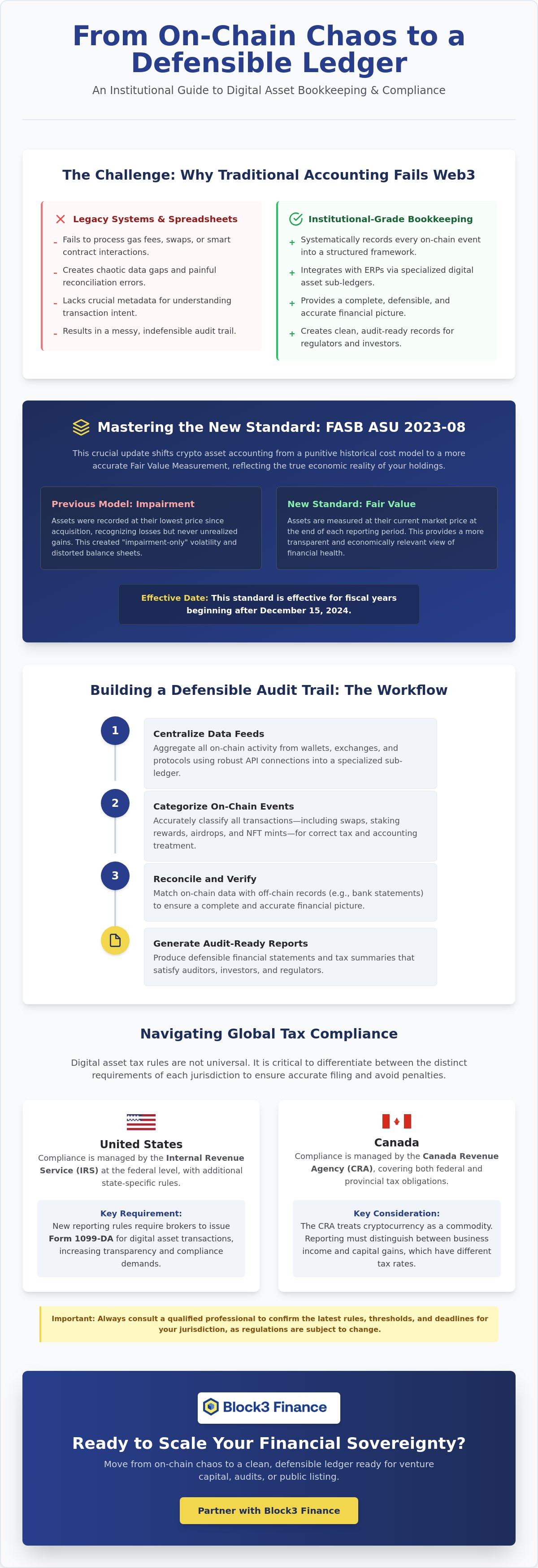
Financial reporting finally reflects economic reality. For years, the punitive "intangible asset" model forced firms to record digital holdings at their lowest historical price, effectively hiding gains while highlighting every dip. The Financial Accounting Standards Board (FASB) resolved this friction with ASU 2023-08. This update requires entities to measure certain crypto assets at fair value, which is the estimated price at which an asset can be sold in an open market. Mastering this standard is now a pillar of institutional-grade digital asset bookkeeping.
The benefits of this shift are immediate. Fair value measurement reduces "impairment-only" volatility, a term describing the accounting practice where assets are only adjusted downward when their value drops but never upward when they recover. However, this precision brings increased scrutiny from auditors. You must now provide detailed disclosures regarding your valuation techniques and price sources. Auditors expect to see a robust methodology that aligns with the AICPA guidance on digital assets to prove that your reported figures are defensible. If the technical requirements of this transition feel overwhelming, our CFO Services can provide the strategic oversight needed to modernize your reporting suite.
Transitioning from the Impairment Model
The historical "lowest price" rule stifled corporate adoption by creating a one-way street for losses. As of 2026, most Tier-1 firms have moved toward the new standard, which is effective for fiscal years beginning after December 15, 2024. In the United States, this is a mandatory shift for entities following U.S. GAAP, which stands for Generally Accepted Accounting Principles and serves as the standard framework for financial reporting in the U.S. Canadian firms, however, generally follow IFRS (International Financial Reporting Standards, the global accounting language used in many countries outside the U.S.) or ASPE (Accounting Standards for Private Enterprises, the simplified accounting framework used by private businesses in Canada). While IFRS allows for a revaluation model under IAS 38, which is the specific international rule governing how intangible assets are recorded, the specific provincial and federal tax implications in Canada differ significantly from the U.S. IRS requirements. We recommend a proactive approach to this transition:
-
Identify which assets in your portfolio meet the specific scope of ASU 2023-08.
-
Establish a cumulative-effect adjustment to retained earnings as of the beginning of the year of adoption.
-
Update internal controls to capture real-time pricing data for quarterly reporting.
Valuation Methodologies for Illiquid Assets
Bookkeeping for NFTs or low-liquidity tokens requires a more nuanced approach than tracking Bitcoin. You must categorize inputs into three levels. Level 1 involves quoted prices in active markets, while Level 2 uses observable inputs like prices for similar assets. Level 3 relies on unobservable inputs, often requiring complex mathematical models for valuation. A consistent valuation policy is the only way to ensure your books remain audit-ready and defensible under rigorous professional examination. Implementing robust digital asset bookkeeping allows you to navigate these levels with the confidence of a seasoned strategist.
Building a Defensible Audit Trail: The Operational Workflow
Institutional mastery requires moving beyond the high-level accounting standards discussed previously and into the mechanics of daily execution. A robust operational workflow is the only way to transform thousands of raw on-chain events into a clean, defensible general ledger. This process begins with data aggregation, where you centralize API feeds from exchanges, hardware wallets, and custodial providers into a single source of truth. Once the data is centralized, you must assign precise tax and accounting labels to every event, such as a staking reward, an airdrop, or a simple swap. Precise digital asset bookkeeping ensures that every transaction hash is accounted for before it ever reaches your primary financial statements.
Accuracy at this stage is non-negotiable because it informs your cost basis, which is the original value of an asset for tax purposes, typically the purchase price plus any transaction fees. You must apply your chosen methodology, such as FIFO (First-In, First-Out) or HIFO (Highest-In, First-Out), at the individual lot level to ensure tax efficiency. This level of detail is essential for adhering to IRS guidelines on digital assets in the United States. For transactions occurring on or after January 1, 2025, U.S. brokers must report gross proceeds on the new Form 1099-DA. In Canada, the CRA (Canada Revenue Agency) requires similar diligence. The CRA generally treats cryptocurrency as a commodity, meaning transactions may trigger capital gains or business income depending on whether the activity is considered a personal investment or a business operation. You should consult with a professional to confirm whether your provincial or state requirements add further layers of reporting.
The Role of Specialized Crypto Sub-Ledgers
Standard bank feeds cannot interpret the complexity of a blockchain. You need a specialized crypto sub-ledger to bridge the gap between immutable on-chain data and traditional ERP systems like NetSuite, QuickBooks, or Xero. These sub-ledgers handle the heavy lifting of liquidity provisioning and collateralized loans, providing a clear mapping for every transaction hash. This mapping is the backbone of Blockchain Financial Records: Building an Audit Trail, allowing you to prove the provenance of every entry on your balance sheet during a rigorous audit or venture capital due diligence process.
Common Bookkeeping Pitfalls to Avoid
Errors often stem from "Unidentified Inflows." Airdrops and "dust" transactions, which are small amounts of unwanted tokens sent to a wallet by unknown parties, can clutter your books if not handled with a clear policy. You must also decide how to treat gas fees. While some firms expense them immediately, others treat them as an adjustment to the cost basis of the asset. Failing to reconcile these details during a monthly "close" creates compounding errors that make year-end filing a nightmare. Effective digital asset bookkeeping eliminates this friction, replacing regulatory anxiety with the calm confidence of an audit-ready enterprise.
Specialized Bookkeeping for DAOs and Web3 Enterprises
Decentralized Autonomous Organizations (DAOs) represent the frontier of corporate structure, but their decentralized nature often leads to centralized accounting headaches. Achieving institutional-grade digital asset bookkeeping for a DAO requires a specialized approach that accounts for native token volatility and the specific legal wrappers used in jurisdictions like Wyoming, Tennessee, or Utah. While skeptics ask if a DAO can truly be compliant, the success of Block3 Finance with over 980 global clients proves that decentralized governance and rigorous financial oversight can coexist. We move the narrative from a defensive posture to one of mastery, ensuring your treasury is a tool for growth rather than a liability.
Managing a DAO treasury involves more than just balancing a ledger. You must account for native token reserves and "locked" ecosystem grants that may not yet be liquid. These assets must be recorded at fair value, ensuring the community has a clear view of the organization's runway. This transparency is vital when handling the legal and accounting overlap in "Token-as-a-Service" (TaaS) models, where the issuance and distribution of tokens must be tracked with surgical precision. If your DAO treasury needs professional oversight, our Monthly Accounting services provide the elite strategy required to maintain financial sovereignty.
Multi-Sig Governance and Financial Oversight
The role of the bookkeeper in a multi-sig environment is that of a "Visionary Navigator" who verifies intent before execution. You aren't just recording history; you're ensuring that every transaction aligns with approved governance proposals. This verification process prevents internal friction and builds trust with your community of token holders. Reporting on treasury health with transparency and accuracy is the only way to satisfy stakeholders who demand real-time data. Treasury transparency is a key factor in DAO longevity, as it provides the fiscal proof needed to sustain a decentralized ecosystem.
Web3 Payroll: Compliance at Scale
Tracking the fair value of tokens at the exact moment of distribution is vital for tax withholding and contractor reporting. Tax withholding is the process where an employer deducts a portion of an employee's pay and sends it directly to the government as a partial payment of the employee's income tax. In the United States, the IRS requires reporting for digital asset payments, which often involves issuing Form 1099-NEC to contractors. Conversely, the CRA in Canada requires businesses to report these payments as business income or through T4A forms, depending on provincial regulations and the recipient's employment status. Mastering Crypto Payroll Compliance: Paying Global Teams prevents the common pitfalls of global distribution. You must accurately record the fair value in the local currency (USD or CAD) at the time of the transaction to ensure both the entity and the recipient remain in good standing with their respective authorities.
Scaling Your Financial Sovereignty with Block3 Finance
Mastering the complexities of on-chain finance requires more than a subscription to a tracking tool. It demands a partner who possesses the technical rigor of a traditional auditor and the mindset of a bold innovator. Block3 Finance serves as that elite partner, turning fragmented data into clean, defensible records through institutional-grade digital asset bookkeeping. With over 13 years of blockchain expertise, we act as your Visionary Navigator, shifting your financial posture from defensive compliance to offensive growth. Our Ontario-based team maintains a worldwide footprint, providing specialized support to more than 980 clients navigating the highest stakes of Web3.
Our reach is global, but our precision is local. Whether you're managing federal and state obligations for the IRS in the United States or provincial and federal filings for the CRA in Canada, we ensure your books remain distinct and accurate. For Canadian entities, we navigate the specific "commodity" classification used by the CRA, while for U.S. firms, we implement the latest reporting regimes like the new Form 1099-DA. This jurisdictional expertise ensures that your records are defensible in any boardroom or audit chamber. Our comprehensive suite, including Monthly Accounting, Audits and Compliance, and CFO Services, provides the professional weight needed to scale with confidence.
Why Expert Oversight Trumps Software Alone
Software often chokes on smart contract failures or edge cases that require human interpretation. Block3 provides the essential "Human-in-the-Loop" necessity to resolve these frictions. While platforms focus on automated feeds, they cannot offer the strategic "White-Glove" corporate structuring needed for complex treasury management. We bridge the gap between Silicon Valley innovation and Wall Street discipline. We ensure your records satisfy the most demanding auditors by interpreting the intent behind the data, not just the raw transaction hash.
Your Roadmap to Financial Mastery
You don't have to stay trapped in a cycle of messy spreadsheets and reconciliation anxiety. We help you move from a chaotic history to an audit-ready future, providing the peace of mind that comes from working with the top-ranked firm by Bitcoin.com. We don't just provide a service; we offer a roadmap for thriving in a complex world. By combining deep experience with a commitment to best practices, we empower you to gain total command over a volatile landscape.
Ready to master your digital assets? Book a consultation with Block3 Finance today.
Command Your Financial Future in the Web3 Era
The shift toward institutional maturity is no longer a distant prospect; it's a present reality. By mastering the fair value standard and implementing rigorous sub-ledger workflows, you move beyond mere survival into a state of financial mastery. This evolution in digital asset bookkeeping ensures that your organization remains audit-ready for venture capital or public listing, regardless of whether you're navigating IRS reporting in the United States or CRA compliance in Canada. You've seen how specialized oversight for DAOs and Web3 enterprises turns on-chain chaos into a strategic asset that fuels long-term growth.
Expertise is the bridge between innovation and stability. Block3 Finance brings 13+ years of blockchain financial expertise and a track record of serving 980+ global clients to your corner. As the firm top-ranked by Bitcoin.com, we provide the "Visionary Navigator" approach your brand needs to thrive in a complex landscape. You don't have to navigate these volatile waters alone.
Secure Your Financial Future: Get Audit-Ready with Block3 Finance
Your journey toward total command over your digital assets starts now. We're here to help you turn compliance into your greatest competitive advantage.
Frequently Asked Questions
What is the difference between digital asset bookkeeping and traditional bookkeeping?
Traditional bookkeeping relies on centralized bank statements, whereas digital asset bookkeeping focuses on reconciling decentralized, on-chain events. You're dealing with 24/7 transaction volume and complex smart contract metadata that legacy systems can't interpret. While a bank statement shows a simple transfer, a blockchain record may involve gas fees, internal swaps, and liquidity provisioning that require specialized categorization to maintain a defensible general ledger.
How does FASB ASU 2023-08 change how I record crypto on my balance sheet?
FASB ASU 2023-08 requires entities to measure certain crypto assets at fair value rather than using the historical cost-minus-impairment model. This change ensures your balance sheet reflects the true economic reality of your holdings at each reporting date. In the United States, this standard is effective for fiscal years starting after December 15, 2024. For Canadian firms, you should check with the CRA or a professional regarding IFRS revaluation options, as rules differ across the border.
Can I use QuickBooks or Xero for my crypto transactions?
You can use QuickBooks or Xero, but you shouldn't rely on their native bank feeds for blockchain data. These traditional platforms aren't built to handle the thousands of micro-transactions common in Web3. Instead, you must use a specialized sub-ledger to aggregate and categorize your on-chain activity first. Once the data is clean and reconciled, you can sync the summarized entries into your primary ERP to maintain a single source of truth.
What is a crypto sub-ledger and why does my business need one?
A crypto sub-ledger is a specialized accounting tool that aggregates data from wallets and exchanges to calculate cost basis and fair value. Your business needs one because it provides the necessary mapping that traditional ledgers lack. Without this layer, reconciling complex DeFi activities or high-frequency trades becomes impossible. It acts as the bridge that ensures every transaction hash is accounted for and remains audit-ready for venture capital or public listing.
How do I account for gas fees in my digital asset records?
Gas fees are typically treated as either an immediate expense or an adjustment to the cost basis of the asset. The choice depends on your specific accounting policy and the nature of the transaction. In the United States, the IRS generally allows these to be added to the basis of the acquired property. In Canada, the CRA considers them part of the transaction cost. Consistency is your most important asset; you must apply the same treatment across all records.
What documents do I need to provide for a crypto audit in 2026?
For a 2026 audit, you'll need comprehensive transaction logs, wallet addresses, and API keys for all exchange accounts. Auditors will specifically look for cost basis reports and evidence of fair value measurement at each reporting period. If you're in the U.S., be ready to provide copies of Form 1099-DA. If you operate in Canada, have your provincial and federal tax reconciliations prepared to show how your crypto activity was converted to CAD for reporting.
How does Block3 Finance handle high-volume DeFi and NFT transactions?
Block3 Finance utilizes specialized workflows to manage high-volume DeFi and NFT activity that standard software often misses. We provide professional oversight to interpret smart contract interactions and resolve "unidentified inflows" like airdrops. Our team provides the strategic leadership needed to turn these complex events into clean, defensible records. We serve as the elite navigator for firms that require more than just automated tracking to achieve digital asset bookkeeping mastery.
Is it legal to pay my global employees in cryptocurrency?
It's legal to pay employees in crypto, but you must comply with local withholding and reporting laws. In the United States, the IRS requires you to report these payments as wages on Form W-2 or as compensation on Form 1099-NEC. In Canada, the CRA mandates that you report the fair market value in CAD on a T4 or T4A slip. You must calculate the value at the exact time of distribution to ensure accurate tax withholding for each jurisdiction.

Article by
Mahad Mohamed
Mahad Mohamed is an accountant and the CEO of Block3 Finance, with over 26+ years of Canadian and international tax and accounting experience. A crypto accounting specialist since the early days of Bitcoin, he has consulted for over 38 crypto companies and collaborated with legal professionals on regulatory matters. His expertise spans corporate reorganization, cross-border tax structuring (Canada & US), tax disputes, and CRA audits.
Previously, Mahad worked for the Canada Revenue Agency (CRA), Big4 accounting firms, and served as a Rulings Officer for the Federal Tax Authority of the UAE before acquiring Tax Partners in 2014.
Block3 Finance and Tax Partners has 44 full-time accountants and over 9,800+ clients.
Disclaimer
This article provides general information only and is current as of its publication date. It has not been updated and may be out of date. It does not constitute legal advice and should not be relied upon as such. Every tax situation is unique and may differ from the examples discussed in this article. If you have specific questions, you should seek the advice of our accountants for your unique circumstances.
Frequently Asked Questions
Why Traditional General Ledgers Struggle with Web3
Blockchain data is immutable, but financial records often require correction and adjustment. This creates a fundamental friction between the ledger and the chain. Raw blockchain explorers provide the "what" but rarely the "why," leaving a massive data gap regarding transaction intent. Metadata such as the purpose of a transfer is often missing from the raw data, making it impossible to reconcile without manual intervention. High-volume traders must utilize a specialized digital asset sub-ledger to aggregate and categorize thousands of events before syncing summarized data with their primary financial system.
The Institutional Shift in 2026
The year 2026 marks a definitive shift in the maturation of the industry. Standardized global regulations, such as the FASB ASU 2023-08 in the United States and evolving CRA guidelines in Canada, have ended the "wait-and-see" era for corporate finance. Tier-1 firms now prioritize proactive compliance to remain attractive to institutional partners. In this environment, "Defensible Books" are the primary currency for earning venture capital trust. Whether you're filing with the IRS in the U.S. or reporting federal and provincial taxes to the CRA in Canada, your records must be beyond reproach to ensure long-term stability. Financial reporting finally reflects economic reality. For years, the punitive "intangible asset" model forced firms to record digital holdings at their lowest historical price, effectively hiding gains while highlighting every dip. The Financial Accounting Standards Board (FASB) resolved this friction with ASU 2023-08. This update requires entities to measure certain crypto assets at fair value, which is the estimated price at which an asset can be sold in an open market. Mastering this standard is now a pillar of institutional-grade digital asset bookkeeping. The benefits of this shift are immediate. Fair value measurement reduces "impairment-only" volatility, a term describing the accounting practice where assets are only adjusted downward when their value drops but never upward when they recover. However, this precision brings increased scrutiny from auditors. You must now provide detailed disclosures regarding your valuation techniques and price sources. Auditors expect to see a robust methodology that aligns with the AICPA guidance on digital assets to prove that your reported figures are defensible. If the technical requirements of this transition feel overwhelming, our CFO Services can provide the strategic oversight needed to modernize your reporting suite.
Transitioning from the Impairment Model
The historical "lowest price" rule stifled corporate adoption by creating a one-way street for losses. As of 2026, most Tier-1 firms have moved toward the new standard, which is effective for fiscal years beginning after December 15, 2024. In the United States, this is a mandatory shift for entities following U.S. GAAP, which stands for Generally Accepted Accounting Principles and serves as the standard framework for financial reporting in the U.S. Canadian firms, however, generally follow IFRS (International Financial Reporting Standards, the global accounting language used in many countries outside the U.S.) or ASPE (Accounting Standards for Private Enterprises, the simplified accounting framework used by private businesses in Canada). While IFRS allows for a revaluation model under IAS 38, which is the specific international rule governing how intangible assets are recorded, the specific provincial and federal tax implications in Canada differ significantly from the U.S. IRS requirements. We recommend a proactive approach to this transition:
Valuation Methodologies for Illiquid Assets
Bookkeeping for NFTs or low-liquidity tokens requires a more nuanced approach than tracking Bitcoin. You must categorize inputs into three levels. Level 1 involves quoted prices in active markets, while Level 2 uses observable inputs like prices for similar assets. Level 3 relies on unobservable inputs, often requiring complex mathematical models for valuation. A consistent valuation policy is the only way to ensure your books remain audit-ready and defensible under rigorous professional examination. Implementing robust digital asset bookkeeping allows you to navigate these levels with the confidence of a seasoned strategist. Institutional mastery requires moving beyond the high-level accounting standards discussed previously and into the mechanics of daily execution. A robust operational workflow is the only way to transform thousands of raw on-chain events into a clean, defensible general ledger. This process begins with data aggregation, where you centralize API feeds from exchanges, hardware wallets, and custodial providers into a single source of truth. Once the data is centralized, you must assign precise tax and accounting labels to every event, such as a staking reward, an airdrop, or a simple swap. Precise digital asset bookkeeping ensures that every transaction hash is accounted for before it ever reaches your primary financial statements. Accuracy at this stage is non-negotiable because it informs your cost basis, which is the original value of an asset for tax purposes, typically the purchase price plus any transaction fees. You must apply your chosen methodology, such as FIFO (First-In, First-Out) or HIFO (Highest-In, First-Out), at the individual lot level to ensure tax efficiency. This level of detail is essential for adhering to IRS guidelines on digital assets in the United States. For transactions occurring on or after January 1, 2025, U.S. brokers must report gross proceeds on the new Form 1099-DA. In Canada, the CRA (Canada Revenue Agency) requires similar diligence. The CRA generally treats cryptocurrency as a commodity, meaning transactions may trigger capital gains or business income depending on whether the activity is considered a personal investment or a business operation. You should consult with a professional to confirm whether your provincial or state requirements add further layers of reporting.
The Role of Specialized Crypto Sub-Ledgers
Standard bank feeds cannot interpret the complexity of a blockchain. You need a specialized crypto sub-ledger to bridge the gap between immutable on-chain data and traditional ERP systems like NetSuite, QuickBooks, or Xero. These sub-ledgers handle the heavy lifting of liquidity provisioning and collateralized loans, providing a clear mapping for every transaction hash. This mapping is the backbone of Blockchain Financial Records: Building an Audit Trail, allowing you to prove the provenance of every entry on your balance sheet during a rigorous audit or venture capital due diligence process.
Common Bookkeeping Pitfalls to Avoid
Errors often stem from "Unidentified Inflows." Airdrops and "dust" transactions, which are small amounts of unwanted tokens sent to a wallet by unknown parties, can clutter your books if not handled with a clear policy. You must also decide how to treat gas fees. While some firms expense them immediately, others treat them as an adjustment to the cost basis of the asset. Failing to reconcile these details during a monthly "close" creates compounding errors that make year-end filing a nightmare. Effective digital asset bookkeeping eliminates this friction, replacing regulatory anxiety with the calm confidence of an audit-ready enterprise. Decentralized Autonomous Organizations (DAOs) represent the frontier of corporate structure, but their decentralized nature often leads to centralized accounting headaches. Achieving institutional-grade digital asset bookkeeping for a DAO requires a specialized approach that accounts for native token volatility and the specific legal wrappers used in jurisdictions like Wyoming, Tennessee, or Utah. While skeptics ask if a DAO can truly be compliant, the success of Block3 Finance with over 980 global clients proves that decentralized governance and rigorous financial oversight can coexist. We move the narrative from a defensive posture to one of mastery, ensuring your treasury is a tool for growth rather than a liability. Managing a DAO treasury involves more than just balancing a ledger. You must account for native token reserves and "locked" ecosystem grants that may not yet be liquid. These assets must be recorded at fair value, ensuring the community has a clear view of the organization's runway. This transparency is vital when handling the legal and accounting overlap in "Token-as-a-Service" (TaaS) models, where the issuance and distribution of tokens must be tracked with surgical precision. If your DAO treasury needs professional oversight, our Monthly Accounting services provide the elite strategy required to maintain financial sovereignty.
Multi-Sig Governance and Financial Oversight
The role of the bookkeeper in a multi-sig environment is that of a "Visionary Navigator" who verifies intent before execution. You aren't just recording history; you're ensuring that every transaction aligns with approved governance proposals. This verification process prevents internal friction and builds trust with your community of token holders. Reporting on treasury health with transparency and accuracy is the only way to satisfy stakeholders who demand real-time data. Treasury transparency is a key factor in DAO longevity, as it provides the fiscal proof needed to sustain a decentralized ecosystem.
Web3 Payroll: Compliance at Scale
Tracking the fair value of tokens at the exact moment of distribution is vital for tax withholding and contractor reporting. Tax withholding is the process where an employer deducts a portion of an employee's pay and sends it directly to the government as a partial payment of the employee's income tax. In the United States, the IRS requires reporting for digital asset payments, which often involves issuing Form 1099-NEC to contractors. Conversely, the CRA in Canada requires businesses to report these payments as business income or through T4A forms, depending on provincial regulations and the recipient's employment status. Mastering Crypto Payroll Compliance: Paying Global Teams prevents the common pitfalls of global distribution. You must accurately record the fair value in the local currency (USD or CAD) at the time of the transaction to ensure both the entity and the recipient remain in good standing with their respective authorities. Mastering the complexities of on-chain finance requires more than a subscription to a tracking tool. It demands a partner who possesses the technical rigor of a traditional auditor and the mindset of a bold innovator. Block3 Finance serves as that elite partner, turning fragmented data into clean, defensible records through institutional-grade digital asset bookkeeping. With over 13 years of blockchain expertise, we act as your Visionary Navigator, shifting your financial posture from defensive compliance to offensive growth. Our Ontario-based team maintains a worldwide footprint, providing specialized support to more than 980 clients navigating the highest stakes of Web3. Our reach is global, but our precision is local. Whether you're managing federal and state obligations for the IRS in the United States or provincial and federal filings for the CRA in Canada, we ensure your books remain distinct and accurate. For Canadian entities, we navigate the specific "commodity" classification used by the CRA, while for U.S. firms, we implement the latest reporting regimes like the new Form 1099-DA. This jurisdictional expertise ensures that your records are defensible in any boardroom or audit chamber. Our comprehensive suite, including Monthly Accounting, Audits and Compliance, and CFO Services, provides the professional weight needed to scale with confidence.
Why Expert Oversight Trumps Software Alone
Software often chokes on smart contract failures or edge cases that require human interpretation. Block3 provides the essential "Human-in-the-Loop" necessity to resolve these frictions. While platforms focus on automated feeds, they cannot offer the strategic "White-Glove" corporate structuring needed for complex treasury management. We bridge the gap between Silicon Valley innovation and Wall Street discipline. We ensure your records satisfy the most demanding auditors by interpreting the intent behind the data, not just the raw transaction hash.
Your Roadmap to Financial Mastery
You don't have to stay trapped in a cycle of messy spreadsheets and reconciliation anxiety. We help you move from a chaotic history to an audit-ready future, providing the peace of mind that comes from working with the top-ranked firm by Bitcoin.com. We don't just provide a service; we offer a roadmap for thriving in a complex world. By combining deep experience with a commitment to best practices, we empower you to gain total command over a volatile landscape. Ready to master your digital assets? Book a consultation with Block3 Finance today. The shift toward institutional maturity is no longer a distant prospect; it's a present reality. By mastering the fair value standard and implementing rigorous sub-ledger workflows, you move beyond mere survival into a state of financial mastery. This evolution in digital asset bookkeeping ensures that your organization remains audit-ready for venture capital or public listing, regardless of whether you're navigating IRS reporting in the United States or CRA compliance in Canada. You've seen how specialized oversight for DAOs and Web3 enterprises turns on-chain chaos into a strategic asset that fuels long-term growth. Expertise is the bridge between innovation and stability. Block3 Finance brings 13+ years of blockchain financial expertise and a track record of serving 980+ global clients to your corner. As the firm top-ranked by Bitcoin.com, we provide the "Visionary Navigator" approach your brand needs to thrive in a complex landscape. You don't have to navigate these volatile waters alone. Secure Your Financial Future: Get Audit-Ready with Block3 Finance Your journey toward total command over your digital assets starts now. We're here to help you turn compliance into your greatest competitive advantage.
What is the difference between digital asset bookkeeping and traditional bookkeeping?
Traditional bookkeeping relies on centralized bank statements, whereas digital asset bookkeeping focuses on reconciling decentralized, on-chain events. You're dealing with 24/7 transaction volume and complex smart contract metadata that legacy systems can't interpret. While a bank statement shows a simple transfer, a blockchain record may involve gas fees, internal swaps, and liquidity provisioning that require specialized categorization to maintain a defensible general ledger.
How does FASB ASU 2023-08 change how I record crypto on my balance sheet?
FASB ASU 2023-08 requires entities to measure certain crypto assets at fair value rather than using the historical cost-minus-impairment model. This change ensures your balance sheet reflects the true economic reality of your holdings at each reporting date. In the United States, this standard is effective for fiscal years starting after December 15, 2024. For Canadian firms, you should check with the CRA or a professional regarding IFRS revaluation options, as rules differ across the border.
Can I use QuickBooks or Xero for my crypto transactions?
You can use QuickBooks or Xero, but you shouldn't rely on their native bank feeds for blockchain data. These traditional platforms aren't built to handle the thousands of micro-transactions common in Web3. Instead, you must use a specialized sub-ledger to aggregate and categorize your on-chain activity first. Once the data is clean and reconciled, you can sync the summarized entries into your primary ERP to maintain a single source of truth.
What is a crypto sub-ledger and why does my business need one?
A crypto sub-ledger is a specialized accounting tool that aggregates data from wallets and exchanges to calculate cost basis and fair value. Your business needs one because it provides the necessary mapping that traditional ledgers lack. Without this layer, reconciling complex DeFi activities or high-frequency trades becomes impossible. It acts as the bridge that ensures every transaction hash is accounted for and remains audit-ready for venture capital or public listing.
How do I account for gas fees in my digital asset records?
Gas fees are typically treated as either an immediate expense or an adjustment to the cost basis of the asset. The choice depends on your specific accounting policy and the nature of the transaction. In the United States, the IRS generally allows these to be added to the basis of the acquired property. In Canada, the CRA considers them part of the transaction cost. Consistency is your most important asset; you must apply the same treatment across all records.
What documents do I need to provide for a crypto audit in 2026?
For a 2026 audit, you'll need comprehensive transaction logs, wallet addresses, and API keys for all exchange accounts. Auditors will specifically look for cost basis reports and evidence of fair value measurement at each reporting period. If you're in the U.S., be ready to provide copies of Form 1099-DA. If you operate in Canada, have your provincial and federal tax reconciliations prepared to show how your crypto activity was converted to CAD for reporting.
How does Block3 Finance handle high-volume DeFi and NFT transactions?
Block3 Finance utilizes specialized workflows to manage high-volume DeFi and NFT activity that standard software often misses. We provide professional oversight to interpret smart contract interactions and resolve "unidentified inflows" like airdrops. Our team provides the strategic leadership needed to turn these complex events into clean, defensible records. We serve as the elite navigator for firms that require more than just automated tracking to achieve digital asset bookkeeping mastery.
Is it legal to pay my global employees in cryptocurrency?
It's legal to pay employees in crypto, but you must comply with local withholding and reporting laws. In the United States, the IRS requires you to report these payments as wages on Form W-2 or as compensation on Form 1099-NEC. In Canada, the CRA mandates that you report the fair market value in CAD on a T4 or T4A slip. You must calculate the value at the exact time of distribution to ensure accurate tax withholding for each jurisdiction.