
A standard tax return is no longer a sufficient defense against the sophisticated blockchain analytics now deployed by the IRS and CRA. You've likely felt the mounting anxiety that comes with reconciling thousands of DeFi swaps, wondering if an inaccurate cost basis calculation will trigger a high-stakes audit. This is why a specialized crypto cpa is no longer a luxury for serious investors; they're a necessary navigator in a landscape where the rules of the game shift with every new regulatory bulletin.
We understand the frustration of trying to map complex on-chain movements to traditional tax forms while managing a volatile portfolio. This guide empowers you to move from a defensive posture to one of total command by providing the expertise required to manage digital asset compliance across borders. You'll learn how to protect your growth through legal tax-minimization strategies while ensuring your financial statements remain audit-ready for both US and Canadian authorities.
Our analysis breaks down the critical 2025 reporting standards, including the implementation of Form 1099-DA in the United States and the specific capital gains inclusion rates enforced by the CRA in Canada. We provide the roadmap you need to resolve friction and maintain intellectual depth in your financial reporting.
Key Takeaways
- Understand why a specialized crypto cpa is essential for navigating blockchain forensics and digital asset tax laws that legacy accountants often overlook.
- Learn how to transform chaotic on-chain data into clean, audit-ready financial statements through professional monthly bookkeeping and forensic reconciliation.
- Identify the critical distinctions between United States IRS reporting requirements and Canadian CRA commodity tax frameworks to prevent costly jurisdictional errors.
- Establish a rigorous framework for vetting specialized financial advisors by prioritizing deep blockchain-specific experience over traditional accounting credentials.
- Transition from defensive compliance to strategic growth by leveraging expert insights on corporate structuring and global digital asset mastery.
What is a Crypto CPA and why is specialization critical in 2026?
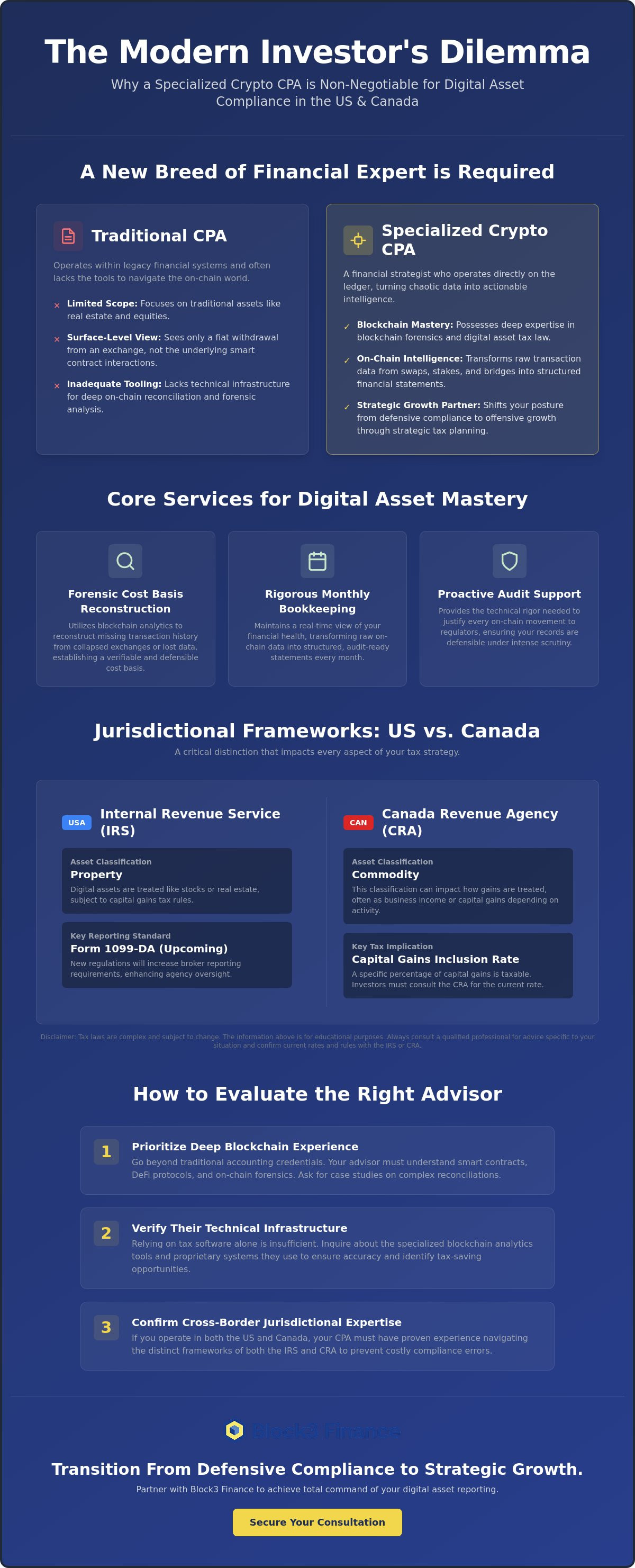
A crypto cpa is a certified professional who possesses specialized mastery in blockchain forensics and digital asset tax law. Unlike traditional accountants who focus on legacy assets like real estate or public equities, these experts operate directly on the ledger. They transform chaotic, raw transaction data into structured financial intelligence. This specialization is vital because the industry has moved beyond simple "buy and hold" strategies. We now inhabit an era of complex global crypto legal frameworks where every swap, stake, and bridge carries distinct tax implications.
The standard CPA often lacks the technical infrastructure to perform on-chain reconciliation. While a legacy professional might see a single withdrawal from an exchange, a specialist sees the underlying smart contract interaction. They navigate high-stakes environments with the mindset of a Visionary Navigator; they shift your posture from defensive compliance to offensive growth. This expertise is particularly critical when dealing with the jurisdictional divide between the United States and Canada. The IRS in the US treats digital assets as property, whereas the CRA in Canada classifies them as commodities. It's a distinction that dictates everything from cost basis to inclusion rates.
The limitations of standard tax software
Automated tax tools frequently struggle with the complexity of DeFi and NFT ecosystems. These platforms often miscalculate the cost basis, which refers to the original value of an asset for tax purposes, especially during multi-hop trades or liquidity pool entries. Relying solely on software without human oversight invites inaccuracies that can lead to audits. A professional provides the necessary intervention to ensure you maintain defensible financial records. They identify tax-saving opportunities, such as strategic loss harvesting, that algorithms typically overlook.
The role of the CPA in Web3 business growth
For scaling startups, the relationship with an advisor must evolve beyond annual filing. Integrated CFO services provide the strategic oversight needed to manage high-volume transactions and complex liquidity pool accounting. This involves more than just balancing books; it requires an elite strategist who understands how to resolve friction between on-chain activity and traditional reporting. A crypto cpa serves as the essential bridge between decentralized protocols and centralized regulatory requirements.
Core services of a professional crypto accounting firm
Professional accounting in the digital asset space is defined by the transformation of raw blockchain data into structured, audit-ready financial statements. It isn't enough to simply aggregate transaction history. A crypto cpa must perform a meticulous reconciliation process that accounts for gas fees, slippage, and complex smart contract interactions that standard ledger systems often ignore. For scaling startups, this process requires rigorous monthly bookkeeping to maintain a real-time view of runway and liabilities. Without this steady cadence, firms risk entering tax season with a chaotic backlog that obscures their true financial health.
The stakes for accuracy have never been higher. As tax authorities implement more aggressive tracking, having specialized audit support becomes a critical layer of defense. This service provides the technical rigor needed to justify every on-chain movement to regulators. Whether you are managing a treasury for a decentralized protocol or a high-frequency trading firm, your records must be defensible under intense scrutiny. This proactive approach shifts the focus from mere survival to long-term stability.
Tax filing and forensic cost basis reconstruction
Reconciling thousands of transactions across disparate wallets and exchanges is a forensic challenge. When exchanges collapse or data is lost, a crypto cpa utilizes advanced blockchain analytics to reconstruct missing history and establish a verifiable cost basis. This work is essential for maintaining tax compliance across jurisdictions. In the United States, taxpayers must adhere to specific IRS guidance on virtual currency, which treats these assets as property. Conversely, the Canadian CRA views cryptocurrency as a commodity, requiring a 50% capital gains inclusion rate for most individuals. We ensure that your reporting reflects these specific legal realities without conflating the two frameworks.
CFO and corporate entity structuring
Strategic growth requires an elite strategist who can look beyond the current tax year. Our CFO services provide Web3 firms and DAOs with the intellectual leadership needed to navigate international tax efficiency. This includes implementing robust on- and off-ramp solutions to ensure seamless fiat operations while staying within regulatory thresholds. Effective corporate structuring can significantly minimize long-term liability by positioning the entity correctly within global legal frameworks. If you are ready to gain total command over your financial future, exploring a partnership for monthly accounting and strategic oversight is the next logical step.
Jurisdictional frameworks: US IRS vs. Canadian CRA
Navigating cross-border digital asset compliance requires more than just general accounting knowledge. It demands the precision of a crypto cpa who understands that the IRS and CRA operate on fundamentally different philosophies. One of the most common mistakes global investors make is applying United States tax logic to Canadian returns. Such errors don't just lead to inaccuracies; they invite regulatory friction that can jeopardize your entire financial portfolio. While both jurisdictions generally treat cryptocurrency as property rather than legal tender, the specific reporting obligations and tax triggers vary significantly.
You must verify all current rates, thresholds, and filing deadlines directly with the respective authorities. Tax laws in this space evolve rapidly. Relying on outdated information or cross-border assumptions is a defensive posture that leads to audits. We advocate for an offensive strategy rooted in jurisdictional mastery. This ensures your growth remains protected regardless of where you reside or operate your business.
For those expanding their reach into the European Union, it is often necessary to explore Italian Fiscal Representation to navigate specific regional tax obligations and maintain a seamless international presence.
The United States perspective: IRS compliance
The Internal Revenue Service (IRS) requires every taxpayer to answer a specific question on Form 1040 regarding the receipt, sale, or exchange of digital assets. In the US, your transactions are categorized as either capital gains or ordinary income. If you sell an asset held for investment, it's a capital gain. However, if you receive assets through airdrops or staking rewards, the IRS treats the fair market value of those tokens as ordinary income at the moment of receipt. Failing to report these micro-events can create a systemic gap in your filing that a crypto cpa must forensically resolve.
The Canadian perspective: CRA compliance
The Canada Revenue Agency (CRA) views cryptocurrency as a commodity. The primary challenge in Canada is determining whether your activity constitutes a "business" or a "capital" transaction. This distinction depends on your intent and the frequency of your trades. If the CRA deems your activity as business income, 100% of your profits are taxable. For capital transactions, only a portion of the gain is included in your taxable income. You must also track your Adjusted Cost Base (ACB), which is the average cost of your holdings calculated in Canadian dollars at the time of each transaction. This requires meticulous record-keeping for both T1 individual and T2 corporate filings to ensure total command over your tax liability.
How to evaluate and hire the right crypto CPA
Selecting a financial partner in the Web3 space requires a fundamental shift in perspective. You aren't just looking for someone to fill out forms; you need an elite strategist who understands the technical nuances of decentralized finance. A crypto cpa must demonstrate deep immersion in the ecosystem to provide the level of protection your assets deserve. Generic accounting credentials provide a baseline of ethics, but they do not guarantee the technical rigor required to reconcile a multi-chain DeFi portfolio or handle the complexities of NFT minting. You deserve a partner who acts as a Visionary Navigator, transforming your volatile data into a roadmap for growth.
Look for firms that offer a comprehensive suite of services beyond basic tax filing. Integrated crypto-to-fiat payment solutions are a hallmark of a firm that truly navigates the friction between on-chain activity and legacy banking. Mastery over protocols like Uniswap, Aave, or Compound is non-negotiable. If an advisor cannot explain the tax implications of impermanent loss or DAO governance participation, they cannot effectively minimize your liability. A true specialist will prioritize experience and a proven track record of handling high-stakes environments over standard corporate accounting tenure.
Essential questions for your initial consultation
A structured interview process is the best way to vet a professional advisor. Focus your inquiries on their technical methodology and cross-border expertise. Consider asking these critical questions:
- How do you handle cost basis reconstruction for assets moved across Layer 2 networks or sidechains?
- What is your specific methodology for ensuring defensible record-keeping during a CRA or IRS audit?
- Can you navigate the specific cross-border reporting requirements for a US citizen residing in Canada or a Canadian firm with US subsidiaries?
These questions reveal whether a firm possesses the technical depth to serve as your strategic partner. Their answers should be methodical, logical, and grounded in current regulatory realities.
Red Flags to avoid when hiring
Ethics and transparency are the foundations of any professional relationship. Avoid any advisor who suggests omitting on-chain activity or "hiding" assets from regulators. This is a defensive, high-risk approach that often leads to catastrophic legal consequences. Be wary of firms that rely on manual spreadsheets instead of specialized blockchain accounting tools. A lack of historical blockchain knowledge is a deal-breaker because it prevents the accurate reconstruction of early-stage transactions and cost basis data. Additionally, be cautious of firms that provide a generic approach to international tax; a strategy that works for the IRS in the United States may be entirely incompatible with the CRA's commodity-based framework in Canada. If you require an elite partner to secure your digital future, partner with our specialized accounting team to begin your journey toward total financial command.
Block3 Finance: Your partner in digital asset mastery
In a landscape defined by volatility and rapid regulatory evolution, your choice of a financial partner determines your trajectory. Block3 Finance operates as a Visionary Navigator for high-stakes environments, providing the technical rigor of a traditional auditor alongside the mindset of a bold innovator. We bring over 13 years of specialized blockchain financial expertise to the table. This deep historical knowledge allows our team to resolve friction that standard accounting firms cannot even identify. By partnering with a specialized crypto cpa, you shift your narrative from merely managing regulations to achieving total command over your growth.
Our firm has cultivated a reputation for stability and intellectual depth within the digital asset space. We don't just observe the industry; we are active participants in its evolution. This commitment to best practices ensures that your financial statements remain audit-ready regardless of how complex your on-chain activity becomes. We empower our clients to move from a state of anxiety over potential audits to a position of agency and liberation. It is time to stop reacting to the market and start mastering it.
Why 980+ clients trust our blockchain expertise
Our track record is built on the ability to transform chaotic on-chain data into clean, professional financial records. With over 980 global clients, we have refined a methodology that scales with the needs of individual investors and multi-national Web3 firms alike. While we maintain deep local roots in Ontario, our international offices provide the global reach necessary to navigate cross-border compliance. This includes maintaining a strict distinction between the commodity-based reporting requirements of the CRA in Canada and the property-based rules enforced by the IRS in the United States. Our work has earned recognition as a top-tier provider by Bitcoin.com, a testament to our standing as a trusted financial institution in the crypto ecosystem.
Take command of your financial future
True mastery requires an offensive approach to compliance. Instead of reacting to new rules, we help you anticipate them through strategic planning and robust corporate structuring. We ensure that your filings for both the US and Canadian jurisdictions are accurate, timely, and optimized to minimize liability through legal frameworks. Whether you are navigating the new reporting requirements of the IRS in the United States or tracking the adjusted cost base for the CRA in Canada, our team provides the intellectual leadership you need to thrive. Secure your audit-ready financials and take the first step toward total financial command. You can begin this journey by engaging with Block3 Finance professional services to secure your next filing season.
Achieve Total Command Over Your Digital Assets
The era of casual crypto reporting has ended. As the IRS and CRA deploy increasingly sophisticated analytics, your financial security depends on the technical rigor of your records. We've explored why a specialized crypto cpa is essential for reconciling complex on-chain events and why distinguishing between US property rules and Canadian commodity frameworks is the only way to avoid systemic risk. Transitioning from raw data to audit-ready statements requires more than software; it requires a navigator who understands the history and future of the ledger.
You don't have to navigate this volatile environment alone. Block3 Finance provides the intellectual leadership and forensic mastery needed to turn chaotic data into a strategic asset. Ranked #1 by Bitcoin.com and trusted by 980+ clients globally, our team brings 13+ years of blockchain financial expertise to every engagement. It's time to reclaim your agency and move toward total financial command.
Secure your financial future with Block3 Finance, the Visionary Navigators of crypto accounting.
Your path to audit-ready financials and minimized liability starts with a commitment to excellence. We're ready to help you evolve and thrive in this new economy.
Frequently Asked Questions
What is a Crypto CPA and how do they differ from traditional accountants?
A crypto cpa is a certified professional who possesses specialized mastery in blockchain forensics and digital asset tax law. They differ from traditional accountants by operating directly on the ledger instead of merely processing bank statements. This expertise is vital for navigating high-stakes environments where legacy accounting systems fail to capture the technical reality of smart contract interactions and decentralized protocols.
Do I need a Crypto CPA if I already use crypto tax software?
Automated tools often provide a false sense of security; they frequently miscalculate cost basis for complex DeFi swaps or NFT mints. A specialist provides the human professional oversight necessary to produce audit-ready financial statements that stand up to regulatory scrutiny. While software is a useful tool, a professional navigator ensures your records are defensible and identifies tax-saving opportunities that algorithms miss.
How does the IRS (US) view cryptocurrency differently than the CRA (Canada)?
The US IRS classifies digital assets as property, requiring specific reporting on Form 1040; meanwhile, the Canadian CRA treats these assets as commodities. In the United States, you must report airdrops or staking rewards as ordinary income at their fair market value at the time of receipt. In Canada, you must track your Adjusted Cost Base (ACB) in Canadian dollars to determine if a transaction results in business income or capital gains.
Can a Crypto CPA help me if I have lost my historical transaction data?
Forensic cost basis reconstruction allows a professional to rebuild your transaction history even when exchange data is missing or lost. By using specialized blockchain analytics, a specialist can trace the movement of assets through your wallets to establish a verifiable financial record. This proactive approach resolves friction and ensures your filings remain accurate despite historical data gaps or defunct exchange records.
Are NFT and DeFi transactions taxed differently than simple Bitcoin trades?
Complex interactions like staking rewards, liquidity pool entries, and NFT minting trigger different tax events than simple buy and hold strategies. Simple trades usually result in straightforward capital gains or losses. However, DeFi events often involve multiple taxable steps, such as wrapping tokens or receiving interest; these require precise accounting to avoid overpaying or triggering an audit from the IRS or CRA.
What happens if I fail to report my cryptocurrency holdings to the IRS or CRA?
Non-compliance triggers aggressive enforcement actions, including substantial penalties and interest charges from both the IRS and CRA. In the United States, the IRS includes a mandatory digital asset question on Form 1040 to identify non-filers. In Canada, financial institutions are required to report transactions over $10,000 to FINTRAC, providing the CRA with significant visibility into your fiat movements and potential tax liabilities.
How much does it cost to hire a specialized crypto accounting firm?
Professional fees depend entirely on the volume of your transactions and the technical complexity of your on-chain activity. A high-frequency DeFi trader requires more forensic reconciliation than a long-term holder with fewer movements. You should contact a specialized firm directly to receive a tailored quote based on your specific portfolio needs rather than relying on generic industry estimates that may not reflect your situation.
Can a Crypto CPA assist with corporate structuring for a Web3 startup?
Integrated CFO services provide the strategic leadership required to optimize corporate shells for international tax efficiency and regulatory stability. This includes implementing robust on-ramp and off-ramp solutions and managing treasury operations for DAOs or Web3 firms. A crypto cpa ensures that your entity is structured to minimize long-term liability while maintaining total command over cross-border regulatory requirements in both US and Canadian jurisdictions.

Article by
Mahad Mohamed
Mahad Mohamed is an accountant and the CEO of Block3 Finance, with over 26+ years of Canadian and international tax and accounting experience. A crypto accounting specialist since the early days of Bitcoin, he has consulted for over 38 crypto companies and collaborated with legal professionals on regulatory matters. His expertise spans corporate reorganization, cross-border tax structuring (Canada & US), tax disputes, and CRA audits.
Previously, Mahad worked for the Canada Revenue Agency (CRA), Big4 accounting firms, and served as a Rulings Officer for the Federal Tax Authority of the UAE before acquiring Tax Partners in 2014.
Block3 Finance and Tax Partners has 44 full-time accountants and over 9,800+ clients.
Disclaimer
This article provides general information only and is current as of its publication date. It has not been updated and may be out of date. It does not constitute legal advice and should not be relied upon as such. Every tax situation is unique and may differ from the examples discussed in this article. If you have specific questions, you should seek the advice of our accountants for your unique circumstances.
Frequently Asked Questions
The limitations of standard tax software
Automated tax tools frequently struggle with the complexity of DeFi and NFT ecosystems. These platforms often miscalculate the cost basis, which refers to the original value of an asset for tax purposes, especially during multi-hop trades or liquidity pool entries. Relying solely on software without human oversight invites inaccuracies that can lead to audits. A professional provides the necessary intervention to ensure you maintain defensible financial records. They identify tax-saving opportunities, such as strategic loss harvesting, that algorithms typically overlook.
The role of the CPA in Web3 business growth
For scaling startups, the relationship with an advisor must evolve beyond annual filing. Integrated CFO services provide the strategic oversight needed to manage high-volume transactions and complex liquidity pool accounting. This involves more than just balancing books; it requires an elite strategist who understands how to resolve friction between on-chain activity and traditional reporting. A crypto cpa serves as the essential bridge between decentralized protocols and centralized regulatory requirements. Professional accounting in the digital asset space is defined by the transformation of raw blockchain data into structured, audit-ready financial statements. It isn't enough to simply aggregate transaction history. A crypto cpa must perform a meticulous reconciliation process that accounts for gas fees, slippage, and complex smart contract interactions that standard ledger systems often ignore. For scaling startups, this process requires rigorous monthly bookkeeping to maintain a real-time view of runway and liabilities. Without this steady cadence, firms risk entering tax season with a chaotic backlog that obscures their true financial health. The stakes for accuracy have never been higher. As tax authorities implement more aggressive tracking, having specialized audit support becomes a critical layer of defense. This service provides the technical rigor needed to justify every on-chain movement to regulators. Whether you are managing a treasury for a decentralized protocol or a high-frequency trading firm, your records must be defensible under intense scrutiny. This proactive approach shifts the focus from mere survival to long-term stability.
Tax filing and forensic cost basis reconstruction
Reconciling thousands of transactions across disparate wallets and exchanges is a forensic challenge. When exchanges collapse or data is lost, a crypto cpa utilizes advanced blockchain analytics to reconstruct missing history and establish a verifiable cost basis. This work is essential for maintaining tax compliance across jurisdictions. In the United States, taxpayers must adhere to specific IRS guidance on virtual currency, which treats these assets as property. Conversely, the Canadian CRA views cryptocurrency as a commodity, requiring a 50% capital gains inclusion rate for most individuals. We ensure that your reporting reflects these specific legal realities without conflating the two frameworks.
CFO and corporate entity structuring
Strategic growth requires an elite strategist who can look beyond the current tax year. Our CFO services provide Web3 firms and DAOs with the intellectual leadership needed to navigate international tax efficiency. This includes implementing robust on- and off-ramp solutions to ensure seamless fiat operations while staying within regulatory thresholds. Effective corporate structuring can significantly minimize long-term liability by positioning the entity correctly within global legal frameworks. If you are ready to gain total command over your financial future, exploring a partnership for monthly accounting and strategic oversight is the next logical step. Navigating cross-border digital asset compliance requires more than just general accounting knowledge. It demands the precision of a crypto cpa who understands that the IRS and CRA operate on fundamentally different philosophies. One of the most common mistakes global investors make is applying United States tax logic to Canadian returns. Such errors don't just lead to inaccuracies; they invite regulatory friction that can jeopardize your entire financial portfolio. While both jurisdictions generally treat cryptocurrency as property rather than legal tender, the specific reporting obligations and tax triggers vary significantly. You must verify all current rates, thresholds, and filing deadlines directly with the respective authorities. Tax laws in this space evolve rapidly. Relying on outdated information or cross-border assumptions is a defensive posture that leads to audits. We advocate for an offensive strategy rooted in jurisdictional mastery. This ensures your growth remains protected regardless of where you reside or operate your business.
The United States perspective: IRS compliance
The Internal Revenue Service (IRS) requires every taxpayer to answer a specific question on Form 1040 regarding the receipt, sale, or exchange of digital assets. In the US, your transactions are categorized as either capital gains or ordinary income. If you sell an asset held for investment, it's a capital gain. However, if you receive assets through airdrops or staking rewards, the IRS treats the fair market value of those tokens as ordinary income at the moment of receipt. Failing to report these micro-events can create a systemic gap in your filing that a crypto cpa must forensically resolve.
The Canadian perspective: CRA compliance
The Canada Revenue Agency (CRA) views cryptocurrency as a commodity. The primary challenge in Canada is determining whether your activity constitutes a "business" or a "capital" transaction. This distinction depends on your intent and the frequency of your trades. If the CRA deems your activity as business income, 100% of your profits are taxable. For capital transactions, only a portion of the gain is included in your taxable income. You must also track your Adjusted Cost Base (ACB), which is the average cost of your holdings calculated in Canadian dollars at the time of each transaction. This requires meticulous record-keeping for both T1 individual and T2 corporate filings to ensure total command over your tax liability. Selecting a financial partner in the Web3 space requires a fundamental shift in perspective. You aren't just looking for someone to fill out forms; you need an elite strategist who understands the technical nuances of decentralized finance. A crypto cpa must demonstrate deep immersion in the ecosystem to provide the level of protection your assets deserve. Generic accounting credentials provide a baseline of ethics, but they do not guarantee the technical rigor required to reconcile a multi-chain DeFi portfolio or handle the complexities of NFT minting. You deserve a partner who acts as a Visionary Navigator, transforming your volatile data into a roadmap for growth. Look for firms that offer a comprehensive suite of services beyond basic tax filing. Integrated crypto-to-fiat payment solutions are a hallmark of a firm that truly navigates the friction between on-chain activity and legacy banking. Mastery over protocols like Uniswap, Aave, or Compound is non-negotiable. If an advisor cannot explain the tax implications of impermanent loss or DAO governance participation, they cannot effectively minimize your liability. A true specialist will prioritize experience and a proven track record of handling high-stakes environments over standard corporate accounting tenure.
Essential questions for your initial consultation
A structured interview process is the best way to vet a professional advisor. Focus your inquiries on their technical methodology and cross-border expertise. Consider asking these critical questions: These questions reveal whether a firm possesses the technical depth to serve as your strategic partner. Their answers should be methodical, logical, and grounded in current regulatory realities.
Red Flags to avoid when hiring
Ethics and transparency are the foundations of any professional relationship. Avoid any advisor who suggests omitting on-chain activity or "hiding" assets from regulators. This is a defensive, high-risk approach that often leads to catastrophic legal consequences. Be wary of firms that rely on manual spreadsheets instead of specialized blockchain accounting tools. A lack of historical blockchain knowledge is a deal-breaker because it prevents the accurate reconstruction of early-stage transactions and cost basis data. Additionally, be cautious of firms that provide a generic approach to international tax; a strategy that works for the IRS in the United States may be entirely incompatible with the CRA's commodity-based framework in Canada. If you require an elite partner to secure your digital future, partner with our specialized accounting team to begin your journey toward total financial command. In a landscape defined by volatility and rapid regulatory evolution, your choice of a financial partner determines your trajectory. Block3 Finance operates as a Visionary Navigator for high-stakes environments, providing the technical rigor of a traditional auditor alongside the mindset of a bold innovator. We bring over 13 years of specialized blockchain financial expertise to the table. This deep historical knowledge allows our team to resolve friction that standard accounting firms cannot even identify. By partnering with a specialized crypto cpa, you shift your narrative from merely managing regulations to achieving total command over your growth. Our firm has cultivated a reputation for stability and intellectual depth within the digital asset space. We don't just observe the industry; we are active participants in its evolution. This commitment to best practices ensures that your financial statements remain audit-ready regardless of how complex your on-chain activity becomes. We empower our clients to move from a state of anxiety over potential audits to a position of agency and liberation. It is time to stop reacting to the market and start mastering it.
Why 980+ clients trust our blockchain expertise
Our track record is built on the ability to transform chaotic on-chain data into clean, professional financial records. With over 980 global clients, we have refined a methodology that scales with the needs of individual investors and multi-national Web3 firms alike. While we maintain deep local roots in Ontario, our international offices provide the global reach necessary to navigate cross-border compliance. This includes maintaining a strict distinction between the commodity-based reporting requirements of the CRA in Canada and the property-based rules enforced by the IRS in the United States. Our work has earned recognition as a top-tier provider by Bitcoin.com, a testament to our standing as a trusted financial institution in the crypto ecosystem.
Take command of your financial future
True mastery requires an offensive approach to compliance. Instead of reacting to new rules, we help you anticipate them through strategic planning and robust corporate structuring. We ensure that your filings for both the US and Canadian jurisdictions are accurate, timely, and optimized to minimize liability through legal frameworks. Whether you are navigating the new reporting requirements of the IRS in the United States or tracking the adjusted cost base for the CRA in Canada, our team provides the intellectual leadership you need to thrive. Secure your audit-ready financials and take the first step toward total financial command. You can begin this journey by engaging with Block3 Finance professional services to secure your next filing season. The era of casual crypto reporting has ended. As the IRS and CRA deploy increasingly sophisticated analytics, your financial security depends on the technical rigor of your records. We've explored why a specialized crypto cpa is essential for reconciling complex on-chain events and why distinguishing between US property rules and Canadian commodity frameworks is the only way to avoid systemic risk. Transitioning from raw data to audit-ready statements requires more than software; it requires a navigator who understands the history and future of the ledger. You don't have to navigate this volatile environment alone. Block3 Finance provides the intellectual leadership and forensic mastery needed to turn chaotic data into a strategic asset. Ranked #1 by Bitcoin.com and trusted by 980+ clients globally, our team brings 13+ years of blockchain financial expertise to every engagement. It's time to reclaim your agency and move toward total financial command. Secure your financial future with Block3 Finance, the Visionary Navigators of crypto accounting. Your path to audit-ready financials and minimized liability starts with a commitment to excellence. We're ready to help you evolve and thrive in this new economy.
What is a Crypto CPA and how do they differ from traditional accountants?
A crypto cpa is a certified professional who possesses specialized mastery in blockchain forensics and digital asset tax law. They differ from traditional accountants by operating directly on the ledger instead of merely processing bank statements. This expertise is vital for navigating high-stakes environments where legacy accounting systems fail to capture the technical reality of smart contract interactions and decentralized protocols.
Do I need a Crypto CPA if I already use crypto tax software?
Automated tools often provide a false sense of security; they frequently miscalculate cost basis for complex DeFi swaps or NFT mints. A specialist provides the human professional oversight necessary to produce audit-ready financial statements that stand up to regulatory scrutiny. While software is a useful tool, a professional navigator ensures your records are defensible and identifies tax-saving opportunities that algorithms miss.
How does the IRS (US) view cryptocurrency differently than the CRA (Canada)?
The US IRS classifies digital assets as property, requiring specific reporting on Form 1040; meanwhile, the Canadian CRA treats these assets as commodities. In the United States, you must report airdrops or staking rewards as ordinary income at their fair market value at the time of receipt. In Canada, you must track your Adjusted Cost Base (ACB) in Canadian dollars to determine if a transaction results in business income or capital gains.
Can a Crypto CPA help me if I have lost my historical transaction data?
Forensic cost basis reconstruction allows a professional to rebuild your transaction history even when exchange data is missing or lost. By using specialized blockchain analytics, a specialist can trace the movement of assets through your wallets to establish a verifiable financial record. This proactive approach resolves friction and ensures your filings remain accurate despite historical data gaps or defunct exchange records.
Are NFT and DeFi transactions taxed differently than simple Bitcoin trades?
Complex interactions like staking rewards, liquidity pool entries, and NFT minting trigger different tax events than simple buy and hold strategies. Simple trades usually result in straightforward capital gains or losses. However, DeFi events often involve multiple taxable steps, such as wrapping tokens or receiving interest; these require precise accounting to avoid overpaying or triggering an audit from the IRS or CRA.
What happens if I fail to report my cryptocurrency holdings to the IRS or CRA?
Non-compliance triggers aggressive enforcement actions, including substantial penalties and interest charges from both the IRS and CRA. In the United States, the IRS includes a mandatory digital asset question on Form 1040 to identify non-filers. In Canada, financial institutions are required to report transactions over $10,000 to FINTRAC, providing the CRA with significant visibility into your fiat movements and potential tax liabilities.
How much does it cost to hire a specialized crypto accounting firm?
Professional fees depend entirely on the volume of your transactions and the technical complexity of your on-chain activity. A high-frequency DeFi trader requires more forensic reconciliation than a long-term holder with fewer movements. You should contact a specialized firm directly to receive a tailored quote based on your specific portfolio needs rather than relying on generic industry estimates that may not reflect your situation.
Can a Crypto CPA assist with corporate structuring for a Web3 startup?
Integrated CFO services provide the strategic leadership required to optimize corporate shells for international tax efficiency and regulatory stability. This includes implementing robust on-ramp and off-ramp solutions and managing treasury operations for DAOs or Web3 firms. A crypto cpa ensures that your entity is structured to minimize long-term liability while maintaining total command over cross-border regulatory requirements in both US and Canadian jurisdictions.