
The June 2026 ruling in Paschall v. Commissioner has effectively ended the era of ambiguity regarding when digital assets become taxable. If you have the unrestricted ability to sell, exchange, or dispose of your rewards, the IRS considers that exact moment the definitive point of receipt. Mastering the nuances of crypto staking tax treatment is no longer just a compliance hurdle; it's a strategic necessity for any serious participant in the blockchain ecosystem.
Tracking thousands of daily micro-transactions while managing the ambiguous status of Liquid Staking Tokens (LSTs) creates a systemic friction that can feel overwhelming. You're right to be concerned about the precision of your cost-basis tracking, especially as the rollout of Form 1099-DA signals a significant increase in IRS monitoring and enforcement. This guide empowers you to master the complexities of staking tax liability by applying the "dominion and control" framework to your specific portfolio. You'll gain a clear methodology for calculating Fair Market Value and building defensible financial records. We will outline the exact steps required to ensure your 2026 filings are audit-ready, shifting your focus from the fear of regulation to the total command of your digital wealth.
Key Takeaways
- Understand how the evolution of IRS Revenue Ruling 2023-14 into the 2026 regulatory environment has shifted the burden of proof directly onto the individual taxpayer.
- Master the "dominion and control" framework to precisely time your crypto staking tax treatment, ensuring you recognize income only when you gain the legal authority to dispose of assets.
- Establish a defensible cost basis by implementing consistent pricing oracles that capture the fair market value of rewards at the exact minute of receipt.
- Navigate the specialized tax nuances of Liquid Staking Tokens and DeFi protocols to accurately distinguish between taxable swaps and non-taxable asset wrapping.
- Transform fragmented on-chain transaction data into clean, audit-ready financial records that satisfy the rigorous requirements of 2026 institutional compliance.
The 2026 Landscape: Why Crypto Staking Tax Treatment Matters
The fiscal environment of 2026 represents a paradigm shift in digital asset oversight. While the industry once operated under a voluntary disclosure ethos, the implementation of Form 1099-DA has transitioned the market into an era of automated transparency. The IRS now receives direct data on gross proceeds from digital asset brokers, leaving little room for retroactive adjustments or omissions. This evolution stems from Revenue Ruling 2023-14, which codified the requirement to report rewards as income upon receipt. The 2026 ruling in Paschall v. Commissioner has further refined this, establishing that dominion and control is the singular trigger for liability. Precision is now the baseline.
Global tax authorities have intensified their focus on Proof-of-Stake (PoS) protocols because these systems generate predictable, high-frequency wealth. For active participants, the sheer volume of daily or even hourly micro-transactions creates a significant accounting burden. Managing this data requires more than a spreadsheet. It demands a sophisticated framework for crypto staking tax treatment that can withstand the scrutiny of a modern audit. The margin for error has vanished. Professional accounting is no longer a luxury for high-volume stakers; it's a defensive necessity for preserving capital.
Staking as Gross Income: The Foundation
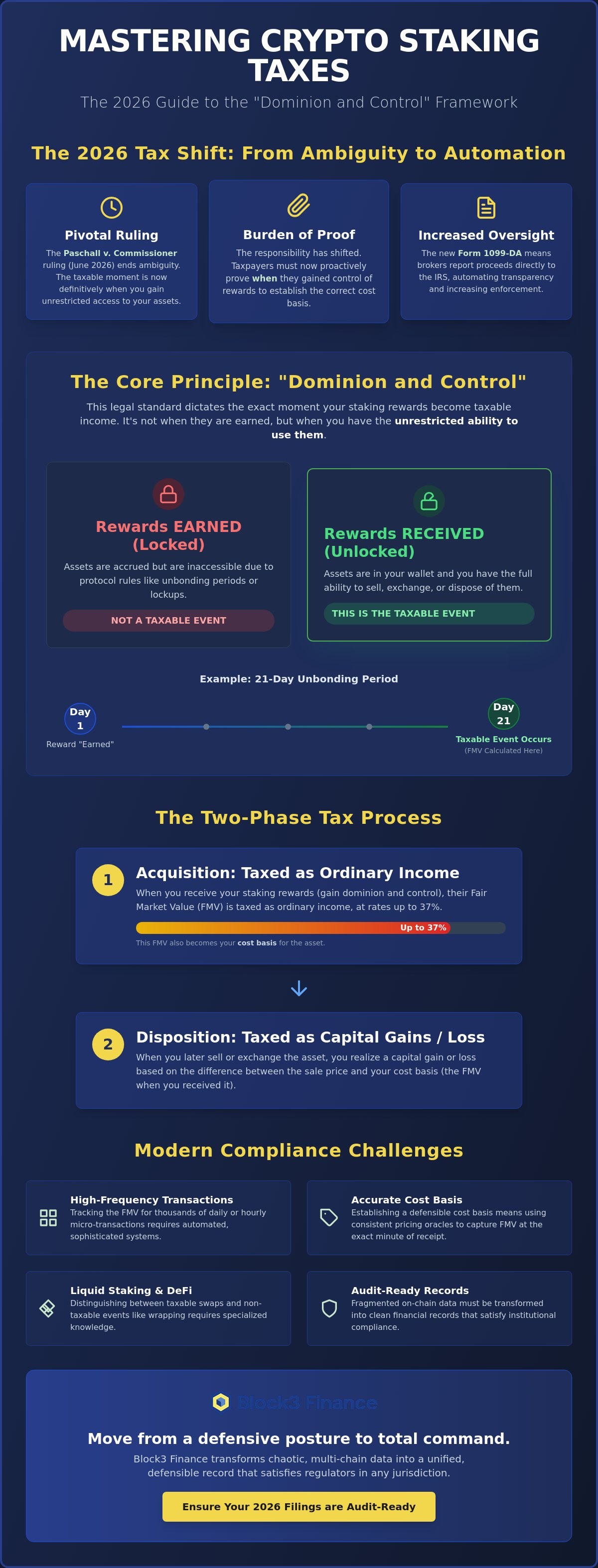
The Internal Revenue Code is clear under Section 61(a): all accessions to wealth are taxable unless specifically excluded. Staking rewards do not qualify for exclusion. Instead, they're treated as ordinary income based on their Fair Market Value (FMV) at the moment of receipt. This creates a critical distinction for your tax strategy. While the eventual sale of the asset may trigger a capital gain or loss, the initial acquisition is taxed at ordinary rates. These rates can reach as high as 37% for single filers earning over $640,600 in 2026. For corporate entities, the reporting requirements are even more stringent, requiring meticulous ledger entries that reconcile on-chain activity with traditional balance sheets.
Global Context: Beyond the IRS
Compliance is rarely a single-jurisdiction effort for the modern investor. The UK's HMRC and Canada's CRA have mirrored the IRS's proactive stance, though their specific definitions of disposal and income often diverge in subtle, high-stakes ways. International investors must reconcile these conflicting rules to avoid double taxation or unintended penalties. Block3 Finance serves as a strategic partner in this space, providing the cross-border expertise necessary to navigate these diverse legal frameworks. We transform chaotic, multi-chain data into a unified, defensible record that satisfies regulators in any jurisdiction. We move you from a defensive posture to one of total command over your global portfolio.
Defining 'Dominion and Control' in Staking Transactions
Dominion and control is the legal moment a taxpayer gains the ability to sell, exchange, or otherwise dispose of an asset. This legal standard serves as the pivot point for your crypto staking tax treatment; it dictates the exact fair market value you must report to the IRS. While a protocol may accrue rewards for your validator daily, the date of receipt is often legally distinct from the date the reward was earned. If an asset is subject to an unbonding period or a protocol-level lockup, you don't possess dominion until those restrictions lapse. You cannot be taxed on wealth you cannot yet access, but the moment that barrier falls, the tax clock starts ticking.
The friction between 'earned' and 'received' is most visible in the unbonding periods common to many Proof-of-Stake networks. During a 21 or 28 day unbonding window, your assets are in a state of transit; you lack the power to dispose of them. Therefore, the taxable event occurs when the tokens finally land in your spendable balance. This distinction is critical for high-stakes portfolios where price volatility during the unbonding period can significantly alter your ultimate tax liability. Whether you use non-custodial wallets or centralized platforms, the timing of your "ability to dispose" remains the definitive metric for compliance.
Locked vs. Unlocked Rewards
Compounding rewards present a unique challenge. In many systems, rewards are automatically re-staked, increasing your bonded position without a manual claim. If you have the power to 'unstake' at any time, the IRS likely considers you in control of those rewards as they accrue. This is why dominion and control remains the most contested area in modern audits. Taxpayers often argue that 'bonded' tokens are restricted, while the IRS, citing IRS Revenue Ruling 2023-14, focuses on the taxpayer's constructive receipt of the wealth. Strategic timing of your claims can help manage this liability, but only if your records are flawless.
The Role of Centralized Exchanges
Centralized exchanges simplify the user experience but complicate the reporting trail. Platforms now issue Form 1099-DA, which reports your 'dominion' based on their internal ledger. However, relying solely on exchange data is risky for complex activity. These forms often fail to account for off-platform movements or specific cost-basis nuances. Our team at Block3 Finance utilizes a rigorous methodology to reconcile exchange-provided data with on-chain reality, ensuring your filings are defensible. Consulting a professional crypto tax accountant allows you to move from a defensive posture to one of total mastery over your financial narrative.
Calculating Fair Market Value and Establishing Cost Basis
Determining the Fair Market Value (FMV) of tokens at the exact minute of receipt is the cornerstone of a defensible tax strategy. In a 24/7 market characterized by high volatility, a few minutes of delay can significantly skew your reported income. This precision is vital because your initial valuation establishes the cost basis for every future transaction involving that asset. While the Jarrett 2.0 lawsuit continues to challenge the timing and nature of these taxable events, the current regulatory expectation remains fixed on the fair market value at the moment of dominion. You must capture this data in real-time to prevent the accumulation of data rot that often plagues year-end reporting.
The cumulative effect of cost basis tracking cannot be overstated. Every staking reward you receive is an acquisition that will eventually trigger a capital gain or loss upon disposal. If you fail to record the FMV accurately at the start, your entire financial narrative becomes vulnerable to correction. For high-frequency stakers, managing 'dust' rewards creates an additional layer of friction. In 2026, practical bookkeeping requires establishing clear thresholds for these micro-transactions. While the IRS technically requires reporting of all income, utilizing a consistent, automated framework for aggregate reporting of sub-cent rewards can streamline your ledger without sacrificing compliance.
Price Oracle Selection and Consistency
Success in crypto staking tax treatment depends on the integrity of your data sources. Whether you utilize reputable aggregators like CoinGecko and CoinMarketCap or rely on DEX-specific pricing for niche tokens, your choice must be documented and applied universally. Switching your valuation methodology or pricing sources in the middle of a fiscal year signals a lack of systemic integrity and serves as a major red flag for IRS auditors. We recommend a "white-glove" approach to data curation, ensuring that your pricing oracles align with the liquidity pools where you actually operate. This level of intellectual depth transforms your records from a mere list of numbers into a robust roadmap for audit defense.
Cost Basis Tracking for Future Sales
Your staking income today is the foundation for your capital gains tomorrow. Choosing between accounting methods like FIFO (First-In, First-Out) or HIFO (Highest-In, First-Out) allows you to strategically manage your tax burden when you eventually exit a position. However, these strategies are only effective if your data is clean and current. The necessity of monthly bookkeeping has never been more apparent than in the 2026 landscape. We help you navigate these choices, ensuring that your accounting method aligns with your broader financial goals while maintaining total command over your volatile portfolio. By resolving the friction of on-chain data now, you secure your agency for the future.
Advanced Scenarios: Liquid Staking, Slashing, and DeFi
Complexity is the natural byproduct of financial innovation. As you move beyond basic validator rewards into the world of liquid derivatives and decentralized protocols, your crypto staking tax treatment requires a higher level of intellectual rigor. The introduction of Liquid Staking Tokens (LSTs) and the inherent risks of network slashing create unique friction points that traditional accounting methods often fail to resolve. You must navigate these advanced scenarios with a proactive strategy that anticipates regulatory scrutiny rather than reacting to it. Mastery of these nuances is what separates the passive observer from the sophisticated market participant.
The intersection of staking and DeFi yield farming creates layered tax liabilities that can quickly become unmanageable without a methodical framework. When you commit staked assets to liquidity pools or use them as collateral, you're often triggering multiple taxable events simultaneously. These include the accrual of ordinary income from rewards and the potential capital gains from the movement of the underlying assets. Resolving these frictions requires a deep immersion in smart contract logic to ensure that every transaction is categorized with precision. We believe that vision and execution are inseparable, especially when protecting high-stakes portfolios from inaccurate reporting.
Liquid Staking: Income or Exchange?
The debate surrounding Liquid Staking Tokens like stETH or jitoSOL centers on whether the initial acquisition constitutes a property-for-property exchange. If you swap native ETH for stETH, the 2026 consensus increasingly views this as a taxable disposal of the original asset, triggering an immediate capital gain or loss based on the fair market value at that moment. However, the subsequent "accrual" of value within the LST—where the token's price increases relative to the underlying asset—presents a different challenge. Global jurisdictions remain divided on whether this internal growth is taxable income or a deferred gain. We provide high-net-worth investors with the specialized oversight needed to document these positions, ensuring that every swap and rebase is reflected in a clean, defensible ledger.
Slashing and Network Penalties
Network penalties, or "slashing," represent a direct loss of principal that most generic tax software is unequipped to handle. Under 2026 rules, these events are typically treated as investment losses, but the burden of proof rests entirely on the taxpayer. You must provide clear on-chain evidence that a slashing event occurred and that your balance was reduced by the protocol's consensus rules. Since these losses are not "disposals" in the traditional sense, they require manual adjustment to your cost basis to ensure you aren't overpaying on future gains. If your portfolio involves high-stakes validation, you need a partner who understands the technical nuances of protocol-level penalties. Our Audits and Compliance services are designed to transform this chaotic on-chain data into a position of strategic strength, giving you total command over your digital wealth.
Institutional Compliance with Block3 Finance
Block3 Finance leverages over 13 years of specialized expertise to resolve the systemic friction between complex blockchain activity and legacy financial systems. We serve as a visionary navigator for high-volume traders, decentralized autonomous organizations (DAOs), and emerging Web3 startups. Our methodology transforms chaotic on-chain data into clean, defensible financial records that satisfy the most rigorous institutional standards. We move beyond simple reporting. We empower you to gain total command over your fiscal narrative. Mastering your crypto staking tax treatment requires a blend of technical auditing and strategic foresight that generic services cannot provide. We lead where others follow.
The distinction between individual stakers and corporate or DAO operations is a critical gap in the current market. While an individual may focus on personal income, a DAO requires a partner who can navigate the intersection of treasury management, corporate governance, and tax liability. Web3 startups face the additional burden of reconciling payroll and operational expenses against a volatile digital treasury. Our team provides the intellectual leadership and mentorship necessary to thrive in this high-stakes environment. We don't just manage your regulations; we help you master them.
Beyond Software: The Need for Specialized Accountants
Standard tax software often collapses under the weight of high-frequency transactions and intricate DeFi interactions. These automated tools frequently miscategorize wrapping events or fail to account for the nuances of "dominion and control" that we have established as the 2026 legal standard. They lack the intellectual depth required to reconcile liquid staking rewards or protocol-level slashing events with precision. The Block3 advantage lies in our proactive human oversight of automated data ingestion. We build a comprehensive audit trail that stands up to the heightened regulatory scrutiny of 2026. This disciplined approach ensures that your records are not just compliant, but optimized for long-term growth and audit defense.
Strategic Corporate Structuring
Transitioning from a passive staker to a structured business entity can significantly enhance your capital efficiency and agency. Our team provides strategic corporate structuring to maximize expense deductibility and streamline operational overhead. By treating your staking operations as a formal enterprise, you unlock the ability to deduct hardware costs, node hosting fees, and professional advisory services. This shift from a defensive posture to an offensive one is core to our philosophy. We also implement robust on- and off-ramp solutions for corporate treasuries, facilitating seamless movement between digital assets and fiat liquidity. Through our specialized CFO services, we provide a roadmap for thriving in a volatile landscape. Vision and execution are inseparable. Secure your 2026 tax compliance with a Block3 specialist.
Command Your Digital Legacy
The 2026 regulatory shift has turned precision into a prerequisite for wealth preservation. You've seen how the "dominion and control" framework dictates the timing of your liability, while consistent valuation methodologies protect your cost basis from future erosion. Navigating the nuances of crypto staking tax treatment is no longer a matter of guesswork; it's a strategic operation that requires the technical rigor of a seasoned strategist. By resolving the friction of complex liquid staking and slashing events now, you secure your financial agency for the years ahead.
Block3 Finance stands as your partner in this evolution. As the firm ranked #1 Crypto Tax Firm by Bitcoin.com, we bring over 13 years of blockchain financial expertise to your portfolio. We've served more than 980 global clients, transforming fragmented on-chain data into defensible, institutional-grade records. Don't let the complexity of modern compliance hinder your growth. Schedule a consultation for specialized crypto tax filing to ensure your strategy is as innovative as the assets you hold. You possess the vision to build; we provide the roadmap to thrive.
Frequently Asked Questions
Is crypto staking considered income or capital gains?
Staking rewards are categorized as ordinary income at the moment you gain dominion and control over the assets. This initial valuation establishes your cost basis; any subsequent change in value between the time of receipt and the time of sale is then treated as a capital gain or loss. This dual-layered crypto staking tax treatment ensures that the IRS captures the value of the new property as income while taxing the appreciation as a separate investment event.
What happens if I don't report my staking rewards on my taxes?
Failure to report staking rewards can trigger a cascade of regulatory friction, including accuracy-related penalties, compounded interest, and heightened audit risk. Since the 2026 rollout of Form 1099-DA, the IRS possesses automated data on many digital asset transactions, making omissions easily detectable. Maintaining a proactive stance through transparent reporting is the only way to ensure total command over your financial future and avoid the heavy hand of enforcement.
How do I calculate the fair market value of daily staking rewards?
You calculate the fair market value by identifying the token's price on a reputable exchange or aggregator at the exact minute you gain the ability to dispose of it. For high-frequency rewards, we recommend utilizing automated tools that pull data from consistent pricing oracles to maintain a defensible record. This methodical approach resolves the friction of daily price volatility and ensures your cost basis is grounded in verifiable on-chain reality.
Are liquid staking tokens (LSTs) taxed differently than direct staking?
Liquid staking tokens often trigger different tax events because the initial move from a native token to a derivative like stETH is frequently viewed as a taxable property-for-property exchange. While direct staking produces ordinary income rewards, an LST's value may accrue within the token itself, potentially deferring tax until the point of sale or redemption. Navigating these nuances requires a sophisticated understanding of smart contract logic to distinguish between taxable income and capital appreciation.
Can I deduct losses from staking 'slashing' on my tax return?
You can typically report slashing events as an investment loss, though the specific classification depends on whether you're operating as an individual or a structured business entity. Because these losses aren't standard disposals, you must provide definitive on-chain evidence to prove the reduction in your principal balance. Documenting these network penalties is essential to prevent overpaying on your aggregate gains and maintaining an accurate reflection of your digital wealth.
Do I owe tax on staking rewards if I haven't sold the tokens yet?
Yes, you owe tax on staking rewards as soon as you have dominion and control, regardless of whether you've converted them to fiat or other assets. The IRS views the receipt of the reward itself as an accession to wealth, similar to receiving interest in a traditional bank account. This requirement creates a potential liquidity challenge, making proactive cash flow planning a core component of a successful crypto staking tax treatment strategy.
How does the IRS find out about my staking income?
The IRS monitors staking income through the 1099-DA reporting mandate and advanced on-chain analytics that link public wallet addresses to individual identities. Centralized exchanges are now required to disclose gross proceeds, providing the government with a clear window into your digital asset activity. Relying on the perceived anonymity of the blockchain is a high-stakes gamble that often leads to systemic legal and financial friction.
What is the best accounting method (FIFO, LIFO, HIFO) for staking rewards?
The best method depends on your specific financial goals, but HIFO often provides the most significant tax optimization by minimizing recognized gains. While FIFO is the standard default, adopting a more strategic strategy like HIFO requires meticulous record-keeping to remain defensible under audit. Our team helps you evaluate these methodologies to ensure your accounting choice aligns with your broader vision for capital growth and mastery over your portfolio.

Article by
Mahad Mohamed
Mahad Mohamed is an accountant and the CEO of Block3 Finance, with over 26+ years of Canadian and international tax and accounting experience. A crypto accounting specialist since the early days of Bitcoin, he has consulted for over 38 crypto companies and collaborated with legal professionals on regulatory matters. His expertise spans corporate reorganization, cross-border tax structuring (Canada & US), tax disputes, and CRA audits.
Previously, Mahad worked for the Canada Revenue Agency (CRA), Big4 accounting firms, and served as a Rulings Officer for the Federal Tax Authority of the UAE before acquiring Tax Partners in 2014.
Block3 Finance and Tax Partners has 44 full-time accountants and over 9,800+ clients.
Disclaimer
This article provides general information only and is current as of its publication date. It has not been updated and may be out of date. It does not constitute legal advice and should not be relied upon as such. Every tax situation is unique and may differ from the examples discussed in this article. If you have specific questions, you should seek the advice of our accountants for your unique circumstances.
Frequently Asked Questions
Staking as Gross Income: The Foundation
The Internal Revenue Code is clear under Section 61(a): all accessions to wealth are taxable unless specifically excluded. Staking rewards do not qualify for exclusion. Instead, they're treated as ordinary income based on their Fair Market Value (FMV) at the moment of receipt. This creates a critical distinction for your tax strategy. While the eventual sale of the asset may trigger a capital gain or loss, the initial acquisition is taxed at ordinary rates. These rates can reach as high as 37% for single filers earning over $640,600 in 2026. For corporate entities, the reporting requirements are even more stringent, requiring meticulous ledger entries that reconcile on-chain activity with traditional balance sheets.
Global Context: Beyond the IRS
Compliance is rarely a single-jurisdiction effort for the modern investor. The UK's HMRC and Canada's CRA have mirrored the IRS's proactive stance, though their specific definitions of disposal and income often diverge in subtle, high-stakes ways. International investors must reconcile these conflicting rules to avoid double taxation or unintended penalties. Block3 Finance serves as a strategic partner in this space, providing the cross-border expertise necessary to navigate these diverse legal frameworks. We transform chaotic, multi-chain data into a unified, defensible record that satisfies regulators in any jurisdiction. We move you from a defensive posture to one of total command over your global portfolio. Dominion and control is the legal moment a taxpayer gains the ability to sell, exchange, or otherwise dispose of an asset. This legal standard serves as the pivot point for your crypto staking tax treatment; it dictates the exact fair market value you must report to the IRS. While a protocol may accrue rewards for your validator daily, the date of receipt is often legally distinct from the date the reward was earned. If an asset is subject to an unbonding period or a protocol-level lockup, you don't possess dominion until those restrictions lapse. You cannot be taxed on wealth you cannot yet access, but the moment that barrier falls, the tax clock starts ticking. The friction between 'earned' and 'received' is most visible in the unbonding periods common to many Proof-of-Stake networks. During a 21 or 28 day unbonding window, your assets are in a state of transit; you lack the power to dispose of them. Therefore, the taxable event occurs when the tokens finally land in your spendable balance. This distinction is critical for high-stakes portfolios where price volatility during the unbonding period can significantly alter your ultimate tax liability. Whether you use non-custodial wallets or centralized platforms, the timing of your "ability to dispose" remains the definitive metric for compliance.
Locked vs. Unlocked Rewards
Compounding rewards present a unique challenge. In many systems, rewards are automatically re-staked, increasing your bonded position without a manual claim. If you have the power to 'unstake' at any time, the IRS likely considers you in control of those rewards as they accrue. This is why dominion and control remains the most contested area in modern audits. Taxpayers often argue that 'bonded' tokens are restricted, while the IRS, citing IRS Revenue Ruling 2023-14, focuses on the taxpayer's constructive receipt of the wealth. Strategic timing of your claims can help manage this liability, but only if your records are flawless.
The Role of Centralized Exchanges
Centralized exchanges simplify the user experience but complicate the reporting trail. Platforms now issue Form 1099-DA, which reports your 'dominion' based on their internal ledger. However, relying solely on exchange data is risky for complex activity. These forms often fail to account for off-platform movements or specific cost-basis nuances. Our team at Block3 Finance utilizes a rigorous methodology to reconcile exchange-provided data with on-chain reality, ensuring your filings are defensible. Consulting a professional crypto tax accountant allows you to move from a defensive posture to one of total mastery over your financial narrative. Determining the Fair Market Value (FMV) of tokens at the exact minute of receipt is the cornerstone of a defensible tax strategy. In a 24/7 market characterized by high volatility, a few minutes of delay can significantly skew your reported income. This precision is vital because your initial valuation establishes the cost basis for every future transaction involving that asset. While the Jarrett 2.0 lawsuit continues to challenge the timing and nature of these taxable events, the current regulatory expectation remains fixed on the fair market value at the moment of dominion. You must capture this data in real-time to prevent the accumulation of data rot that often plagues year-end reporting. The cumulative effect of cost basis tracking cannot be overstated. Every staking reward you receive is an acquisition that will eventually trigger a capital gain or loss upon disposal. If you fail to record the FMV accurately at the start, your entire financial narrative becomes vulnerable to correction. For high-frequency stakers, managing 'dust' rewards creates an additional layer of friction. In 2026, practical bookkeeping requires establishing clear thresholds for these micro-transactions. While the IRS technically requires reporting of all income, utilizing a consistent, automated framework for aggregate reporting of sub-cent rewards can streamline your ledger without sacrificing compliance.
Price Oracle Selection and Consistency
Success in crypto staking tax treatment depends on the integrity of your data sources. Whether you utilize reputable aggregators like CoinGecko and CoinMarketCap or rely on DEX-specific pricing for niche tokens, your choice must be documented and applied universally. Switching your valuation methodology or pricing sources in the middle of a fiscal year signals a lack of systemic integrity and serves as a major red flag for IRS auditors. We recommend a "white-glove" approach to data curation, ensuring that your pricing oracles align with the liquidity pools where you actually operate. This level of intellectual depth transforms your records from a mere list of numbers into a robust roadmap for audit defense.
Cost Basis Tracking for Future Sales
Your staking income today is the foundation for your capital gains tomorrow. Choosing between accounting methods like FIFO (First-In, First-Out) or HIFO (Highest-In, First-Out) allows you to strategically manage your tax burden when you eventually exit a position. However, these strategies are only effective if your data is clean and current. The necessity of monthly bookkeeping has never been more apparent than in the 2026 landscape. We help you navigate these choices, ensuring that your accounting method aligns with your broader financial goals while maintaining total command over your volatile portfolio. By resolving the friction of on-chain data now, you secure your agency for the future. Complexity is the natural byproduct of financial innovation. As you move beyond basic validator rewards into the world of liquid derivatives and decentralized protocols, your crypto staking tax treatment requires a higher level of intellectual rigor. The introduction of Liquid Staking Tokens (LSTs) and the inherent risks of network slashing create unique friction points that traditional accounting methods often fail to resolve. You must navigate these advanced scenarios with a proactive strategy that anticipates regulatory scrutiny rather than reacting to it. Mastery of these nuances is what separates the passive observer from the sophisticated market participant. The intersection of staking and DeFi yield farming creates layered tax liabilities that can quickly become unmanageable without a methodical framework. When you commit staked assets to liquidity pools or use them as collateral, you're often triggering multiple taxable events simultaneously. These include the accrual of ordinary income from rewards and the potential capital gains from the movement of the underlying assets. Resolving these frictions requires a deep immersion in smart contract logic to ensure that every transaction is categorized with precision. We believe that vision and execution are inseparable, especially when protecting high-stakes portfolios from inaccurate reporting.
Liquid Staking: Income or Exchange?
The debate surrounding Liquid Staking Tokens like stETH or jitoSOL centers on whether the initial acquisition constitutes a property-for-property exchange. If you swap native ETH for stETH, the 2026 consensus increasingly views this as a taxable disposal of the original asset, triggering an immediate capital gain or loss based on the fair market value at that moment. However, the subsequent "accrual" of value within the LST—where the token's price increases relative to the underlying asset—presents a different challenge. Global jurisdictions remain divided on whether this internal growth is taxable income or a deferred gain. We provide high-net-worth investors with the specialized oversight needed to document these positions, ensuring that every swap and rebase is reflected in a clean, defensible ledger.
Slashing and Network Penalties
Network penalties, or "slashing," represent a direct loss of principal that most generic tax software is unequipped to handle. Under 2026 rules, these events are typically treated as investment losses, but the burden of proof rests entirely on the taxpayer. You must provide clear on-chain evidence that a slashing event occurred and that your balance was reduced by the protocol's consensus rules. Since these losses are not "disposals" in the traditional sense, they require manual adjustment to your cost basis to ensure you aren't overpaying on future gains. If your portfolio involves high-stakes validation, you need a partner who understands the technical nuances of protocol-level penalties. Our Audits and Compliance services are designed to transform this chaotic on-chain data into a position of strategic strength, giving you total command over your digital wealth. Block3 Finance leverages over 13 years of specialized expertise to resolve the systemic friction between complex blockchain activity and legacy financial systems. We serve as a visionary navigator for high-volume traders, decentralized autonomous organizations (DAOs), and emerging Web3 startups. Our methodology transforms chaotic on-chain data into clean, defensible financial records that satisfy the most rigorous institutional standards. We move beyond simple reporting. We empower you to gain total command over your fiscal narrative. Mastering your crypto staking tax treatment requires a blend of technical auditing and strategic foresight that generic services cannot provide. We lead where others follow. The distinction between individual stakers and corporate or DAO operations is a critical gap in the current market. While an individual may focus on personal income, a DAO requires a partner who can navigate the intersection of treasury management, corporate governance, and tax liability. Web3 startups face the additional burden of reconciling payroll and operational expenses against a volatile digital treasury. Our team provides the intellectual leadership and mentorship necessary to thrive in this high-stakes environment. We don't just manage your regulations; we help you master them.
Beyond Software: The Need for Specialized Accountants
Standard tax software often collapses under the weight of high-frequency transactions and intricate DeFi interactions. These automated tools frequently miscategorize wrapping events or fail to account for the nuances of "dominion and control" that we have established as the 2026 legal standard. They lack the intellectual depth required to reconcile liquid staking rewards or protocol-level slashing events with precision. The Block3 advantage lies in our proactive human oversight of automated data ingestion. We build a comprehensive audit trail that stands up to the heightened regulatory scrutiny of 2026. This disciplined approach ensures that your records are not just compliant, but optimized for long-term growth and audit defense.
Strategic Corporate Structuring
Transitioning from a passive staker to a structured business entity can significantly enhance your capital efficiency and agency. Our team provides strategic corporate structuring to maximize expense deductibility and streamline operational overhead. By treating your staking operations as a formal enterprise, you unlock the ability to deduct hardware costs, node hosting fees, and professional advisory services. This shift from a defensive posture to an offensive one is core to our philosophy. We also implement robust on- and off-ramp solutions for corporate treasuries, facilitating seamless movement between digital assets and fiat liquidity. Through our specialized CFO services, we provide a roadmap for thriving in a volatile landscape. Vision and execution are inseparable. Secure your 2026 tax compliance with a Block3 specialist. The 2026 regulatory shift has turned precision into a prerequisite for wealth preservation. You've seen how the "dominion and control" framework dictates the timing of your liability, while consistent valuation methodologies protect your cost basis from future erosion. Navigating the nuances of crypto staking tax treatment is no longer a matter of guesswork; it's a strategic operation that requires the technical rigor of a seasoned strategist. By resolving the friction of complex liquid staking and slashing events now, you secure your financial agency for the years ahead. Block3 Finance stands as your partner in this evolution. As the firm ranked #1 Crypto Tax Firm by Bitcoin.com, we bring over 13 years of blockchain financial expertise to your portfolio. We've served more than 980 global clients, transforming fragmented on-chain data into defensible, institutional-grade records. Don't let the complexity of modern compliance hinder your growth. Schedule a consultation for specialized crypto tax filing to ensure your strategy is as innovative as the assets you hold. You possess the vision to build; we provide the roadmap to thrive.
Is crypto staking considered income or capital gains?
Staking rewards are categorized as ordinary income at the moment you gain dominion and control over the assets. This initial valuation establishes your cost basis; any subsequent change in value between the time of receipt and the time of sale is then treated as a capital gain or loss. This dual-layered crypto staking tax treatment ensures that the IRS captures the value of the new property as income while taxing the appreciation as a separate investment event.
What happens if I don't report my staking rewards on my taxes?
Failure to report staking rewards can trigger a cascade of regulatory friction, including accuracy-related penalties, compounded interest, and heightened audit risk. Since the 2026 rollout of Form 1099-DA, the IRS possesses automated data on many digital asset transactions, making omissions easily detectable. Maintaining a proactive stance through transparent reporting is the only way to ensure total command over your financial future and avoid the heavy hand of enforcement.
How do I calculate the fair market value of daily staking rewards?
You calculate the fair market value by identifying the token's price on a reputable exchange or aggregator at the exact minute you gain the ability to dispose of it. For high-frequency rewards, we recommend utilizing automated tools that pull data from consistent pricing oracles to maintain a defensible record. This methodical approach resolves the friction of daily price volatility and ensures your cost basis is grounded in verifiable on-chain reality.
Are liquid staking tokens (LSTs) taxed differently than direct staking?
Liquid staking tokens often trigger different tax events because the initial move from a native token to a derivative like stETH is frequently viewed as a taxable property-for-property exchange. While direct staking produces ordinary income rewards, an LST's value may accrue within the token itself, potentially deferring tax until the point of sale or redemption. Navigating these nuances requires a sophisticated understanding of smart contract logic to distinguish between taxable income and capital appreciation.
Can I deduct losses from staking 'slashing' on my tax return?
You can typically report slashing events as an investment loss, though the specific classification depends on whether you're operating as an individual or a structured business entity. Because these losses aren't standard disposals, you must provide definitive on-chain evidence to prove the reduction in your principal balance. Documenting these network penalties is essential to prevent overpaying on your aggregate gains and maintaining an accurate reflection of your digital wealth.
Do I owe tax on staking rewards if I haven't sold the tokens yet?
Yes, you owe tax on staking rewards as soon as you have dominion and control, regardless of whether you've converted them to fiat or other assets. The IRS views the receipt of the reward itself as an accession to wealth, similar to receiving interest in a traditional bank account. This requirement creates a potential liquidity challenge, making proactive cash flow planning a core component of a successful crypto staking tax treatment strategy.
How does the IRS find out about my staking income?
The IRS monitors staking income through the 1099-DA reporting mandate and advanced on-chain analytics that link public wallet addresses to individual identities. Centralized exchanges are now required to disclose gross proceeds, providing the government with a clear window into your digital asset activity. Relying on the perceived anonymity of the blockchain is a high-stakes gamble that often leads to systemic legal and financial friction.
What is the best accounting method (FIFO, LIFO, HIFO) for staking rewards?
The best method depends on your specific financial goals, but HIFO often provides the most significant tax optimization by minimizing recognized gains. While FIFO is the standard default, adopting a more strategic strategy like HIFO requires meticulous record-keeping to remain defensible under audit. Our team helps you evaluate these methodologies to ensure your accounting choice aligns with your broader vision for capital growth and mastery over your portfolio.